
Storieta
Try it free
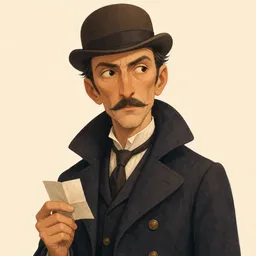
Sherlock Holmes: character portrait from The Adventures of Sherlock Holmes (Arthur Conan Doyle)

A character in The Adventures of Sherlock Holmes

Sherlock Holmes

Sherlock Holmes by Arthur Conan Doyle1892

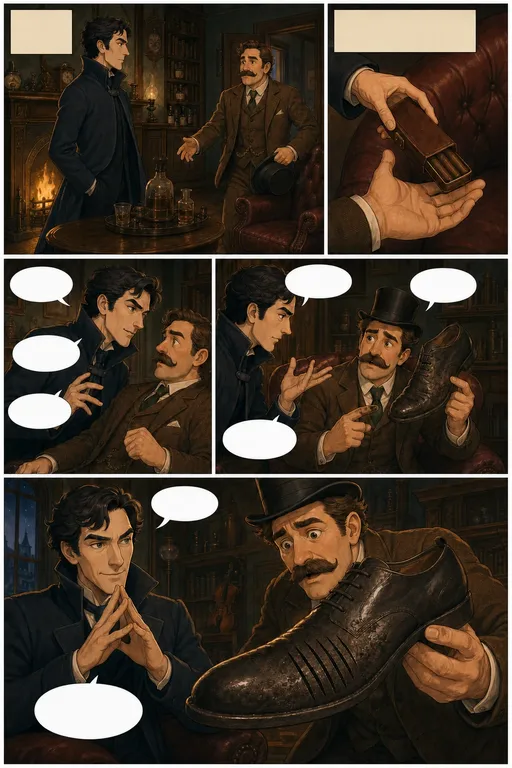
Sherlock Holmes is the world’s only consulting detective at 221B Baker Street: a bohemian, razor-observant reasoner who reads a client’s trade and history from a frayed cuff, a boot-scrape, or a pipe-ash before a word of the case is spoken.

Also known as: Holmes, Mr. Holmes

Inside the story

Meet Sherlock Holmes

In the twelve cases of The Adventures of Sherlock Holmes (1892), Dr. John H. Watson describes his friend and former Baker Street flatmate as the most perfect reasoning and observing machine the world has seen. Alternating between weeks of restless lethargy in his armchair and sudden wolfhound bursts of energy on a scent, Holmes studies crime as an exact science: he has written monographs on a hundred and forty varieties of pipe, cigar, and cigarette ash, on secret ciphers, and on the tracing of footsteps.

Though Watson calls him cold-blooded toward softer passions so as never to admit a distracting factor into his mental results, Holmes in practice is theatrical, dryly humorous, and bound by his own code of justice rather than Scotland Yard’s statute book.
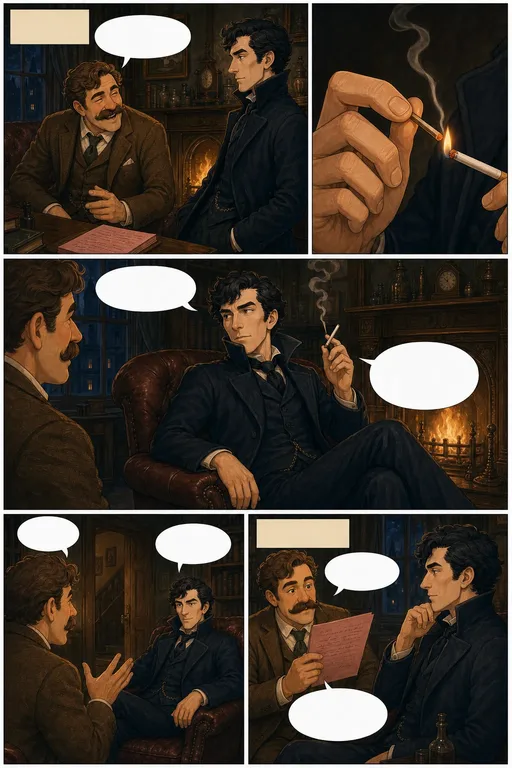
Character analysis

Why Sherlock Holmes matters

Across The Adventures of Sherlock Holmes, Conan Doyle uses Holmes to look behind the respectable curtains of Victorian London and the English country house. Many of the cases brought to 221B Baker Street involve no crime that the police can prosecute: a stepfather disguising himself to woo his own stepdaughter for her income, an aristocratic bridegroom, or a terrified governess hired to impersonate her employer’s daughter.

Holmes’s method combines minute physical inspection on hands and knees with bold disguises as a drunken groom, an amiable nonconformist clergyman, or an opium-den lounger. And when the official law cannot reach a culprit, or when a first offender like James Ryder in “The Blue Carbuncle” is already terrified out of crime for life, Holmes is willing to act as judge and let a penitent man go free.

In the novel

Key moments

The moments above summarize key deductions from “A Scandal in Bohemia,” “The Red-Headed League,” “The Boscombe Valley Mystery,” and “The Speckled Band.”

  1. A Scandal in Bohemia

    Seeing versus observing on the Baker Street stairs

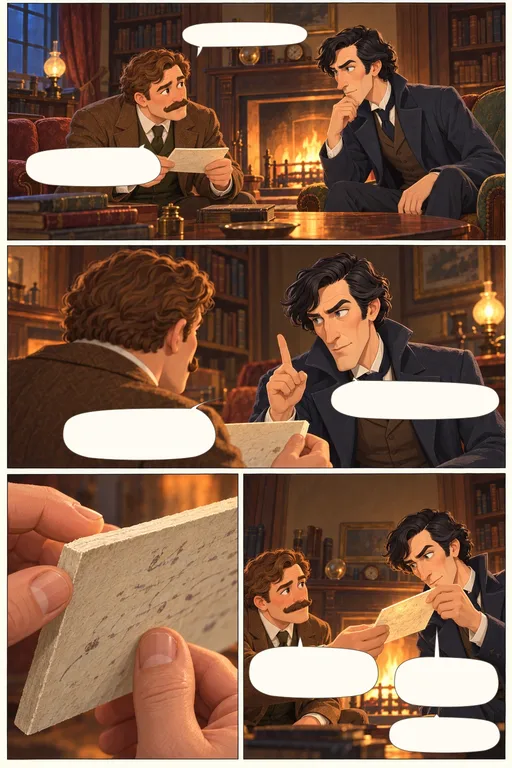
    To show Watson why his deductions seem like conjuring tricks, Holmes asks how many steps lead up from the hall to their sitting-room. Watson has climbed them hundreds of times and cannot say; Holmes knows there are seventeen because he both sees and observes.

    “You see, but you do not observe. The distinction is clear.”

    Sherlock Holmes, A Scandal in Bohemia
  2. A Scandal in Bohemia

    Outwitted by Irene Adler

    Disguised as an injured elderly clergyman, Holmes tricks Irene Adler into revealing the secret wall-panel where she keeps her photograph with the King of Bohemia, only to return the next morning and find she saw through his disguise on the street, married Godfrey Norton, and left a letter addressed to him.

    “To Sherlock Holmes she is always THE woman. I have seldom heard him mention her under any other name.”

    Sherlock Holmes, A Scandal in Bohemia
  3. The Red-Headed League

    The worn knees of Spaulding’s trousers

    Before entering the cobble-stoned square behind Jabez Wilson’s pawnshop in Saxe-Coburg Square, Holmes taps the pavement with his stick and notes the dirty knees of the assistant Vincent Spaulding’s trousers, deducing at once that a tunnel is being dug toward the cellar of the City and Suburban Bank.

    “I beat the pavement with my stick to find whether the cellar stretched out in front or behind.”

    Sherlock Holmes, The Red-Headed League
  4. The Boscombe Valley Mystery

    On all fours by Boscombe Pool

    While Lestrade of Scotland Yard relies on circumstantial evidence against young James McCarthy, Holmes transforms into a bloodhound at the water’s edge, reading from tiptoe prints, a left-handed blow from behind, and a heap of cigar ash that the true killer is a tall, limping left-handed man in a grey cloak.

    “Singularity is almost invariably a clue. The more featureless and commonplace a crime is, the more difficult is it to bring it home.”

    Sherlock Holmes, The Boscombe Valley Mystery
  5. The Adventure of the Speckled Band

    The cane in the dark at Stoke Moran

    Sitting in utter darkness in Julia Stoner’s bedroom with a cane in his hand and a box of matches before him, Holmes waits for the low whistle from Dr. Grimesby Roylott’s adjoining chamber and lashes the dummy bell-rope the instant the deadly swamp adder slides down through the ventilator.

    “When a doctor does go wrong he is the first of criminals. He has nerve and he has knowledge.”

    Sherlock Holmes, The Adventure of the Speckled Band

Never lose track of a character again

Storieta keeps this cast at your side while you read The Adventures of Sherlock Holmes, portraits, names, and an ask-anything assistant that only knows what you've read so far. No spoilers, ever.