
Public-domain ebook
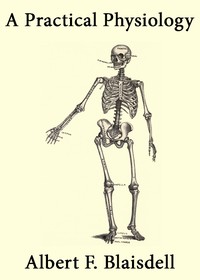
A Practical Physiology: A Text-Book for Higher Schools
Language: en979 downloads on Project Gutenberg
Subjects
In: Health & Medicine·Teaching & Education
Public-domain ebook sourced from Project Gutenberg #10453.
Public-domain ebook
Language: en979 downloads on Project Gutenberg
Subjects
In: Health & Medicine·Teaching & Education
Public-domain ebook sourced from Project Gutenberg #10453.
The opening · free to read
The author has aimed to prepare a text-book on human physiology for use in higher schools. The design of the book is to furnish a practical manual of the more important facts and principles of physiology and hygiene, which will be adapted to the needs of students in high schools, normal schools, and academies.
Teachers know, and students soon learn to recognize the fact, that it is impossible to obtain a clear understanding of the functions of the various parts of the body without first mastering a few elementary facts about their structure. The course adopted, therefore, in this book, is to devote a certain amount of space to the anatomy of the several organs before describing their functions.
A mere knowledge of the facts which can be gained in secondary schools, concerning the anatomy and physiology of the human body, is of little real value or interest in itself. Such facts are important and of practical worth to young students only so far as to enable them to understand the relation of these facts to the great laws of health and to apply them to daily living. Hence, it has been the earnest effort of the author in this book, as in his other physiologies for schools, to lay special emphasis upon such points as bear upon personal health.
Physiology cannot be learned as it should be by mere book study. The result will be meagre in comparison with the capabilities of the subject. The study of the text should always be supplemented by a series of practical experiments. Actual observations and actual experiments are as necessary to illuminate the text and to illustrate important principles in physiology as they are in botany, chemistry, or physics. Hence, as supplementary to the text proper, and throughout the several chapters, a series of carefully arranged and practical experiments has been added. For the most part, they are simple and can be performed with inexpensive and easily obtained apparatus. They are so arranged that some may be omitted and others added as circumstances may allow.
If it becomes necessary to shorten the course in physiology, the various sections printed in smaller type may be omitted or used for home study.
The laws of most of the states now require in our public schools the study of the effects of alcoholic drinks, tobacco, and other narcotics upon the bodily life. This book will be found to comply fully with all such laws.
The author has aimed to embody in simple and concise language the latest and most trustworthy information which can be obtained from the standard authorities on modern physiology, in regard to the several topics.
In the preparation of this text-book the author has had the editorial help of his esteemed friend, Dr. J. E. Sanborn, of Melrose, Mass., and is also indebted to the courtesy of Thomas E. Major, of Boston, for assistance in revising the proofs.
Albert F. Blaisdell.
Boston, August, 1897.
CONTENTS.
Chapter I Introduction Chapter II The Bones Chapter III The Muscles Chapter IV Physical Exercise Chapter V Food and Drink Chapter VI Digestion Chapter VII The Blood and Its Circulation Chapter VIII Respiration Chapter IX The Skin and the Kidneys Chapter X The Nervous System Chapter XI The Special Sense Chapter XII The Throat and the Voice Chapter XIII Accidents and Emergencies Chapter XIV In Sickness and in Health Care of the Sick-Room; Poisons and their Antidotes; Bacteria; Disinfectants; Management of Contagious Diseases. Chapter XV Experimental Work in Physiology Practical Experiments; Use of the Microscope; Additional Experiments; Surface Anatomy and Landmarks. Glossary Index
1. The Study of Physiology. We are now to take up a new study, and in a field quite different from any we have thus far entered. Of all our other studies,—mathematics, physics, history, language,—not one comes home to us with such peculiar interest as does physiology, because this is the study of ourselves.
Every thoughtful young person must have asked himself a hundred questions about the problems of human life: how it can be that the few articles of our daily food—milk, bread, meats, and similar things—build up our complex bodies, and by what strange magic they are transformed into hair, skin, teeth, bones, muscles, and blood.
How is it that we can lift these curtains of our eyes and behold all the wonders of the world around us, then drop the lids, and though at noonday, are instantly in total darkness? How does the minute structure of the ear report to us with equal accuracy the thunder of the tempest, and the hum of the passing bee? Why is breathing so essential to our life, and why cannot we stop breathing when we try? Where within us, and how, burns the mysterious fire whose subtle heat warms us from the first breath of infancy till the last hour of life?
These and scores of similar questions it is the province of this deeply interesting study of physiology to answer.
2. What Physiology should Teach us. The study of physiology is not only interesting, but it is also extremely useful. Every reasonable person should not only wish to acquire the knowledge how best to protect and preserve his body, but should feel a certain profound respect for an organism so wonderful and so perfect as his physical frame. For our bodies are indeed not ourselves, but the frames that contain us,—the ships in which we, the real selves, are borne over the sea of life. He must be indeed a poor navigator who is not zealous to adorn and strengthen his ship, that it may escape the rocks of disease and premature decay, and that the voyage of his life may be long, pleasant, and successful.
But above these thoughts there rises another,—that in studying physiology we are tracing the myriad lines of marvelous ingenuity and forethought, as they appear at every glimpse of the work of the Divine Builder. However closely we study our bodily structure, we are, at our best, but imperfect observers of the handiwork of Him who made us as we are.
3. Distinctive Characters of Living Bodies. Even a very meagre knowledge of the structure and action of our bodies is enough to reveal the following distinctive characters: our bodies are continually breathing, that is, they take in oxygen from the surrounding air; they take in certain substances known as food, similar to those composing the body, which are capable through a process called oxidation, or through other chemical changes, of setting free a certain amount of energy.
Again, our bodies are continually making heat and giving it out to surrounding objects, the production and the loss of heat being so adjusted that the whole body is warm, that is, of a temperature higher than that of surrounding objects. Our bodies, also, move themselves, either one part on another, or the whole body from place to place. The motive power is not from the outside world, but the energy of their movements exists in the bodies themselves, influenced by changes in their surroundings. Finally, our bodies are continually getting rid of so-called waste matters, which may be considered products of the oxidation of the material used as food, or of the substances which make up the organism.
4. The Main Problems of Physiology briefly Stated. We shall learn in a subsequent chapter that the living body is continually losing energy, but by means of food is continually restoring its substance and replenishing its stock of energy. A great deal of energy thus stored up is utilized as mechanical work, the result of physical movements. We shall learn later on that much of the energy which at last leaves the body as heat, exists for a time within the organism in other forms than heat, though eventually transformed into heat. Even a slight change in the surroundings of the living body may rapidly, profoundly, and in special ways affect not only the amount, but the kind of energy set free. Thus the mere touch of a hair may lead to such a discharge of energy, that a body previously at rest may be suddenly thrown into violent convulsions. This is especially true in the case of tetanus, or lockjaw.
The main problem we have to solve in the succeeding pages is to ascertain how it is that our bodies can renew their substance and replenish the energy which they are continually losing, and can, according to the nature of their surroundings, vary not only the amount, but the kind of energy which they set free.
5. Technical Terms Defined. All living organisms are studied usually from two points of view: first, as to their form and structure; second, as to the processes which go on within them. The science which treats of all living organisms is called biology. It has naturally two divisions,—morphology, which treats of the form and structure of living beings, and physiology, which investigates their functions, or the special work done in their vital processes.
The word anatomy, however, is usually employed instead of morphology. It is derived from two Greek words, and means the science of dissection. Human anatomy then deals with the form and structure of the human body, and describes how the different parts and organs are arranged, as revealed by observation, by dissection, and by the microscope.
Histology is that part of anatomy which treats of the minute structure of any part of the body, as shown by the microscope.
Human physiology describes the various processes that go on in the human body in health. It treats of the work done by the various parts of the body, and of the results of the harmonious action of the several organs. Broadly speaking, physiology is the science which treats of functions. By the word function is meant the special work which an organ has to do. An organ is a part of the body which does a special work. Thus the eye is the organ of sight, the stomach of digestion, and the lungs of breathing.
It is plain that we cannot understand the physiology of our bodies without a knowledge of their anatomy. An engineer could not understand the working of his engine unless well acquainted with all its parts, and the manner in which they were fitted together. So, if we are to understand the principles of elementary physiology, we must master the main anatomical facts concerning the organs of the body before considering their special functions.
As a branch of study in our schools, physiology aims to make clear certain laws which are necessary to health, so that by a proper knowledge of them, and their practical application, we may hope to spend happier and more useful, because healthier, lives. In brief, the study of hygiene, or the science of health, in the school curriculum, is usually associated with that of physiology.[1]
6. Chemical Elements in the Body. All of the various complex substances found in nature can be reduced by chemical analysis to about 70 elements, which cannot be further divided. By various combinations of these 70 elements all the substances known to exist in the world of nature are built up. When the inanimate body, like any other substance, is submitted to chemical analysis, it is found that the bone, muscle, teeth, blood, etc., may be reduced to a few chemical elements.
The book keeps going
Reading is free forever. Sign up and watch scenes appear while you read.



Scenes Storieta drew for other classics.
New illustrated classics
Once or twice a month: the latest books to get full character casts, scene art, and free comic editions. No account needed.