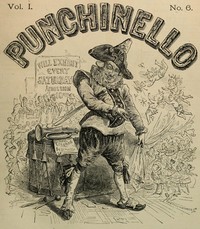
His name, PUNCHINELLO hopes, will not be found a difficult one to articulate. He flatters himself that it has a smack of grape-juice and olives about it. It rhymes with "mellow," which naturally brings us to "good fellow.". On occasions PUNCHINELLO can "bellow," cut a "tremendous swell," O, and he never throws away a chance of pocketing the "yellow." He would like to rhyme with "swallow;" but alas! it can not, can not be.
And yet, in spite of (or perhaps on account of) PUNCHINELLO'S mellifluous name, much cavil has been brought to bear upon him. (Prepare to receive cavilry.)
Squadrons of well-meaning persons with speaking-trumpets marched to and fro before the sponsors of PUNCHINELLO, each roaring at them to stop such a name as that, and attend to his suggestion, and his only.
One did not like PUNCHINELLO because it means a "little Punch," and he--the speaking-trumpeter--liked a great deal; and lo! while he spoke, he changed his trumpet for several horns. Then he was taken with a fit of herpetology in his boots, and sank to advise no more.
Another--a fellow with an infinite fancy for buffo minstrelsy--was vociferous that PUNCHINELLO should be called "Tommy Dodd." The discussion upon this lasted for three months; but finally, "Tommy Dodd" was rejected on account of the superfluously aristocratic aroma that exhaled from the name.
Four divisions of men with banners then came by, each division respectively composed of members of the waning families of Smith, Brown, Jones, and Robinson, and each division bawled and thundered that the name round which it rallied should be adopted instead of PUNCHINELLO, on pain of death.
And thousands of others came with suggestions of a like sort; for which some of them wanted "stamps." And when they had all had their say, PUNCHINELLO was called PUNCHINELLO, and nothing else--a name by which he means to stand or fall.
And now to business. PUNCHINELLO is not going to define his position here. He refrains from boring his readers with prolix gammon about his foreign and domestic relations. He will content himself (and readers, he hopes) by briefly mentioning that he has foreign and domestic relations in every part of the habitable globe, and that they each and all furnish him with correspondence of the most reliable and spicy character, regularly and for publication. Among his foreign relations he is happy to reckon M. MEISSONNIER, the celebrated French artist, to whom he is indebted for the original painting from which PUNCHINELLO, as he appears on his own title-page, is taken.
A preface is not the place in which to enlarge upon topics of great humanitarian interest, political importance, or social progress. PUNCHINELLO will merely touch a few of such matters, then, and these with a light finger. (No allusion, here, to the "light-fingered gentry," for whom PUNCHINELLO keeps a large grape vine in pickle.)
PUNCHINELLO observes the incipient tendency to return to specie payments. To this revival, however, he is not as yet prepared to give his adhesion, though, on the whole, he considers it preferable to relapsing fever, which is also noted on 'Change. Cuba shall have her due share of attention from him. And if She-Cuba, (Queen of the Antilles, you know,) why not also He-Cuba?--lovely and preposterous woman, who, from her eagerness to slip on certain habiliments that are masculine, but shall here be nameless, shall henceforth be appropriately distinguished by that name.
Let other important topics take care of themselves. PUNCHINELLO will only add that he would at any time rather suspend the public plunderers than habeas corpus, and that he means to take the gloss off the grim joke that "Hanging for murder's played out in New-York."
It is pleasant for PUNCHINELLO to draw the attention of his readers to the fact that this, his First Number, is dated April 2d--the day after All Fools' Day. This is cheering; since thus it is manifest that PUNCHINELLO leaves all the fools and jesters behind, and is, therefore, first in the race for the crown of comic laurel and the quiver of satiric shafts.
And now, by DAN PHOEBUS!--that's the DAN (ah!) that drives the Sun, you know, and is the biggest spot upon it--here we find that we have talked ourself all the way to DELMONICO'S, and there's CHARLEY on the lookout.
Punchinello: "Good evening, Mr. DELMONICO; have you any room for us?"
Delmonico: "You are very welcome, Mr. PUNCHINELLO, and your rooms are quite ready; for we have been expecting you ever so long. Of course, your staff of artists can be accommodated in our Drawing-room, if you will permit me to throw off so insignificant a joke."
Punchinello: "Tut, CHARLES!--'tis a joke of the first water, (first brandy-and-water, CHARLES.) Cap your joke with another as good, and then consider yourself on our staff. Lead us to our apartments, CHARLES."
And so, looking from his pleasant Fifth Avenue windows, PUNCHINELLO waves a salutation to his audience with a "May you be happy, each and all of you, and live all your days in clover," (admission ten cents.)
§ 2. It shall be the duty of the Commissioners of the Central Park to devote said Park, on the Fourth day of July next, to the erection of poles (or polls) for the purpose of enabling voters to grab from the grab-bag.
§ 3. HORACE GREELEY, PETER COOPER, the Rev. Dr. THOMPSON, DANIEL DREW, and REDDY THE BLACKSMITH, are hereby constituted Inspectors and Canvassers for the grabbers.
§ 4. It shall be the duty of the said inspectors to prepare a registry-list of all the persons intending to grab, who are required to serve a notice of intention through the post-office upon REDDY THE BLACKSMITH, the Chairman. DANIEL DREW is to provide funds wherewith to pay the postage.
§ 5. The registry-list shall be alphabetically prepared, and the number of chances shall be determined by dividing the number of grabbers by the number of offices.
§ 6. The grabbers shall be selected by lot.
§ 7. The lots shall be drawn by REDDY THE BLACKSMITH from his own hat, his eyes wide open, while every other inspector, and the voters, shall be blindfolded with newspapers from the files of the Christian Union; whereupon, as the names of the fortunate grabbers are called, each one shall proceed to the grab-bag and grab his office.
§ 8. There shall be no repeaters of the process.
§ 9. The persons thus grabbing offices shall be then and there, by the Inspectors, declared duly elected to the offices grabbed, for life.
§ 10. Any vacancy occurring by assassination shall be immediately filled by the Inspectors appointing the assassin.
§ 11. Every person owning real estate on the Island shall contribute one ninety-ninth part of his income to the said grab-bag. On the following Christmas, in the presence of the grab income-bents of offices, the Inspectors shall proceed to divide the proceeds of these taxable contributions, and one half of these proceeds shall be equally divided among the grab income-bents of offices. The other half shall be devoted to paving every conceivable surface of the city with wooden pavement.
§ 12. Owners of real estate in the city of New York are hereby allowed to make their own arrangements with the gas companies for the supply of light; but nothing herein shall be construed to devote any part of the proceeds to light the public streets at night and real estate owners shall be allowed to make their own arrangements for the supply of water with the grab income-bents of the Croton Grab Board.
§ 13. The sewers of the city shall be converted to burial places for persons assassinated at political meetings.
§ 14. Nothing herein contained shall be so construed as to permit any judge to grant an injunction against any grabbers of the offices.
§ 15. The "dead-beats," heretofore known as policemen and soldiers of the first division, are hereby legislated out of office, and it shall be a felony punishable with assassination for any one to go unarmed with a six-shooter.
§ 16. All provisions of the United States or State constitutions inconsistent with the above provisions are hereby repealed.
Because a jury-mast is a makeshift for a lost spar, it does not follow that a jury-woman is a make-shift for any body. In fact, the women who sit upon juries are not the sort of women who personally supply the family linen.
This contrivance will be found very useful for various purposes. It will do to put books upon, to write upon, to iron clothes upon, and for any other purpose where it is considered desirable to support household objects at a distance from the floor. One of its chief advantages is to serve as a receptacle for the food of a family during meals. If on such occasions it be covered with a white linen or cotton cloth, its appearance will be much improved, and in time it can not fail to become a favorite article of furniture.
The next hint will please the ladies. Take two pieces of cotton or woolen cloth, of any size from two inches to a foot square, and sew them together at the edges, leaving, however, a small place unsewed at one corner. You will now find that you have something like a square bag. This is to be tightly filled with wool, bran, mowings, clippings of human hair, or something of the kind, and the open corner is then to be sewed up. When finished, the affair will assume this appearance and will be found very useful for the preservation of pins. The manner of using it is as follows: you take the pin in the hand and firmly press it into the bag, when it will be found that the body of the pin will easily enter, but that the head will prevent its entire disappearance. The stuffing of the bag will retain the pin in its position until a slight degree of force is used to withdraw it. With the use of this ingenious little contrivance, pins can be kept in safety with the points always hidden and their heads exposed to view. It will be found much more economical and convenient than the plan of carrying pins loose in the pocket, and eventually will be generally adopted, we think. The top and corners can be ornamented à discrétion.
Hint the third is especially addressed to country families. Take one of the ordinary toilet-tables that are to be found in so many rural habitations, and, on removing the white cover, you will probably find that the table is formed of an empty flour-barrel with a board nailed on top of it. Remove this board; get a head from another barrel of the same size; place it properly upon the top; put some good hoops around the ends, nail it all up tightly, and you will find that you will have a very good barrel.