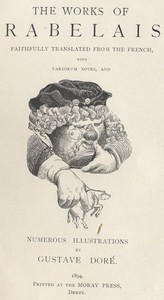
FRANCIS RABELAIS.
THE FIRST BOOK.
To the Honoured, Noble Translator of Rabelais.
Rabelais, whose wit prodigiously was made, All men, professions, actions to invade, With so much furious vigour, as if it Had lived o’er each of them, and each had quit, Yet with such happy sleight and careless skill, As, like the serpent, doth with laughter kill, So that although his noble leaves appear Antic and Gottish, and dull souls forbear To turn them o’er, lest they should only find Nothing but savage monsters of a mind,-- No shapen beauteous thoughts; yet when the wise Seriously strip him of his wild disguise, Melt down his dross, refine his massy ore, And polish that which seem’d rough-cast before, Search his deep sense, unveil his hidden mirth, And make that fiery which before seem’d earth (Conquering those things of highest consequence, What’s difficult of language or of sense), He will appear some noble table writ In the old Egyptian hieroglyphic wit; Where, though you monsters and grotescoes see, You meet all mysteries of philosophy. For he was wise and sovereignly bred To know what mankind is, how ‘t may be led: He stoop’d unto them, like that wise man, who Rid on a stick, when ‘s children would do so. For we are easy sullen things, and must Be laugh’d aright, and cheated into trust; Whilst a black piece of phlegm, that lays about Dull menaces, and terrifies the rout, And cajoles it, with all its peevish strength Piteously stretch’d and botch’d up into length, Whilst the tired rabble sleepily obey Such opiate talk, and snore away the day, By all his noise as much their minds relieves, As caterwauling of wild cats frights thieves. But Rabelais was another thing, a man Made up of all that art and nature can Form from a fiery genius,--he was one Whose soul so universally was thrown Through all the arts of life, who understood Each stratagem by which we stray from good; So that he best might solid virtue teach, As some ‘gainst sins of their own bosoms preach: He from wise choice did the true means prefer, In the fool’s coat acting th’ philosopher. Thus hoary Aesop’s beasts did mildly tame Fierce man, and moralize him into shame; Thus brave romances, while they seem to lay Great trains of lust, platonic love display; Thus would old Sparta, if a seldom chance Show’d a drunk slave, teach children temperance; Thus did the later poets nobly bring The scene to height, making the fool the king. And, noble sir, you vigorously have trod In this hard path, unknown, un-understood By its own countrymen, ‘tis you appear Our full enjoyment which was our despair, Scattering his mists, cheering his cynic frowns (For radiant brightness now dark Rabelais crowns), Leaving your brave heroic cares, which must Make better mankind and embalm your dust, So undeceiving us, that now we see All wit in Gascon and in Cromarty, Besides that Rabelais is convey’d to us, And that our Scotland is not barbarous.
J. De la Salle.
Rablophila.
The First Decade.
The Commendation.
Musa! canas nostrorum in testimonium Amorum, Et Gargantueas perpetuato faces, Utque homini tali resultet nobilis Eccho: Quicquid Fama canit, Pantagruelis erit.
The Argument.
Here I intend mysteriously to sing With a pen pluck’d from Fame’s own wing, Of Gargantua that learn’d breech-wiping king.
Decade the First.
I.
Help me, propitious stars; a mighty blaze Benumbs me! I must sound the praise Of him hath turn’d this crabbed work in such heroic phrase.
II.
What wit would not court martyrdom to hold Upon his head a laurel of gold, Where for each rich conceit a Pumpion-pearl is told:
III.
And such a one is this, art’s masterpiece, A thing ne’er equall’d by old Greece: A thing ne’er match’d as yet, a real Golden Fleece.
IV.
Vice is a soldier fights against mankind; Which you may look but never find: For ‘tis an envious thing, with cunning interlined.
V.
And thus he rails at drinking all before ‘em, And for lewd women does be-whore ‘em, And brings their painted faces and black patches to th’ quorum.
VI.
To drink he was a furious enemy Contented with a six-penny-- (with diamond hatband, silver spurs, six horses.) pie--
VII.
And for tobacco’s pate-rotunding smoke, Much had he said, and much more spoke, But ‘twas not then found out, so the design was broke.
VIII.
Muse! Fancy! Faith! come now arise aloud, Assembled in a blue-vein’d cloud, And this tall infant in angelic arms now shroud.
IX.
To praise it further I would now begin Were ‘t now a thoroughfare and inn, It harbours vice, though ‘t be to catch it in a gin.
X.
Therefore, my Muse, draw up thy flowing sail, And acclamate a gentle hail With all thy art and metaphors, which must prevail.
Jam prima Oceani pars est praeterita nostri. Imparibus restat danda secunda modis. Quam si praestiterit mentem Daemon malus addam, Cum sapiens totus prodierit Rabelais.
Malevolus.
(Reader, the Errata, which in this book are not a few, are casually lost; and therefore the Translator, not having leisure to collect them again, craves thy pardon for such as thou may’st meet with.)
The Author’s Prologue to the First Book.
Most noble and illustrious drinkers, and you thrice precious pockified blades (for to you, and none else, do I dedicate my writings), Alcibiades, in that dialogue of Plato’s, which is entitled The Banquet, whilst he was setting forth the praises of his schoolmaster Socrates (without all question the prince of philosophers), amongst other discourses to that purpose, said that he resembled the Silenes. Silenes of old were little boxes, like those we now may see in the shops of apothecaries, painted on the outside with wanton toyish figures, as harpies, satyrs, bridled geese, horned hares, saddled ducks, flying goats, thiller harts, and other such-like counterfeited pictures at discretion, to excite people unto laughter, as Silenus himself, who was the foster-father of good Bacchus, was wont to do; but within those capricious caskets were carefully preserved and kept many rich jewels and fine drugs, such as balm, ambergris, amomon, musk, civet, with several kinds of precious stones, and other things of great price. Just such another thing was Socrates. For to have eyed his outside, and esteemed of him by his exterior appearance, you would not have given the peel of an onion for him, so deformed he was in body, and ridiculous in his gesture. He had a sharp pointed nose, with the look of a bull, and countenance of a fool: he was in his carriage simple, boorish in his apparel, in fortune poor, unhappy in his wives, unfit for all offices in the commonwealth, always laughing, tippling, and merrily carousing to everyone, with continual gibes and jeers, the better by those means to conceal his divine knowledge. Now, opening this box you would have found within it a heavenly and inestimable drug, a more than human understanding, an admirable virtue, matchless learning, invincible courage, unimitable sobriety, certain contentment of mind, perfect assurance, and an incredible misregard of all that for which men commonly do so much watch, run, sail, fight, travel, toil and turmoil themselves.
Whereunto (in your opinion) doth this little flourish of a preamble tend? For so much as you, my good disciples, and some other jolly fools of ease and leisure, reading the pleasant titles of some books of our invention, as Gargantua, Pantagruel, Whippot (Fessepinte.), the Dignity of Codpieces, of Pease and Bacon with a Commentary, &c., are too ready to judge that there is nothing in them but jests, mockeries, lascivious discourse, and recreative lies; because the outside (which is the title) is usually, without any farther inquiry, entertained with scoffing and derision. But truly it is very unbeseeming to make so slight account of the works of men, seeing yourselves avouch that it is not the habit makes the monk, many being monasterially accoutred, who inwardly are nothing less than monachal, and that there are of those that wear Spanish capes, who have but little of the valour of Spaniards in them. Therefore is it, that you must open the book, and seriously consider of the matter treated in it. Then shall you find that it containeth things of far higher value than the box did promise; that is to say, that the subject thereof is not so foolish as by the title at the first sight it would appear to be.
And put the case, that in the literal sense you meet with purposes merry and solacious enough, and consequently very correspondent to their inscriptions, yet must not you stop there as at the melody of the charming syrens, but endeavour to interpret that in a sublimer sense which possibly you intended to have spoken in the jollity of your heart. Did you ever pick the lock of a cupboard to steal a bottle of wine out of it? Tell me truly, and, if you did, call to mind the countenance which then you had. Or, did you ever see a dog with a marrowbone in his mouth,--the beast of all other, says Plato, lib. 2, de Republica, the most philosophical? If you have seen him, you might have remarked with what devotion and circumspectness he wards and watcheth it: with what care he keeps it: how fervently he holds it: how prudently he gobbets it: with what affection he breaks it: and with what diligence he sucks it. To what end all this? What moveth him to take all these pains? What are the hopes of his labour? What doth he expect to reap thereby? Nothing but a little marrow. True it is, that this little is more savoury and delicious than the great quantities of other sorts of meat, because the marrow (as Galen testifieth, 5. facult. nat. & 11. de usu partium) is a nourishment most perfectly elaboured by nature.
In imitation of this dog, it becomes you to be wise, to smell, feel and have in estimation these fair goodly books, stuffed with high conceptions, which, though seemingly easy in the pursuit, are in the cope and encounter somewhat difficult. And then, like him, you must, by a sedulous lecture, and frequent meditation, break the bone, and suck out the marrow,--that is, my allegorical sense, or the things I to myself propose to be signified by these Pythagorical symbols, with assured hope, that in so doing you will at last attain to be both well-advised and valiant by the reading of them: for in the perusal of this treatise you shall find another kind of taste, and a doctrine of a more profound and abstruse consideration, which will disclose unto you the most glorious sacraments and dreadful mysteries, as well in what concerneth your religion, as matters of the public state, and life economical.