Public-domain ebook
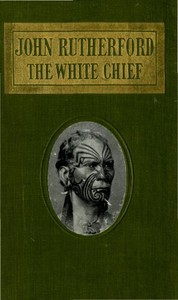
John Rutherford, the White Chief: A Story of Adventure in New Zealand
Language: en903 downloads on Project Gutenberg
Subjects
In: Historical Novels·Adventure
Public-domain ebook sourced from Project Gutenberg #13760.
Public-domain ebook
Language: en903 downloads on Project Gutenberg
Subjects
In: Historical Novels·Adventure
Public-domain ebook sourced from Project Gutenberg #13760.
The opening · free to read
John Rutherford, according to his own account, was born at Manchester about the year 1796. He went to sea, he states, when he was hardly more than ten years of age, having up to that time been employed as a piecer in a cotton factory in his native town; and after that he appears to have been but little in England, or even on shore, for many years.
He served for a considerable time on board a man-of-war off the coast of Brazil; and was afterwards at the storming of San Sebastian, in August, 1813. On coming home from Spain, he entered himself on board another king's ship, bound for Madras, in which he afterwards proceeded to China by the east passage, and lay for about a year at Macao.
In the course of this voyage his ship touched at several islands in the great Indian Archipelago, among others at the Bashee Islands,[D] which have been rarely visited. On his return from the east he embarked on board a convict vessel bound for New South Wales; and afterwards made two trading voyages among the islands of the South Sea.
It was in the course of the former of these that he first saw New Zealand, the vessel having touched at the Bay of Islands, on her way home to Port Jackson.
His second trading voyage in those seas was made in the "Magnet," a three-masted schooner, commanded by Captain Vine; but this vessel having put in at Owhyhee,[E] Rutherford fell sick and was left on that island. Having recovered, however, in about a fortnight, he was taken on board the "Agnes," an American brig of six guns and fourteen men, commanded by Captain Coffin, which was then engaged in trading for pearl and tortoiseshell among the islands of the Pacific.
This vessel, after having touched at various other places, on her return from Owhyhee, approached the east coast of New Zealand, intending to put in for refreshments at the Bay of Islands.
Rutherford states in his journal that this event, which was to him of such importance, occurred on March 6th, 1816. They first came in sight of the Barrier Islands, some distance to the south of the port for which they were making. They accordingly directed their course to the north; but they had not got far on their way when it began to blow a gale from the north-east, which, being aided by a current, not only made it impossible for them to proceed to the Bay of Islands, but even carried them past the mouth of the Thames. It lasted for five days, and when it abated they found themselves some distance to the south of a high point of land, which, from Rutherford's description, there can be no doubt must have been that to which Captain Cook gave the name of East Cape. Rutherford calls it sometimes the East, and sometimes the South-East Cape, and describes it as the highest part of the coast. It lies nearly in latitude 37° 42' S.
The land directly opposite to them was indented by a large bay. This the captain was very unwilling to enter, believing that no ship had ever anchored in it before. We have little doubt, however, that this was the very bay into which Cook first put, on his arrival on the coasts of New Zealand, in the beginning of October, 1769. He called it Poverty Bay, and found it to lie in latitude 38° 42' S. The bay in which Rutherford now was must have been at least very near this part of the coast; and his description answers exactly to that which Cook gives of Poverty Bay.
It was, says Rutherford, in the form of a half-moon, with a sandy beach round it, and at its head a fresh-water river, having a bar across its mouth, which makes it navigable only for boats. He mentions also the height of the land which forms its sides. All these particulars are noticed by Cook. Even the name given to it by the natives, as reported by the one, is not so entirely unlike that stated by the other, as to make it quite improbable that the two are merely the same word differently misrepresented. Cook writes it Taoneroa, and Rutherford Takomardo. The slightest examination of the vocabularies of barbarous tongues, which have been collected by voyagers and travellers, will convince every one of the extremely imperfect manner in which the ear catches sounds to which it is unaccustomed, and of the mistakes to which this and other causes give rise, in every attempt which is made to take down the words of a language from the native pronunciation, by a person who does not understand it.
Reluctant as the captain was to enter this bay, from his ignorance of the coast, and the doubts he consequently felt as to the disposition of the inhabitants, they at last determined to stand in for it, as they had great need of water, and did not know when the wind might permit them to get to the Bay of Islands.
They came to anchor, accordingly, off the termination of a reef of rocks, immediately under some elevated land, which formed one of the sides of the bay. As soon as they had dropped anchor, a great many canoes came off to the ship from every part of the bay, each containing about thirty women, by whom it was paddled. Very few men made their appearance that day; but many of the women remained on board all night, employing themselves chiefly in stealing whatever they could lay their hands on. Their conduct greatly alarmed the captain, and a strict watch was kept during the night.
The next morning one of the chiefs came on board, whose name they were told was Aimy, in a large war-canoe, about sixty feet long, and carrying above a hundred of the natives, all provided with quantities of mats and fishing-lines, made of the strong white flax[F] of the country, with which they professed to be anxious to trade with the crew.
After this chief had been for some time on board, it was agreed that he should return to the land, with some others of his tribe, in the ship's boat, to procure a supply of water. This arrangement the captain was very anxious to make, as he was averse from allowing any of the crew to go on shore, wishing to keep them all on board for the protection of the ship.
In due time the boat returned, laden with water, which was immediately hoisted on board; and the chief and his men were despatched a second time on the same errand. Meanwhile, the rest of the natives continued to take pigs to the ship in considerable numbers; and by the close of the day about two hundred had been purchased, together with a quantity of fern-root to feed them on.
Up to this time, therefore, no hostile disposition had been manifested by the savages; and their intercourse with the ship had been carried on with every appearance of friendship and cordiality, if we except the propensity they had shown to pilfer a few of the tempting rarities exhibited to them by their civilised visitors. Their conduct as to this matter ought perhaps to be taken rather as an evidence that they had not as yet formed any design of attacking the vessel, as they would, in that case, scarcely have taken the trouble of stealing a small part of what they meant immediately to seize upon altogether. On the other hand, such an infraction of the rules of hospitality would not have accorded with that system of insidious kindness by which it is their practice to lull the suspicions of those whom they are on the watch to destroy.
During the night, however, the thieving was renewed, and carried to a more alarming extent, inasmuch as it was found in the morning that some of the natives had not only stolen the lead off the ship's stern, but had also cut away many of the ropes, and carried them off in their canoes. It was not till daybreak, too, that the chief returned with his second cargo of water; and it was then observed that the ship's boat he had taken with him leaked a great deal; on which the carpenter examined her, and found that a great many of the nails had been drawn out of her planks.
About the same time, Rutherford detected one of the natives in the act of stealing the dipson lead,--"which, when I took it from him," says he, "he grinded his teeth and shook his tomahawk at me."
"The captain," he continues, "now paid the chief for fetching the water, giving him two muskets, and a quantity of powder and shot, arms and ammunition being the only articles these people will trade for.
"There were at this time about three hundred of the natives on the deck, with Aimy, the chief, in the midst of them; every man was armed with a green stone, slung with a string around his waist. This weapon they call a 'mery,'[G] the stone being about a foot long, flat, and of an oblong shape, having both edges sharp, and a handle at the end. They use it for the purpose of killing their enemies, by striking them on the head.
"Smoke was now observed rising from several of the hills; and the natives appearing to be mustering on the beach from every part of the bay, the captain grew much afraid, and desired us to loosen the sails, and make haste down to get our dinners, as he intended to put to sea immediately. As soon as we had dined, we went aloft, and I proceeded to loosen the jib. At this time, none of the crew was on deck except the captain and the cook, the chief mate being employed in loading some pistols at the cabin table.
"The natives seized this opportunity of commencing an attack upon the ship. First, the chief threw off the mat which he wore as a cloak, and, brandishing a tomahawk in his hand, began a war-song, when all the rest immediately threw off their mats likewise, and, being entirely naked, began to dance with such violence that I thought they would have stove in the ship's deck.
"The captain, in the meantime, was leaning against the companion, when one of the natives went unperceived behind him, and struck him three or four blows on the head with a tomahawk, which instantly killed him. The cook, on seeing him attacked, ran to his assistance, but was immediately murdered in the same manner.
"I now sat down on the jib-boom, with tears in my eyes, and trembling with terror.
"Here I next saw the chief mate come running up the companion ladder, but before he reached the deck he was struck on the back of the neck in the same manner as the captain and the cook had been. He fell with the blow, but did not die immediately.
"A number of the natives now rushed in at the cabin door, while others jumped down through the skylight, and others were employed in cutting the lanyards of the rigging of the stays. At the same time, four of our crew jumped overboard off the foreyard, but were picked up by some canoes that were coming from the shore, and immediately bound hand and foot.
"The natives now mounted the rigging, and drove the rest of the crew down, all of whom were made prisoners. One of the chiefs beckoned to me to come to him, which I immediately did, and surrendered myself. We were then put all together into a large canoe, our hands being tied; and the New Zealanders, searching us, took from us our knives, pipes, tobacco-boxes, and various other articles. The two dead bodies, and the wounded mate, were thrown into the canoe along with us. The mate groaned terribly, and seemed in great agony, the tomahawk having cut two inches deep into the back of his neck; and all the while one of the natives, who sat in the canoe with us, kept licking the blood from the wound with his tongue. Meantime, a number of women who had been left in the ship had jumped overboard, and were swimming to the shore, after having cut her cable, so that she drifted, and ran aground on the bar near the mouth of the river. The natives had not sense to shake the reefs out of the sails, but had chopped them off along the yards with their tomahawks, leaving the reefed part behind.
The book keeps going
Reading is free forever. Sign up and watch scenes appear while you read.



Scenes Storieta drew for other classics.
New illustrated classics
Once or twice a month: the latest books to get full character casts, scene art, and free comic editions. No account needed.