Public-domain ebook
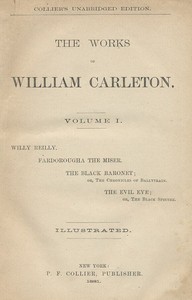
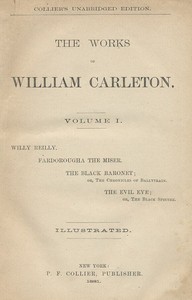
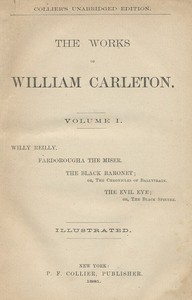
Willy Reilly The Works of William Carleton, Volume One
Language: en884 downloads on Project Gutenberg
Subjects
In: Historical Novels·Romance·Novels
Public-domain ebook sourced from Project Gutenberg #16001.
Public-domain ebook
Language: en884 downloads on Project Gutenberg
Subjects
In: Historical Novels·Romance·Novels
Public-domain ebook sourced from Project Gutenberg #16001.
The opening · free to read
Spirit of George Prince Regent James, Esq., forgive me this commencement! *
* I mean no offence whatsoever to this distinguished and multitudinous writer; but the commencement of this novel really resembled that of so many of his that I was anxious to avoid the charge of imitating him.
It was one evening at the close of a September month and a September day that two equestrians might be observed passing along one of those old and lonely Irish roads that seemed, from the nature of its construction, to have been paved by a society of antiquarians, if a person could judge from its obsolete character, and the difficulty, without risk of neck or limb, of riding a horse or driving a carriage along it. Ireland, as our English readers ought to know, has always been a country teeming with abundance--a happy land, in which want, destitution, sickness, and famine have never been felt or known, except through the mendacious misrepresentations of her enemies. The road we speak of was a proof of this; for it was evident to every observer that, in some season of superabundant food, the people, not knowing exactly how to dispose of their shilling loaves, took to paving the common roads with them, rather than they should be utterly useless. These loaves, in the course of time, underwent the process of petrifaction, but could not, nevertheless, be looked upon as wholly lost to the country. A great number of the Irish, within six of the last preceding years--that is, from '46 to '52--took a peculiar fancy for them as food, which, we presume, caused their enemies to say that we then had hard times in Ireland. Be this as it may, it enabled the sagacious epicures who lived upon them to retire, in due course, to the delightful retreats of Skull and Skibbereen,* and similar asylums, there to pass the very short remainder of their lives in health, ease, and luxury.
* Two poor-houses in the most desolate parts of the County of Cork, where famine, fever, dysentery, and cholera, rendered more destructive by the crowded state of the houses and the consequent want of ventilation, swept away the wretched in-mates to the amount, if we recollect rightly, of sometimes from fifty to seventy per diem in the years '45 and '47.
The evening, as we have said, was about the close of September, when the two equestrians we speak of were proceeding at a pace necessarily slow. One of them was a bluff, fresh-complexioned man, of about sixty summers; but although of a healthy look, and a frame that had evidently once been vigorous, yet he was a good deal stooped, had about him all the impotence of plethora, and his hair, which fell down his shoulders, was white as snow. The other, who rode pretty close to him, was much about his own age, or perhaps a few years older, if one could judge by a face that gave more undeniable evidences of those furrows and wrinkles which Time usually leaves behind him. This person did not ride exactly side by side with the first-mentioned, but a little aback, though not so far as to prevent the possibility of conversation. At this time it may be mentioned here that every man that could afford it wore a wig, with the exception of some of those eccentric individuals that are to be found in every state and period of society, and who are remarkable for that peculiar love of singularity which generally constitutes their character--a small and harmless ambition, easily gratified, and involving no injury to their fellow-creatures. The second horseman, therefore, wore a wig, but the other, although he eschewed that ornament, if it can be called so, was by no means a man of that mild and harmless character which we have attributed to the eccentric and unfashionable class of whom we have just spoken. So far from that, he was a man of an obstinate and violent temper, of strong and unreflecting prejudices both for good and evil, hot, persevering, and vindictive, though personally brave, intrepid, and often generous. Like many of his class, he never troubled his head about religion as a matter that must, and ought to have been, personally, of the chiefest interest to himself, but, at the same time, he was looked upon as one of the best and staunchest Protestants of the day. His loyalty and devotedness to the throne of England were not only unquestionable, but proverbial throughout the country; but, at the same time, he regarded no clergyman, either of his own or any other creed, as a man whose intimacy was worth preserving, unless he was able to take off his three or four bottles of claret after dinner. In fact, not to keep our readers longer in suspense, the relation which he and his companion bore to each other was that of master and servant.
The hour was now a little past twilight, and the western sky presented an unusual, if not an ominous, appearance. A sharp and melancholy breeze was abroad, and the sun, which had set among a mass of red clouds, half placid, and half angry in appearance, had for some brief space gone down. Over from the north, however, glided by imperceptible degrees a long black bar, right across the place of his disappearance, and nothing could be more striking than the wild and unnatural contrast between the dying crimson of the west and this fearful mass of impenetrable darkness that came over it. As yet there was no moon, and the portion of light or rather “darkness visible” that feebly appeared on the sky and the landscape, was singularly sombre and impressive, if not actually appalling. The scene about them was wild and desolate in the extreme; and as the faint outlines of the bleak and barren moors appeared in the dim and melancholy distance, the feelings they inspired were those of discomfort and depression. On each side of them were a variety of lonely lakes, abrupt precipices, and extensive marshes; and as our travellers went along, the hum of the snipe, the feeble but mournful cry of the plover, and the wilder and more piercing whistle of the curlew, still deepened the melancholy dreariness of their situation, and added to their anxiety to press on towards the place of their destination.
“This is a very lonely spot, your honor,” said his servant, whose name was Andrew, or, as he was more familiarly called, Andy Cummiskey.
“Yes, but it's the safer, Andy,” replied his master. “There is not a human habitation within miles of us.”
“It doesn't follow, sir, that this place, above all others in the neighborhood, is not, especially at this hour, without some persons about it. You know I'm no coward, sir.”
“What, you scoundrel! and do you mean to hint that I'm one?”
“Not at all, sir; but you see the truth is, that, this being the very hour for duck and wild-fowl shootin', it's hard to say where or when a fellow might start up, and mistake me for a wild duck, and your honor for a curlew or a bittern.”
He had no sooner spoken than the breeze started, as it were, into more vigorous life, and ere the space of many minutes a dark impenetrable mist or fog was borne over from the solitary hills across the dreary level of country through which they passed, and they felt themselves suddenly chilled, whilst a darkness, almost palpable, nearly concealed them from each other. Now the roads which we have described, being almost without exception in remote and unfrequented parts of the country, are for the most part covered over with a thick sole of close grass, unless where a narrow strip in the centre shows that a pathway is kept worn, and distinctly marked by the tread of foot-passengers. Under all these circumstances, then, our readers need not feel surprised that, owing at once to the impenetrable obscurity around them, and the noiseless nature of the antique and grass-covered pavement over which they went, scarcely a distance of two hundred yards had been gained when they found, to their dismay,' that they had lost their path, and were in one of the wild and heathy stretches of unbounded moor by which they were surrounded.
“We have lost our way, Andy,” observed his master. “We've got off that damned old path; what's to be done? where are you?”
“I'm here, sir,” replied his man; “but as for what's to be done, it would take Mayo Mullen, that sees the fairies and tells fortunes, to tell us that. For heaven's sake, stay where you are, sir, till I get up to you, for if we part from one another, we're both lost. Where are you, sir?”
“Curse you, sirra,” replied his master angrily, “is this either a time or place to jest in? A man that would make a jest in such a situation as this would dance on his father's tombstone.”
“By my soul, sir, and I'd give a five-pound note, if I had it, that you and I were dancing 'Jig Polthogue' on it this minute. But, in the mane time, the devil a one o' me sees the joke your honor speaks of.”
“Why, then, do you ask me where I am, when you know I'm astray, that we're both astray, you snivelling old whelp? By the great and good King William, I'll be lost, Andy!”
“Well, and even if you are, sir,” replied Andy, who, guided by his voice, had now approached and joined him; “even if you are, sir, I trust you'll bear it like a Christian and a Trojan.”
“Get out, you old sniveller--what do you mean by a Trojan?”
“A Trojan, sir, I was tould, is a man that lives by sellin' wild-fowl. They take an oath, sir, before they begin the trade, never to die until they can't help it.”
“You mean to say, or to hint at least, that in addition to our other dangers we run the risk of coming in contact with poachers?”
“Well, then, sir, if I don't mistake they're out to-night. However, don't let us alarm one another. God forbid that I'd say a single word to frighten you; but still, you know yourself that there's many a man not a hundred miles from us that 'ud be glad to mistake you for a target, a mallard, or any other wild-fowl or that description.”
“In the meantime we are both well armed,” replied his master; “but what I fear most is the risk we run of falling down precipices, or walking into lakes or quagmires. What's to be done? This fog is so cursedly cold that it has chilled my very blood into ice.”
“Our best plan, sir, is to dismount, and keep ourselves warm by taking a pleasant stroll across the country. The horses will take care of themselves. In the meantime keep up your spirits--we'll both want something to console us; but this I can tell you, that devil a bit of tombstone ever will go over either of us, barrin' the sky in heaven; and for our coffins, let us pray to the coffin-maker, bekaise, you see, it's the maddhu ruah * (the foxes), and ravens, and other civilized animals that will coffin us both by instalments in their hungry guts, until our bones will be beautiful to look at--afther about six months' bleaching--and a sharp eye 'twould be that 'ud know the difference between masther and man then, I think.”
We omitted to say that a piercing and most severe hoar frost had set in with the fog, and that Cummiskey's master felt the immediate necessity of dismounting, and walking about, in order to preserve some degree of animal heat in his body.
The book keeps going
Reading is free forever. Sign up and watch scenes appear while you read.



Scenes Storieta drew for other classics.
New illustrated classics
Once or twice a month: the latest books to get full character casts, scene art, and free comic editions. No account needed.