Modern Spanish Lyrics
Public-domain ebook
Modern Spanish Lyrics
Language: en2,821 downloads on Project Gutenberg
Subjects
Public-domain ebook sourced from Project Gutenberg #16059.
Public-domain ebook
Language: en2,821 downloads on Project Gutenberg
Subjects
Public-domain ebook sourced from Project Gutenberg #16059.
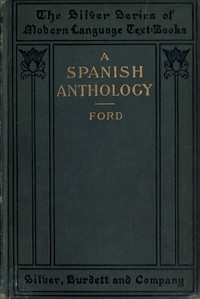
The volume is a curated anthology of Spanish lyric poetry intended for American learners of Castilian. Its editors have deliberately excluded verses lacking clear literary merit, favoring works that will engage a classroom audience while still representing the breadth of the tradition. The collection is organized chronologically, first presenting poems up to 1800, then moving to the nineteenth‑century repertoire, which the editors argue is more accessible to modern readers. Spanish‑American verses are grouped by country and placed in historical sequence, with occasional narrative pieces, romances, and songs that illustrate the link between poetry and music. Extensive notes, a prosody guide, and a vocabulary section accompany the texts, reflecting the scholarly collaboration of professors and literary figures from the United States and Latin America.
The anthology’s voice is scholarly yet pedagogical, offering concise introductions and contextual commentary rather than extensive literary criticism. Its style reflects the nineteenth‑century revival of lyric forms, presenting language that is nearer to contemporary usage while preserving the formal qualities of earlier periods. Readers who are studying Spanish as a foreign language, or who have an interest in the evolution of Iberian and Latin‑American verse, will find the work especially rewarding. The emphasis on lyrical quality, chronological organization, and supportive apparatus makes it a valuable resource for students, teachers, and anyone seeking a structured glimpse into the poetic heritage of the Spanish‑speaking world.
The opening · free to read
The present volume aims to furnish American students of Spanish with a convenient selection of the Castilian lyrics best adapted to class reading. It was the intention of the editors to include no poem which did not possess distinct literary value. On the other hand, some of the most famous Spanish lyrics do not seem apt to awaken the interest of the average student: it is for this reason that scholars will miss the names of certain eminent poets of the siglo de oro. The nineteenth century, hardly inferior in merit and nearer to present-day readers in thought and language, is much more fully represented. No apology is needed for the inclusion of poems by Spanish-American writers, for they will bear comparison both in style and thought with the best work from the mother Peninsula.
The Spanish poems are presented chronologically, according to the dates of their authors. The Spanish-American poems are arranged according to countries and chronologically within those divisions. Omissions are indicated by rows of dots and are due in all cases to the necessity of bringing the material within the limits of a small volume. Three poems (the Fiesta de toros of Moratin, the Castellano leal of Rivas and the Leyenda of Zorrilla) are more narrative than lyric. The romances selected are Page iv the most lyrical of their kind. A few songs have been added to illustrate the relation of poetry to music.
The editors have been constantly in consultation in all parts of the work, but the preparation of the Prosody, the Notes (including articles on Spanish-American literature) and the part of the Introduction dealing with the nineteenth century, was undertaken by Mr. Hills, while Mr. Morley had in charge the Introduction prior to 1800, and the Vocabulary. Aid has been received from many sources. Special thanks are due to Professor J.D.M. Ford and Dr. A.F. Whittem of Harvard University, Don Ricardo Palma of Peru, Don Ruben Dario of Nicaragua, Don Rufino Blanco-Fombona of Venezuela, Professor Carlos Bransby of the University of California, and Dr. Alfred Coester of Brooklyn, N.Y.
E.C.H.
S.G.M.
The book keeps going
Reading is free forever. Sign up and watch scenes appear while you read.



Scenes Storieta drew for other classics.
New illustrated classics
Once or twice a month: the latest books to get full character casts, scene art, and free comic editions. No account needed.