The first book printed in the Philippines has been the object of a hunt which has extended from Manila to Berlin, and from Italy to Chile, for four hundred and fifty years. The patient research of scholars, the scraps of evidence found in books and archives, the amazingly accurate hypotheses of bibliographers who have sifted the material so painstakingly gathered together, combine to make its history a bookish detective story par excellence.
It is easy when a prisoner has been arrested and brought to the dock to give details of his complexion, height, characteristics and identifying marks, to fingerprint him and to photograph him, but how inadequate was the description before his capture, how frequently did false scents draw the pursuer off the right track! It is with this in mind that we examine the subject of this investigation, remembering that it has not been done before in detail. And, to complete the case, the book has been photographed in its entirety and its facsimile herewith published.
In studying the Doctrina Christiana of 1593 there are four general problems which we shall discuss. First, we shall give a physical description of the book. Secondly, we shall trace chronologically the bibliographical history of the Doctrina, that is, we shall record the available evidence which shows that it was the first book printed in the Philippines, and weigh the testimonies which state or imply to the contrary. Thirdly, we shall try to establish the authorship of the text, and lastly, we shall discuss the actual printing.
It hardly needs be told why so few of the incunabula of the Philippines have survived. The paper on which they were printed was one of the most destructible papers ever used in book production. The native worms and insects thrived on it, and the heat and dampness took their slower but equally certain toll. Add to these enemies the acts of providence of which the Philippines have received more than their share--earthquake, fire and flood--and the man-made devastations of war, combined with the fact that there was no systematic attempt made in the Philippines to preserve in archives and libraries the records of the past, and it can well be understood why a scant handful of cradle-books have been preserved. The two fires of 1603 alone, which burned the Dominican convent in Manila to the ground and consumed the whole of Binondo just outside the walls, must have played untold havoc upon the records of the early missionaries. Perhaps the only copies of early Philippine books which exist today, unchronided and forgotten, are those which were sent to Europe in the 16th, 17th and 18th centuries, and may now be lying uncatalogued in some library there.
One copy of this Doctrina was sent to Philip II by the Governor of the Philippines in 1593; and in 1785 a Jesuit philologist, Hervas y Panduro, printed Tagalog texts from a then extant copy. Yet, since that time no example is recorded as having been seen by bibliographer or historian. The provenance of the present one is but imperfectly known. In the spring of 1946 William H. Schab, a New York dealer, was in Paris, and heard through a friend of the existence of a 1593 Manila book. He expressed such incredulity at this information that his friend, feeling his integrity impugned, telephoned the owner then and there, and confirmed the unbelievable "1593." Delighted and enthused, Schab arranged to meet him, found that he was a Paris bookseller and collector who specialized in Pacific imprints and was fully aware of the importance of the volume, and induced him to sell the precious Doctrina. He brought it back with him to the United States and offered it to Lessing J. Rosenwald, who promptly purchased it and presented it to the Library of Congress. Where the book had been before it reached Paris we do not know. Perhaps it is the very copy sent to Philip II, perhaps the copy from which Hervas got his text. Indeed, it may have been churned to the surface by the late Civil War in Spain, and sent from there to France. In the course of years from similar sources may come other books to throw more light upon the only too poorly documented history of the establishment of printing in the Philippine Islands.
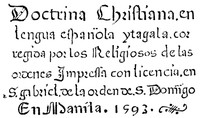
The book, printed in Gothic letters and Tagalog [1] characters on paper made from the paper mulberry, now browned and brittle with age, consists of thirty-eight leaves, comprising a title-page as above, under a woodcut [2] of St. Dominic, with the verso originally blank, but in this copy bearing the contemporary manuscript inscription, Tassada en dos rreales, signed Juan de Cuellar; and seventy-four pages of text in Spanish, Tagalog transliterated into roman letters, and Tagalog in Tagalog characters. The size of the volume, which is unbound, is 9 1/8 by 7 inches, although individual leaves vary somewhat due to chipping. Some of the leaves have become separated from their complements, but enough remain in the original stitching to indicate that the book was originally made up in four gatherings, the first of twelve leaves, the second of ten, the third of ten, and the fourth of six. Although the book is of the size called quarto, the method of printing must have been page by page, so it is doubtful that each sheet was folded twice in the usual quarto manner, but more probable that it was printed four pages to a sheet of paper approximately 9 1/8 by 14 inches, which was folded once.
The volume is printed throughout by the xylographic method, that is to say, each page of text is printed from one wood-block which was carved by hand. Along the inner margins of some pages are vertical lines which were made by the inked edge of the block, and the grain of the wood has caused striations to appear in the printed portions throughout. The unevenness of the impression indicates that the pages were printed in some primitive manner without the help of a conventional press.
The paper, which is one of the distinctive features of most old Oriental books, has been discussed at length by Pardo de Tavera in his study of early Philippine printing, and we can do no better than translate the relevant passage in full:
"I have said before that the material composition of our books is inferior. The imprints before 1830 were made on a paper called by some rice paper, by others silk paper, and by still others China paper, according to their taste. It is detestable, brittle, without consistency or resistance, and was called rice paper because it was supposed to be made from that grain. It was the only kind then used in the Philippines, not only for printing, but for all manner of writing, letters, etc., and it is even recorded that in 1874 when tobacco was a state monopoly, cigarettes were made with this paper, and that the Indians and Chinese preferred it (and perhaps they still do) to rag paper or other kinds, because of the horrible taste it gives the tobacco.
"In China they commonly made paper of bamboo, but more principally from cotton and a plant which travellers have cited only by its common name, which they transcribe in various ways, calling it kochu, kotsu, or kotzu. Today it is known that this plant is an ulmacea (Broussonetia papyrifera) from a mash of which they still make cloth in Japan. Cotton paper is superior to it, and naturally more expensive; but the paper of inferior quality which was received in Manila, where nothing was imported regularly but common articles of low price, was of kotsu. As all Chinese-made paper it was coated with alum, the finer [the paper] the thicker [the coating], for the purpose of whitening it and making the surface smooth, a deplorable business, for it made the paper very moisture absorbent, a condition fatal in such a humid climate as in these islands. Moreover, as the alum used is impure and contains a large proportion of iron salts, the humidity and weather oxidize it which finally darkens the paper, so that Philippine books present a coloration which runs the gamut of tones from the color of bone to that of dark cinnamon." [3]
Because the Doctrina Christiana, which may well be translated "The Teachings of Christianity," contains the basic elements of the religion which the missionaries were trying to spread among the unbaptized in the remote regions of the world, it was the most useful handbook they had. A summary of the contents of the present edition shows the fundamental character of the work. After a syllabary comes the Pater Noster, the primary and most popular prayer of Christianity. Then follow the Ave Maria, Credo, Salve Regina, Articles of Faith, Ten Commandments, Commandments of the Holy Church, Sacraments of the Holy Church, Seven Mortal Sins, Fourteen Works of Charity, Confession and Catechism. Here in a small compass is presented the simplest, most easily learned and most essential tenets of the Catholic Church.
So useful was the Doctrina considered as a guide for those who had just been, or were about to be, converted that the missionary fathers placed it in most cases foremost among the books necessary to have in print in a strange land. It is generally accepted today, although no extant copy is known, that the first book printed in Mexico [4] in 1539 was a Doctrina in Mexican and Spanish. Recent research has shown that the second book printed by the pioneer Jesuit press at Goa, in India, in 1557 was St. Francis Xavier's Doutrina Christao [5] in the Malay language, of which also no copy has yet been located. But there are copies of the first book to come from a South American press, another Doctrina [6] printed in the native and Spanish languages at Lima in 1584. So the choice of this book as the first to be printed at Manila follows a widespread precedent.
We have then a book, the Doctrina Christiana, in Spanish and Tagalog, corrected by priests of more than one order--and this is important in tracing the authorship of the work--and printed by the xylographic method with license at Manila at the Dominican Church of San Gabriel in 1593. So much we get from the title, and in itself it is a fairly complete story, but from the date of its issue until the present time that very fundamental information has not been completely recorded.
This states unequivocally that two books were printed at Manila some time before June 20, 1593, one of which was the Doctrina in Tagalog, and the other the same work in Chinese. Although we are chiefly concerned here with the former, the fact that they were produced at about the same time and probably at the same place makes it necessary to trace the history of both in order to reconstruct the circumstances surrounding the production of the one. Of the Chinese Doctrina no copy has yet come to light, and except for two 1593 references, there are no records of its existence.
Another document [8] of 1593 verifies the information given in the letter of Dasmarinas, differing from it only in one detail. In the Archives of the Indies was found a manuscript account of 1593 listing books written in the Philippines, which says: