Public-domain ebook
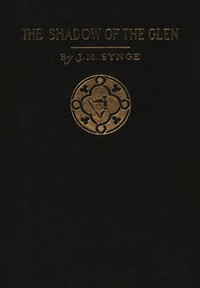
In the Shadow of the Glen
by J. M. Synge
Language: en775 downloads on Project Gutenberg
Subjects
In: One Act Plays·Plays/Films/Dramas·British Literature
Public-domain ebook sourced from Project Gutenberg #1618.
Public-domain ebook
by J. M. Synge
Language: en775 downloads on Project Gutenberg
Subjects
In: One Act Plays·Plays/Films/Dramas·British Literature
Public-domain ebook sourced from Project Gutenberg #1618.
The opening · free to read
SCENE.—_The last cottage at the head of a long glen in County Wicklow._
(Cottage kitchen; turf fire on the right; a bed near it against the wall with a body lying on it covered with a sheet. A door is at the other end of the room, with a low table near it, and stools, or wooden chairs. There are a couple of glasses on the table, and a bottle of whisky, as if for a wake, with two cups, a teapot, and a home-made cake. There is another small door near the bed. Nora Burke is moving about the room, settling a few things, and lighting candles on the table, looking now and then at the bed with an uneasy look. Some one knocks softly at the door. She takes up a stocking with money from the table and puts it in her pocket. Then she opens the door.)
TRAMP. (Outside.) Good evening to you, lady of the house.
NORA. Good evening, kindly stranger, it’s a wild night, God help you, to be out in the rain falling.
TRAMP. It is, surely, and I walking to Brittas from the Aughrim fair.
NORA. Is it walking on your feet, stranger?
TRAMP. On my two feet, lady of the house, and when I saw the light below I thought maybe if you’d a sup of new milk and a quiet decent corner where a man could sleep (he looks in past her and sees the dead man.) The Lord have mercy on us all!
NORA. It doesn’t matter anyway, stranger, come in out of the rain.
TRAMP. (Coming in slowly and going towards the bed.) Is it departed he is?
NORA. It is, stranger. He’s after dying on me, God forgive him, and there I am now with a hundred sheep beyond on the hills, and no turf drawn for the winter.
TRAMP. (Looking closely at the dead man.) It’s a queer look is on him for a man that’s dead.
NORA. (Half-humorously.) He was always queer, stranger, and I suppose them that’s queer and they living men will be queer bodies after.
TRAMP. Isn’t it a great wonder you’re letting him lie there, and he is not tidied, or laid out itself?
NORA. (Coming to the bed.) I was afeard, stranger, for he put a black curse on me this morning if I’ld touch his body the time he’ld die sudden, or let any one touch it except his sister only, and it’s ten miles away she lives in the big glen over the hill.
TRAMP. (Looking at her and nodding slowly.) It’s a queer story he wouldn’t let his own wife touch him, and he dying quiet in his bed.
NORA. He was an old man, and an odd man, stranger, and it’s always up on the hills he was thinking thoughts in the dark mist. (She pulls back a bit of the sheet.) Lay your hand on him now, and tell me if it’s cold he is surely.
TRAMP. Is it getting the curse on me you’ld be, woman of the house? I wouldn’t lay my hand on him for the Lough Nahanagan and it filled with gold.
NORA. (Looking uneasily at the body.) Maybe cold would be no sign of death with the like of him, for he was always cold, every day since I knew him,—and every night, stranger,—(she covers up his face and comes away from the bed); but I’m thinking it’s dead he is surely, for he’s complaining a while back of a pain in his heart, and this morning, the time he was going off to Brittas for three days or four, he was taken with a sharp turn. Then he went into his bed and he was saying it was destroyed he was, the time the shadow was going up through the glen, and when the sun set on the bog beyond he made a great lep, and let a great cry out of him, and stiffened himself out the like of a dead sheep.
TRAMP. (Crosses himself.) God rest his soul.
NORA. (Pouring him out a glass of whisky.) Maybe that would do you better than the milk of the sweetest cow in County Wicklow.
TRAMP. The Almighty God reward you, and may it be to your good health. (He drinks.)
NORA. (Giving him a pipe and tobacco.) I’ve no pipes saving his own, stranger, but they’re sweet pipes to smoke.
TRAMP. Thank you kindly, lady of the house.
NORA. Sit down now, stranger, and be taking your rest.
TRAMP. (Filling a pipe and looking about the room.) I’ve walked a great way through the world, lady of the house, and seen great wonders, but I never seen a wake till this day with fine spirits, and good tobacco, and the best of pipes, and no one to taste them but a woman only.
NORA. Didn’t you hear me say it was only after dying on me he was when the sun went down, and how would I go out into the glen and tell the neighbours, and I a lone woman with no house near me?
TRAMP. (Drinking.) There’s no offence, lady of the house?
NORA. No offence in life, stranger. How would the like of you, passing in the dark night, know the lonesome way I was with no house near me at all?
TRAMP. (Sitting down.) I knew rightly. (He lights his pipe so that there is a sharp light beneath his haggard face.) And I was thinking, and I coming in through the door, that it’s many a lone woman would be afeard of the like of me in the dark night, in a place wouldn’t be so lonesome as this place, where there aren’t two living souls would see the little light you have shining from the glass.
NORA. (Slowly.) I’m thinking many would be afeard, but I never knew what way I’d be afeard of beggar or bishop or any man of you at all. (She looks towards the window and lowers her voice.) It’s other things than the like of you, stranger, would make a person afeard.
TRAMP. (Looking round with a half-shudder.) It is surely, God help us all!
NORA. (Looking at him for a moment with curiosity.) You’re saying that, stranger, as if you were easy afeard.
TRAMP. (Speaking mournfully.) Is it myself, lady of the house, that does be walking round in the long nights, and crossing the hills when the fog is on them, the time a little stick would seem as big as your arm, and a rabbit as big as a bay horse, and a stack of turf as big as a towering church in the city of Dublin? If myself was easily afeard, I’m telling you, it’s long ago I’ld have been locked into the Richmond Asylum, or maybe have run up into the back hills with nothing on me but an old shirt, and been eaten with crows the like of Patch Darcy—the Lord have mercy on him—in the year that’s gone.
NORA. (With interest.) You knew Darcy?
TRAMP. Wasn’t I the last one heard his living voice in the whole world?
NORA. There were great stories of what was heard at that time, but would any one believe the things they do be saying in the glen?
TRAMP. It was no lie, lady of the house.... I was passing below on a dark night the like of this night, and the sheep were lying under the ditch and every one of them coughing, and choking, like an old man, with the great rain and the fog. Then I heard a thing talking—queer talk, you wouldn’t believe at all, and you out of your dreams,—and “Merciful God,” says I, “if I begin hearing the like of that voice out of the thick mist, I’m destroyed surely.” Then I run, and I run, and I run, till I was below in Rathvanna. I got drunk that night, I got drunk in the morning, and drunk the day after,—I was coming from the races beyond—and the third day they found Darcy.... Then I knew it was himself I was after hearing, and I wasn’t afeard any more.
NORA. (Speaking sorrowfully and slowly.) God spare Darcy, he’ld always look in here and he passing up or passing down, and it’s very lonesome I was after him a long while (she looks over at the bed and lowers her voice, speaking very clearly,) and then I got happy again—if it’s ever happy we are, stranger,—for I got used to being lonesome. (A short pause; then she stands up.)
NORA. Was there any one on the last bit of the road, stranger, and you coming from Aughrim?
TRAMP. There was a young man with a drift of mountain ewes, and he running after them this way and that.
The book keeps going
Reading is free forever. Sign up and watch scenes appear while you read.



Scenes Storieta drew for other classics.
New illustrated classics
Once or twice a month: the latest books to get full character casts, scene art, and free comic editions. No account needed.