
Public-domain ebook
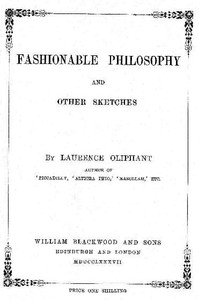
Fashionable Philosophy, and Other Sketches
Language: en347 downloads on Project Gutenberg
Subjects
In: Humour·Essays, Letters & Speeches·British Literature
Public-domain ebook sourced from Project Gutenberg #17120.
Public-domain ebook
Language: en347 downloads on Project Gutenberg
Subjects
In: Humour·Essays, Letters & Speeches·British Literature
Public-domain ebook sourced from Project Gutenberg #17120.
The opening · free to read
Mrs Gloring. Hush!
Lady Fritterly. There, it is getting louder, like distant artillery, and yet so near. Oh, Mr Drygull, what a wonderful man the Rishi must be!
Drygull. Yes; he knew that at this hour to-day I should need an illustration of his power, and he is kindly furnishing us with one. This is an experience which I think our friend over there [_looking towards_ Mr Germsell] would find it difficult to classify.
Germsell. Fussle, have the goodness to step here for a moment--[_points to a woman beating a carpet in the back-yard of an adjoining house_]. That is the tom-tom in the Himalayas they are listening to.
Fussle. Well, now, do you know, I don't feel quite sure of that. I was certainly conscious of a sort of internal hearing of something when you called me, which was not that; it was as though I had fiddlestrings in my head and somebody was beginning to strum upon them.
Germsell. Fiddlestrings indeed--say rather fiddlesticks. I am surprised at a sensible man like yourself listening to such nonsense.
Fussle [_testily_]. It is much greater nonsense for you to tell me I don't hear something I do hear, than for me to hear something you can't hear. You may be deaf, while my sense of hearing may be evolving. Can you hear what Lord Fondleton is saying to Mrs Gloring at this moment?
Germsell. No, and I don't want to.
Fussle. Ah, there it is. You won't hear anything you don't want to. Now I can, and he ought not to say it;--look how she is blushing. Oh, I forgot you are short-sighted. Well, you see, I can hear further than you, and see further than you. Why should you set a limit on the evolution of the senses, and say that no man in the future can ever hear or see further than men have in the past? How dare you, sir, with your imperfect faculties and your perfunctory method of research, which can only cover an infinitesimal period in the existence of this planet, venture to limit the potentialities of those laws which have already converted us from ascidians into men, and which may as easily evolve in us the faculty of hearing tom-toms in the Himalayas while we are sitting here, as of that articulate speech or intelligent reasoning which, owing to their operation, we now possess?
Germsell. Pardon me, you do not possess them, Mr Fussle.
Lady Fritterly. Mr Fussle, might I ask you to take this cup of tea to Mrs Allmash? Mr Germsell, it would be too kind of you to hand Mrs Gloring the cake.
Fussle [_savagely_]. We will continue this conversation at the Minerva.
Mrs Allmash [_apart to the_ Khoja]. Oh, Mr Allyside, I am so glad to hear that you speak English so perfectly! I want you to tell me all about your religion; perhaps it may help us, you know, to find the religion of the future, which we are all longing for. And I am so interested in oriental religions! there is something so charmingly picturesque about them. I quite dote on those dear old Shastras, and Vedas, and Puranas; they contain such a lot of beautiful things, you know.
Ali Seyyid. I know as little, madam, of the Indian books you mention as I do of the Bible, which I have always heard was a very good book, and contained also a great many beautiful things. I am neither a Hindoo nor a Buddhist,--in fact, it is forbidden to me by my religion to tell you exactly what I am.
Mrs Allmash. But indeed I won't tell anybody if you will only confide in me. Oh, this mystery is too exquisitely delicious! Who knows, perhaps you might make a convert of me?
Ali Seyyid [_with an admiring gaze_]. Madam, you would be a prize so well worth winning, that you almost tempt me. The first of our secrets is that we are all things to all men, until we are quite sure of the sympathy of the listener; then we venture a step further.
Mrs Allmash. How wise that is! and how unlike the system adopted by Christians! You may be sure of my most entire sympathy.
Ali Seyyid. The next principle is--but this is a profound secret, which you must promise not to repeat--the rejection of all fixed rules of religion or morality. It really does not matter in the least what you do: the internal disposition is the only thing of any value. Now, as far as I understand, you have already got rid of the religion, or you would not be looking for a new one; all you have to do is to get rid of the morality, and there you are.
Mrs Allmash [_with an expression of horror and alarm_]. Yes, there I should be indeed. Oh, Mr Allyside, what a dreadful man you are! Who started such an extraordinary doctrine?
Ali Seyyid. Well, his name was Hassan-bin-Saba--commonly known among Westerns as the "Old Man of the Mountain." His followers, owing to the value they attached to murder as a remedial agent, have been known by the name of the "Assassins."
Mrs Allmash. Oh, good gracious!
Lady Fritterly. My dear Louisa, what is the matter? You look quite frightened.
Ali Seyyid. Mrs Allmash is a little alarmed because I proposed a new morality for the future, as well as a new religion.
Mr Coldwaite. Excuse me; but in discussions of this sort, I think it is most important that we should clearly understand the meanings of the terms we employ. Now I deny that any difference subsists between religion and morality. That any such distinction should exist in men's minds is due to the fact that dogma is inseparably connected with religion. If you eliminate dogma, what does religion consist of but morality? Substitute the love of Humanity for the love of the Unknowable--which is the subject of worship of Mr Germsell; or of the Deity, who is the object of worship of the majority of mankind--and you obtain a stimulus to morality which will suffice for all human need. It is in this great emotion, as it seems to me, that you will find at once the religion and the morality of the future.
Germsell. From what source do you get the force which enables you to love humanity with a devotion so intense that it shall elevate your present moral standard?
Coldwaite. From humanity itself. I am not going to be entrapped into getting it from any unknowable source; the love of humanity, whether it be humanity as existing, or when absorbed by death into the general mass, is perpetually generating itself.
Mrs Allmash. Then it must produce itself from what was there before; therefore it must be the same love, which keeps on going round and round.
Lord Fondleton. A sort of circular love, in fact. I've often felt it: but I didn't think it right to encourage it.
Lady Fritterly. Lord Fondleton, how can you be so silly? Don't pay attention to him, Mr Coldwaite. I confess I still don't see how you can get a higher love out of humanity than humanity has already got in it, unless you are to look to some other source for it.
Coldwaite. Why, mayn't it evolve from itself?
Germsell. How can it evolve without a propulsive force behind it? The thing is too palpable an absurdity to need argument. You can no more fix limits to the origin of force than you can destroy its persistency.
Lord Fondleton [_aside_]. That seems to me one of those sort of things no fellow can understand.
Germsell. All you can say of it is that it is a conditioned effect of an unconditioned cause. That no idea or feeling arises, save as a result of some physical force expended in producing it, is fast becoming a commonplace of science; and whoever duly weighs the evidence will see that nothing but an overwhelming bias in favour of a preconceived theory can explain its non-acceptance. I think my friend Mr Herbert Spencer has demonstrated this conclusively.
Coldwaite. Pardon me; do I understand you to say that the mental process which enabled Mr Spencer to elaborate his system of philosophy, or that the profound emotion which finds its expression in a love for humanity, are the result of physical force alone?
Germsell. He says so himself, and he ought to know. His whole system of philosophy is nothing more nor less than the result of the liberation of certain forces produced by chemical action in the brain.
Drygull. Then, if I understand you rightly, if the chemical changes which have been taking place for some years past in his brain had liberated a different set of forces, we should have had altogether a different philosophy.
Germsell. The chemical changes would in that case have been different.
Drygull. But the changes must be produced by forces acting on them.
Germsell. Exactly: a force which has its source in the Unknowable produces a certain chemical action in the brain by which it becomes converted into thought or emotion, into love or philosophy, into art or religion, as the case may be: what the nature of that love or philosophy, or art or religion, may be, must depend entirely on the nature of the chemical change.
Lord Fondleton [_aside to_ Mrs Gloring]. I feel the most delightful chemical changes taking place now in my brain, dear Mrs Gloring. May I explain to you the exquisite nature of the forces that are being liberated, and which produce emotions of the most tender character.
The book keeps going
Reading is free forever. Sign up and watch scenes appear while you read.



Scenes Storieta drew for other classics.
New illustrated classics
Once or twice a month: the latest books to get full character casts, scene art, and free comic editions. No account needed.