Public-domain ebook
Punch, or the London Charivari, Volume 1, Complete
by Various
Language: en3,242 downloads on Project Gutenberg
Subjects
In: Punch·Humour·British Literature
Public-domain ebook sourced from Project Gutenberg #17216.
Public-domain ebook
by Various
Language: en3,242 downloads on Project Gutenberg
Subjects
In: Punch·Humour·British Literature
Public-domain ebook sourced from Project Gutenberg #17216.
Punch, or the London Charivari, Volume 1 is a Victorian satirical periodical that began its first half‑year in 1841. The opening pages introduce the magazine as a “refuge for destitute wit” and lay out its many departments, politics, fashion, police, reviews, fine arts, music, drama, sport, and a host of whimsical societies, each staffed by caricatured contributors such as Mrs J. Punch and a “Prophet” who predicts race winners. After this flamboyant preface the volume launches into a detailed political summary of the summer of 1841, recounting parliamentary debates, election results, and speeches by figures like Sir Robert Peel, Mr Disraeli, and Lord John Russell. The text mixes earnest reportage of parliamentary proceedings with the magazine’s characteristic mock‑heroic commentary, setting the tone for a collection that blends current affairs with comic exaggeration.
The voice is unmistakably mid‑Victorian, combining formal prose with a playful, often absurd cataloguing of society’s quirks. Its satire is both topical, targeting politicians, fashions, and the press, and timeless in its lampooning of bureaucratic pomp. Readers who enjoy a blend of historical political discourse and witty, illustrated commentary will find this first volume entertaining, especially those with an interest in 19th‑century British culture, journalism, and the origins of modern humor magazines.
The opening · free to read
Files redesigned by David Widger converting original external links to internal links.
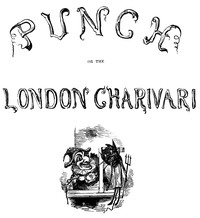
[pg i] PUNCH or the London Charivari, with a vignette of PUNCH. VOLUME THE FIRST. [pg iii] A group of masked players surround PUNCH. A banner reads INTRODUCTION. A letter T is hoisted in a shipyard. his Guffawgraph is intended to form a refuge for destitute witan asylum for the thousands of orphan jokesthe superannuated Joe Millersthe millions of perishing puns, which are now wandering about without so much as a shelf to rest upon! It is also devoted to the emancipation of the JEW desprits all over the world, and the naturalization of those alien JONATHANS, whose adherence to the truth has forced them to emigrate from their native land.
PUNCH has the honour of making his appearance every SATURDAY, and continues, from week to week, to offer to the world all the fun to be found in his own and the following heads:
POLITICS. PUNCH has no party prejudiceshe is conservative in his opposition to Fantoccini and political puppets, but a progressive whig in his love of small change.
FASHIONS. This department is conducted by Mrs. J. Punch, whose extensive acquaintance with the élite of the areas enables her to furnish the earliest information of the movements of the Fashionable World.
POLICE. This portion of the work is under the direction of an experienced noblemana regular attendant at the various officeswho from a strong attachment to PUNCH, is frequently in a position to supply exclusive reports.
[pg iv] REVIEWS. To render this branch of the periodical as perfect as possible, arrangements have been made to secure the critical assistance of John Ketch, Esq., who, from the mildness of the law, and the congenial character of modern literature with his early associations, has been induced to undertake its execution.
FINE ARTS. Anxious to do justice to native talent, the criticisms upon Painting, Sculpture, &c., are confided to one of the most popular artists of the dayPunchs own immortal scene-painter.
MUSIC AND THE DRAMA. These are amongst the most prominent features of the work. The Musical Notices are written by the gentleman who plays the mouth-organ, assisted by the professors of the drum and cymbals. Punch himself does the Drama.
SPORTING. A Prophet is engaged! He foretells not only the winners of each race, but also the VATES and colours of the riders.
THE FACETIÆ Are contributed by the members of the following learned bodies:
THE COURT OF COMMON COUNCIL AND THE ZOOLOGICAL SOCIETY:THE TEMPERANCE ASSOCIATION AND THE WATERPROOFING COMPANY:THE COLLEGE OF PHYSICIANS AND THE HIGHGATE CEMETERY:THE DRAMATIC AUTHORS AND THE MENDICITY SOCIETIES:THE BEEFSTEAK CLUB AND THE ANTI-DRY-ROT COMPANY.
Together with original, humorous, and satirical articles in verse and prose, from all the
Dogs dressed in gentlemen's clothing. FUNNY DOGS WITH COMIC TALES.
[pg v] INTRODUCTION. VOLUME I.JULY TO DECEMBER, 1841. POLITICAL SUMMARY. Early in the month of July, 1841, a small handbill was freely distributed by the newsmen of London, and created considerable amusement and inquiry. That handbill now stands as the INTRODUCTION to this, the first Volume of Punch, and was employed to announce the advent of a publication which has sustained for nearly twenty years a popularity unsurpassed in the history of periodical literature. Punch and the Elections were the only matters which occupied the public mind on July 17, 1842. The Whigs had been defeated in many places where hitherto they had been the popular party, and it was quite evident that the Meeting of Parliament would terminate their lease of Office. [Street Politics.] The House met on the 19th of August, and unanimously elected MR. SHAW LEFEVRE to be Speaker. The address on the QUEENS Speech was moved by MR. MARK PHILLIPS, and seconded by MR. DUNDAS. MR. J.S. WORTLEY moved an amendment, negativing the confidence of the House in the Ministry, and the debate continued to occupy Parliament for four nights, when the Opposition obtained a majority of 91 against the Ministers. Amongst those who spoke against the Government, and directly in favour of SIR ROBERT PEEL, was MR. DISRAELI. In his speech he accused the Whigs of seeking to retain power in opposition to the wishes of the country, and of profaning the name of the QUEEN at their elections, as if she had been a second candidate at some petty poll, and considered that they should blush for the position in which they had placed their Sovereign. MR. BERNAL, Jun., retorted upon MR. DISRAELI for inveighing against the Whigs, with whom he had formerly been associated. SIR ROBERT PEEL, in a speech of great eloquence, condemned the inactivity and feebleness of the existing Government, and promised that, should he displace it, and take office, it should be by walking in the open light, and in the direct paths of the constitution. He would only accept power upon his conception of public duty, and would resign the moment he was satisfied he was unsupported by the confidence of the people, and not continue to hold place when the voice of the country was against him. [Hercules tearing Theseus from the Rock to which he had grown.] LORD JOHN defended the acts of the Ministry, and denied that they had been guilty of harshness to the poor by the New Poor Law, or enemies of the Church by reducing the ARCHBISHOP OF CANTERBURY to the miserable pittance of £15,000 a year, cutting down the BISHOP OF LONDON to no more than £10,000 a year, and the BISHOP OF DURHAM to the wretched stipend of £8,000 a year! He twitted PEEL for his reticence upon the Corn Laws, and denounced the possibility of a sliding scale of duties upon corn. He concluded by saying, I am convinced that, if this country be governed by enlarged and liberal counsels, its power and might will spread and increase, and its influence become greater and greater; liberal principles will prevail, civilisation will be spread to all parts of the globe, and you will bless millions by your acts and mankind by your union. Loud and continued cheering followed this speech, but on division the majority was against the Ministers. When the House met to recommend the report on the amended Address, MR. SHARMAN CRAWFORD moved another amendment, to the effect that the distress of the people referred to in the QUEENS Speech was mainly attributable to the non- representation of the working classes in Parliament. He did not advocate universal suffrage, but one which would give a fair representation of the people. From the want of this arose unjust wars, unjust legislation, unjust monopoly, of which the existing Corn Laws were the most grievous instance. There was no danger in confiding the suffrage to the working classes, who had a vital interest in the public prosperity, and had evinced the truest zeal for freedom.
The amendment was negatived by 283 to 39.
At the next meeting of the House LORD MARCUS HILL read the Answer to the Address, in which the QUEEN declared that ever anxious to listen to the advice of Parliament, she would take immediate measures for the formation of a new Administration. [Punch and Peel.] LORD MELBOURNE, in the House of Lords, announced on the 30th of August that he and his colleagues only held office until their successors were appointed. [Last Pinch.] The House received the announcement in perfect silence, and adjourned immediately afterwards. On the same [pg vi]night, in the House of Commons, LORD JOHN RUSSELL made a similar announcement, and briefly defended the course he and his colleagues had taken, and in reply to some complimentary remarks from LORD STANLEY, approving of LORD JOHNS great zeal, talent, and perseverance, denied that the Crown was answerable for any of the propositions contained in the Speech, which were the result of the advice of HER MAJESTYS Ministers, and for which her Ministers alone were responsible. This declaration was necessary in consequence of the accusation of the Conservatives, that the Ministry had made an unfair use of the QUEENS name in and out of Parliament. [Trimming a Whig.] The new Ministry [The Letter of Introduction] was formed as follows:
THE CABINET. THE DUKE OF WELLINGTON (without office); First Lord of the Treasury, SIR R. PEEL; Lord Chancellor, LORD LYNDHUHST; Chancellor of the Exchequer, RIGHT HON. H. GOULBURN; President of the Council, LORD WHARNCLIFFE; Privy Seal, DUKE OF BUCKINGHAM; Home Secretary, SIR JAMES GRAHAM; Foreign Secretary, EARL OF ABERDEEN; Colonial Secretary, LORD STANLEY; First Lord of the Admiralty, EARL OF HADDINGTON; President of the Board of Control, LORD ELLENBOROUGH; President of the Board of Trade, EARL OF RIPON; Secretary at War, SIR H. HARDINGE; Treasurer of the Navy and Paymaster of the Forces, SIR E. KNATCHBULL.
NOT IN THE CABINET. Postmaster-General, LORD LOWTHER; Chancellor of the Duchy of Lancaster, LORD G. SOMERSET; Woods and Forests, EARL OF LINCOLN; Master-General of the Ordnance, SIR G. MURRAY; Vice-President of the Board of Trade and Master of the Mint, W.E. GLADSTONE; Secretary of the Admiralty, HON. SYDNEY HERBERT; Joint Secretaries of the Treasury, SIR G. CLERK and SIR T. FREMANTLE; Secretaries of the Board of Control, HON. W. BARING and J. EMERSON TENNENT; Home Under-Secretary, HON. C.M. SUTTON; Foreign Under-Secretary, LORD CANNING; Colonial Under- Secretary, G.W. HOPE; Lords of the Treasury, ALEXANDER PRINGLE, H. BARING, J. YOUNG, and J. MILNES GASKELL; Lords of the Admiralty, SIR G. COCKBURN, ADMIRAL SIR W. GAGE, SIR G. SEYMOUR, HON. CAPTAIN GORDON, HON. H.L. COREY; Store-keeper of the Ordnance, J.R. BONHAM; Clerk of the Ordnance, CAPTAIN BOLDERO; Surveyor-General of the Ordnance, COLONEL JONATHAN PEEL; Attorney-General, SIR F. POLLOCK; Solicitor-General, SIR W. FOLLETT; Judge-Advocate, DR. NICHOLL; Governor-General of Canada, SIR C. BAGOT; Lord Advocate of Scotland, SIR W. RAE.
IRELAND. Lord Lieutenant, EARL DE GREY; Lord Chancellor, SIR E. SUGDEN; Chief Secretary, LORD ELIOT; Attorney-General, MR. BLACKBURNE, Q.C.; Solicitor-General, SERJEANT JACKSON.
QUEENS HOUSEHOLD. Lord Chamberlain, EARL DELAWARR; Lord Steward, EARL OF LIVERPOOL; Master of the Horse, EARL OF JERSEY; Master of the Buckhounds, EARL OF ROSSLYN; Captain of the Yeomen of the Guard, MARQUIS OF LOTHIAN; Captain of the Gentlemen Pensioners, LORD FORESTER; Vice- Chamberlain, LORD ERNEST BRUCE; Treasurer of the Household, EARL JERMYN; Controller of the Household, HON. D. DAMER; Lords in Waiting, LORD ABOYNE, LORD RIVERS, LORD HARDWICKE, LORD BYRON, EARL OF WARWICK, VISCOUNT SYDNEY, EARL OF MORTON, and MARQUIS OF ORMONDE; Groom in Waiting, CAPTAIN MEYNELL; Mistress of the Robes, DUCHESS OF BUCCLEUCH; Ladies of the Bedchamber, MARCHIONESS CAMDEN, LADY LYTTELTON, LADY PORTMAN, LADY BARHAM, and COUNTESS OF CHARLEMONT.
PRINCE ALBERTS HOUSEHOLD. Groom of the Stole, MARQUIS OF EXETER; Sergeant-at-Arms, COLONEL PERCEVAL; Clerk Marshal, LORD C. WELLESLEY.
The members of the new Government were re-elected without an exception, and the House of Commons met again on September 16. SIR ROBERT PEEL made a statement to the House, in which he merely intimated that he should adopt the Estimates [Playing the Knave] of his predecessors, and continue the existing Poor-Law and its Establishment to the 31st of July following. He declined to announce his own financial measures until the next Session, and continued in this determination unmoved by the speeches of LORD JOHN RUSSELL, LORD PALMERSTON, and other Members of the Opposition. MR. FIELDEN moved that no supplies be granted until after an inquiry into the distress of the country; but the motion was negatived by a large majority. Continual reference was made by MR. COBDEN, MR. VILLIERS, and others to the strong desire of the people for a Repeal of the Corn Laws, and which had been loudly expressed out of the House for more than four years. MR. BUSFIELD FERRAND denied the necessity for any alteration, and accused the manufacturers of fomenting the agitation for their own selfish ends, and to increase their power of reducing the wages of the already starving workmen. MR. MARK PHILLIPS, in a capital speech, disproved all MR. FERRANDS statements. SIR ROBERT PEEL brought in a Bill to continue the Poor Law Commission for six months, and MR. FIELDERS Amendment [The Well Dressed and the Well to Do] to reject it was negatived by 183 to 18. LORD MELBOURNE attacked, in the House of Lords, the Ministerial plan of finance, and their silence as to the future [Mr. Sancho Bull and his State Physician], and invited the DUKE OF WELLINGTON to bring forward a measure for an alteration of the Corn Laws, promising him a full House if he would do so. The Duke declined the invitation, as he never announced an intention which he did not entertain, and he had not considered the operation of the Corn Laws sufficiently to bring forward a scheme for the alteration of them. This statement led on a subsequent evening to an intimation from the DUKE OF WELLINGTON, in reply to the EARL OF RADNOR, that a consideration of the Corn Laws was only declined at the present time. On the 7th of October Parliament was prorogued until November 11th, the Lords Commissioners being the LORD CHANCELLOR, the DUKE OF WELLINGTON, the DUKE OF BUCKINGHAM, the EARL OF SHAFTESBURY, and LORD WHARNCLIFFE.
The book keeps going
Reading is free forever. Sign up and watch scenes appear while you read.



Scenes Storieta drew for other classics.
New illustrated classics
Once or twice a month: the latest books to get full character casts, scene art, and free comic editions. No account needed.