Public-domain ebook
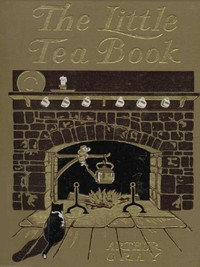
The Little Tea Book
Language: en592 downloads on Project Gutenberg
Subjects
In: Poetry·Mythology, Legends & Folklore·Travel Writing
Public-domain ebook sourced from Project Gutenberg #19392.
Public-domain ebook
Language: en592 downloads on Project Gutenberg
Subjects
In: Poetry·Mythology, Legends & Folklore·Travel Writing
Public-domain ebook sourced from Project Gutenberg #19392.
The opening · free to read
After all, tea is the drink! Domestically and socially it is the beverage of the world. There may be those who will come forward with their figures to prove that other fruits of the soil-- agriculturally and commercially--are more important. Perhaps they are right when quoting statistics. But what other product can compare with tea in the high regard in which it has always been held by writers whose standing in literature, and recognized good taste in other walks, cannot be questioned?
A glance through this book will show that the spirit of the tea beverage is one of peace, comfort, and refinement. As these qualities are all associated with the ways of women, it is to them, therefore--the real rulers of the world--that tea owes its prestige and vogue.
Further peeps through these pages prove this to be true; for nearly all the allusions and references to the beverage, by male writers, reveal the womanly influence that tea imparts. But this is not all. The side-lights of history, customs, manners, and modes of living which tea plays in the life of all nations will be found entertaining and instructive. Linked with the fine feminine atmosphere which pervades the drinking of the beverage everywhere, a leaf which can combine so much deserves, at least, a little human hearing for its long list of virtues; for its peaceful walks, talks, tales, tattle, frills, and fancies which go to make up this tribute to "the cup that cheers but not inebriates."
Darma, third son of Koyuwo, King of India, a religions high priest from Siaka (the author of that Eastern paganism about a thousand years before the Christian era), coming to China, to teach the way of happiness, lived a most austere life, passing his days in continual mortification, and retiring by night to solitudes, in which he fed only upon the leaves of trees and other vegetable productions. After several years passed in this manner, in fasting and watching, it happened that, contrary to his vows, the pious Darma fell asleep! When he awoke, he was so much enraged at himself, that, to prevent the offence to his vows for the future, he got rid of his eyelids and placed them on the ground. On the following day, returning to his accustomed devotions, he beheld, with amazement, springing up from his eyelids, two small shrubs of an unusual appearance, such as he had never before seen, and of whose qualities he was, of course, entirely ignorant. The saint, however, not being wholly devoid of curiosity--or, perhaps, being unusually hungry--was prompted to eat of the leaves, and immediately felt within him a wonderful elevation of mind, and a vehement desire of divine contemplation, with which he acquainted his disciples, who were eager to follow the example of their instructor, and they readily received into common use the fragrant plant which has been the theme of so many poetical and literary pens in succeeding ages.
From what enchanted Eden came thy leaves That hide such subtle spirits of perfume? Did eyes preadamite first see the bloom, Luscious nepenthe of the soul that grieves?
By thee the tired and torpid mind conceives Fairer than roses brightening life's gloom, Thy protean charm can every form assume And turn December nights to April eves.
Thy amber-tinted drops bring back to me Fantastic shapes of great Mongolian towers, Emblazoned banners, and the booming gong; I hear the sound of feast and revelry, And smell, far sweeter than the sweetest flowers, The kiosks of Pekin, fragrant of Oolong!
Although the legend credits the pious East Indian with the discovery of tea, there is no evidence extant that India is really the birthplace of the plant.
Since India has no record of date, or facts, on stone or tablet, or ever handed down a single incident of song or story--apart from the legend--as to the origin of tea, one is loath to accept the claim--if claim they assert--of a people who are not above practising the "black art" at every turn of their fancy.
Certain it is that China, first in many things, knew tea as soon as any nation of the world. The early Chinese were not only more progressive than other peoples, but linked with their progress were important researches, and invaluable discoveries, which the civilized world has long ago recognized. Then, why not add tea to the list?
At any rate, it is easy to believe that the Chinese were first in the tea fields, and that undoubtedly the plant was a native of both China and Japan when it was slumbering on the slopes of India, unpicked, unsteeped, undrunk, unhonored, and unsung.
A celebrated Buddhist, St. Dengyo Daishai, is credited with having introduced tea into Japan from China as early as the fourth century. It is likely that he was the first to teach the Japanese the use of the herb, for it had long been a favorite beverage in the mountains of the Celestial Kingdom. The plant, however, is found in so many parts of Japan that there can be little doubt but what it is indigenous there as well.
The word TEA is of Chinese origin, being derived from the Amoy and Swatow reading, "Tay," of the same character, which expresses both the ancient name of tea, "T'su," and the more modern one, "Cha." Japanese tea, "Chiya"--pronounced Châ.
Tea was not known in China before the Tang dynasty, 618-906 A.D. An infusion of some kind of leaf, however, was used as early as the Chow dynasty, 1122-255 B.C., as we learn from the Urh-ya, a glossary of terms used in ancient history and poetry. This work, which is classified by subjects, has been assigned as the beginning of the Chow dynasty, but belongs more properly to the era of Confucius, K'ung Kai, 551-479 B.C.
Although known in Japan for more than a thousand years, tea only gradually became the national beverage as late as the fourteenth century.
In the first half of the eighth century, 729 A.D., there was a record made of a religious festival, at which the forty-fifth Mikado---"Sublime Gate"--Shommei Tenno, entertained the Buddhist priests with tea, a hitherto unknown beverage from Corea, which country was for many years the high-road of Chinese culture to Japan.
After the ninth century, 823 A.D., and for four centuries thereafter, tea fell into disuse, and almost oblivion, among the Japanese. The nobility, and Buddhist priests, however, continued to drink it as a luxury.
During the reign of the eighty-third Emperor, 1199-1210 A.D., the cultivation of tea was permanently established in Japan. In 1200, the bonze, Yei-Sei, brought tea seeds from China, which he planted on the mountains in one of the most northern provinces. Yei-Sei is also credited with introducing the Chinese custom of ceremonious tea-drinking. At any rate, he presented tea seeds to Mei-ki, the abbot of the monastery of To-gano (to whom the use of tea had been recommended for its stimulating properties), and instructed him in the mystery of its cultivation, treatment, and preparation. Mei-ki, who laid out plantations near Uzi, was successful as a pupil, and even now the tea-growers of that neighborhood pay tribute to his memory by annually offering at his shrine the first gathered tea-leaves.
After that period, the use of tea became more and more in fashion, the monks and their kindred having discovered its property of keeping them awake during long vigils and nocturnal prayers.
Prom this time on the development and progress of the plant are interwoven with the histories and customs of these countries.
Venus her myrtle, Phoebus has her bays; Tea both excels, which she vouchsafes to praise. The best of Queens, and best of herbs, we owe To that bold nation, which the way did show To the fair region where the sun doth rise, Whose rich productions we so justly prize. The Muse's friend, tea does our fancy aid, Repress those vapors which the head invade, And keep the palace of the soul serene, Tit on her birthday to salute the Queen.
Waller was born in 1605, and died in 1687, aged eighty-two.
Tea was brought into Europe by the DUTCH EAST INDIA COMPANY, in 1610. It was at least forty, and perhaps forty-seven, years later that England woke up to the fascinations of the new drink. Dr. Johnson puts it at even a later date, for he claims that tea was first introduced into England by Lords Arlington and Ossory, in 1666, and really made its debut into society when the wives of these noblemen gave it its vogue.
If Dr. Johnson's statement is intended to mean that nothing is anything until the red seal of the select says, "Thus shall it be," he is right in the year he has selected. If, on the other hand, the Doctor had in mind society at large, he is "mixed in his dates," or leaves, for tea was drawn and drunk in London nine years before that date.
Garway, the founder of Garraway's coffee house, claimed the honor of being first to offer tea in leaf and drink for public sale, in 1657. It is pretty safe to fix the entrance of tea into Europe even a few years ahead of his announcement, for merchants in those days did not advertise their wares in advance.
However, this date is about the beginning of TEA TIME, for in the Mercurius Politicius of September, 1658, appeared the following advertisement:
That excellent and by all Physitians approved China drink, called by the Chineans, Tcha, by other nations, Tay, or Tea, is sold at the Sultana's Head, a Copphee House, in Sweetings Rents, by the Royal Exchange, London.
Like all new things, when they have fastened on to the public's favor, tea was on everybody's lips and in everybody's mouth. It was lauded to the skies, and was supposed to be good for all the ills of the flesh. It would cure colds and consumption, clear the sight, remove lassitude, purify the liver, improve digestion, create appetite, strengthen the memory, and cure fever and ague.
One panegyrist says, while never putting the patient in mind of his disease, it cheers the heart, without disordering the head; strengthens the feet of the old, and settles the heads of the young; cools the brain of the hard drinker, and warms that of the sober student; relieves the sick, and makes the healthy better. Epicures drink it for want of an appetite; bon vivants, to remove the effects of a surfeit of wine; gluttons, as a remedy for indigestion; politicians, for the vertigo; doctors, for drowsiness; prudes, for the vapors; wits, for the spleen; and beaux to improve their complexions; summing up, by declaring tea to be a treat for the frugal, a regale for the luxurious, a successful agent for the man of business, and a bracer for the idle.
Poets and verse-makers joined the chorus in praise of tea, in Greek and Latin. One poet pictures Hebe pouring the delightful cup for the goddesses, who, finding it made their beauty brighter and their wit more brilliant, drank so deeply as to disgust Jupiter, who had forgotten that he, himself,
"Drank tea that happy morn, When wise Minerva of his brain was born."
Laureant Tate, who wrote a poem on tea in two cantos, described a family jar among the fair deities, because each desired to become the special patroness of the ethereal drink destined to triumph over wine. Another versifier exalts it at the expense of its would-be rival, coffee:
The book keeps going
Reading is free forever. Sign up and watch scenes appear while you read.



Scenes Storieta drew for other classics.
New illustrated classics
Once or twice a month: the latest books to get full character casts, scene art, and free comic editions. No account needed.