
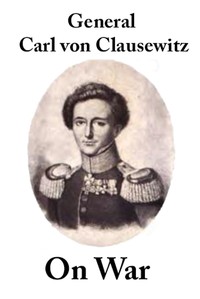
Public-domain ebook
On War
Language: en9,750 downloads on Project Gutenberg
Subjects
In: History - Warfare·Philosophy & Ethics
Public-domain ebook sourced from Project Gutenberg #1946.
Public-domain ebook
Language: en9,750 downloads on Project Gutenberg
Subjects
In: History - Warfare·Philosophy & Ethics
Public-domain ebook sourced from Project Gutenberg #1946.
The work is a scholarly treatise on the nature of armed conflict, written by the Prussian general Carl von Clausewitz. Its opening frames war as a political instrument, “the exercise of force for the attainment of a political object”, and links the analysis to contemporary European concerns, from the symbolism of Germany’s flag to the balance of forces that keeps the continent at peace. The author draws parallels between his ideas and those of Darwin, arguing that both reveal a “law” of survival that operates without moral judgment. He then surveys recent historical episodes, Königgrätz, Sedan, the Hague Conference, and warns that the equilibrium of military power is fragile, suggesting that the readiness of nations to mobilise “every available man, horse, and gun” is the decisive factor in avoiding catastrophe.
Clausewitz writes in a dense, philosophically charged style typical of early‑nineteenth‑century military literature, mixing historical illustration with sweeping theory. The language is formal, often invoking classical references such as the Bhagavad Gītā, and assumes familiarity with European political and military history. Readers who relish rigorous analysis of strategy, politics, and the psychology of war, students of history, political science, or military studies, will find the book rewarding, while those seeking a narrative account of battles may prefer a more accessible treatment.
The opening · free to read
It reveals “War,” stripped of all accessories, as the exercise of force for the attainment of a political object, unrestrained by any law save that of expediency, and thus gives the key to the interpretation of German political aims, past, present, and future, which is unconditionally necessary for every student of the modern conditions of Europe. Step by step, every event since Waterloo follows with logical consistency from the teachings of Napoleon, formulated for the first time, some twenty years afterwards, by this remarkable thinker.
What Darwin accomplished for Biology generally Clausewitz did for the Life-History of Nations nearly half a century before him, for both have proved the existence of the same law in each case, viz., “The survival of the fittest”—the “fittest,” as Huxley long since pointed out, not being necessarily synonymous with the ethically “best.” Neither of these thinkers was concerned with the ethics of the struggle which each studied so exhaustively, but to both men the phase or condition presented itself neither as moral nor immoral, any more than are famine, disease, or other natural phenomena, but as emanating from a force inherent in all living organisms which can only be mastered by understanding its nature. It is in that spirit that, one after the other, all the Nations of the Continent, taught by such drastic lessons as Königgrätz and Sedan, have accepted the lesson, with the result that to-day Europe is an armed camp, and peace is maintained by the equilibrium of forces, and will continue just as long as this equilibrium exists, and no longer.
Whether this state of equilibrium is in itself a good or desirable thing may be open to argument. I have discussed it at length in my “War and the World’s Life”; but I venture to suggest that to no one would a renewal of the era of warfare be a change for the better, as far as existing humanity is concerned. Meanwhile, however, with every year that elapses the forces at present in equilibrium are changing in magnitude—the pressure of populations which have to be fed is rising, and an explosion along the line of least resistance is, sooner or later, inevitable.
As I read the teaching of the recent Hague Conference, no responsible Government on the Continent is anxious to form in themselves that line of least resistance; they know only too well what War would mean; and we alone, absolutely unconscious of the trend of the dominant thought of Europe, are pulling down the dam which may at any moment let in on us the flood of invasion.
Now no responsible man in Europe, perhaps least of all in Germany, thanks us for this voluntary destruction of our defences, for all who are of any importance would very much rather end their days in peace than incur the burden of responsibility which War would entail. But they realise that the gradual dissemination of the principles taught by Clausewitz has created a condition of molecular tension in the minds of the Nations they govern analogous to the “critical temperature of water heated above boiling-point under pressure,” which may at any moment bring about an explosion which they will be powerless to control.
The case is identical with that of an ordinary steam boiler, delivering so and so many pounds of steam to its engines as long as the envelope can contain the pressure; but let a breach in its continuity arise—relieving the boiling water of all restraint—and in a moment the whole mass flashes into vapour, developing a power no work of man can oppose.
The ultimate consequences of defeat no man can foretell. The only way to avert them is to ensure victory; and, again following out the principles of Clausewitz, victory can only be ensured by the creation in peace of an organisation which will bring every available man, horse, and gun (or ship and gun, if the war be on the sea) in the shortest possible time, and with the utmost possible momentum, upon the decisive field of action—which in turn leads to the final doctrine formulated by Von der Goltz in excuse for the action of the late President Kruger in 1899:
“The Statesman who, knowing his instrument to be ready, and seeing War inevitable, hesitates to strike first is guilty of a crime against his country.”
It is because this sequence of cause and effect is absolutely unknown to our Members of Parliament, elected by popular representation, that all our efforts to ensure a lasting peace by securing efficiency with economy in our National Defences have been rendered nugatory.
This estimate of the influence of Clausewitz’s sentiments on contemporary thought in Continental Europe may appear exaggerated to those who have not familiarised themselves with M. Gustav de Bon’s exposition of the laws governing the formation and conduct of crowds I do not wish for one minute to be understood as asserting that Clausewitz has been conscientiously studied and understood in any Army, not even in the Prussian, but his work has been the ultimate foundation on which every drill regulation in Europe, except our own, has been reared. It is this ceaseless repetition of his fundamental ideas to which one-half of the male population of every Continental Nation has been subjected for two to three years of their lives, which has tuned their minds to vibrate in harmony with his precepts, and those who know and appreciate this fact at its true value have only to strike the necessary chords in order to evoke a response sufficient to overpower any other ethical conception which those who have not organised their forces beforehand can appeal to.
The recent set-back experienced by the Socialists in Germany is an illustration of my position. The Socialist leaders of that country are far behind the responsible Governors in their knowledge of the management of crowds. The latter had long before (in 1893, in fact) made their arrangements to prevent the spread of Socialistic propaganda beyond certain useful limits. As long as the Socialists only threatened capital they were not seriously interfered with, for the Government knew quite well that the undisputed sway of the employer was not for the ultimate good of the State. The standard of comfort must not be pitched too low if men are to be ready to die for their country. But the moment the Socialists began to interfere seriously with the discipline of the Army the word went round, and the Socialists lost heavily at the polls.
If this power of predetermined reaction to acquired ideas can be evoked successfully in a matter of internal interest only, in which the “obvious interest” of the vast majority of the population is so clearly on the side of the Socialist, it must be evident how enormously greater it will prove when set in motion against an external enemy, where the “obvious interest” of the people is, from the very nature of things, as manifestly on the side of the Government; and the Statesman who failed to take into account the force of the “resultant thought wave” of a crowd of some seven million men, all trained to respond to their ruler’s call, would be guilty of treachery as grave as one who failed to strike when he knew the Army to be ready for immediate action.
As already pointed out, it is to the spread of Clausewitz’s ideas that the present state of more or less immediate readiness for war of all European Armies is due, and since the organisation of these forces is uniform this “more or less” of readiness exists in precise proportion to the sense of duty which animates the several Armies. Where the spirit of duty and self-sacrifice is low the troops are unready and inefficient; where, as in Prussia, these qualities, by the training of a whole century, have become instinctive, troops really are ready to the last button, and might be poured down upon any one of her neighbours with such rapidity that the very first collision must suffice to ensure ultimate success—a success by no means certain if the enemy, whoever he may be, is allowed breathing-time in which to set his house in order.
An example will make this clearer. In 1887 Germany was on the very verge of War with France and Russia. At that moment her superior efficiency, the consequence of this inborn sense of duty—surely one of the highest qualities of humanity—was so great that it is more than probable that less than six weeks would have sufficed to bring the French to their knees. Indeed, after the first fortnight it would have been possible to begin transferring troops from the Rhine to the Niemen; and the same case may arise again. But if France and Russia had been allowed even ten days’ warning the German plan would have been completely defeated. France alone might then have claimed all the efforts that Germany could have put forth to defeat her.
Yet there are politicians in England so grossly ignorant of the German reading of the Napoleonic lessons that they expect that Nation to sacrifice the enormous advantage they have prepared by a whole century of self-sacrifice and practical patriotism by an appeal to a Court of Arbitration, and the further delays which must arise by going through the medieval formalities of recalling Ambassadors and exchanging ultimatums.
Most of our present-day politicians have made their money in business—a “form of human competition greatly resembling War,” to paraphrase Clausewitz. Did they, when in the throes of such competition, send formal notice to their rivals of their plans to get the better of them in commerce? Did Mr. Carnegie, the arch-priest of Peace at any price, when he built up the Steel Trust, notify his competitors when and how he proposed to strike the blows which successively made him master of millions? Surely the Directors of a Great Nation may consider the interests of their shareholders—i.e., the people they govern—as sufficiently serious not to be endangered by the deliberate sacrifice of the preponderant position of readiness which generations of self-devotion, patriotism and wise forethought have won for them?
As regards the strictly military side of this work, though the recent researches of the French General Staff into the records and documents of the Napoleonic period have shown conclusively that Clausewitz had never grasped the essential point of the Great Emperor’s strategic method, yet it is admitted that he has completely fathomed the spirit which gave life to the form; and notwithstanding the variations in application which have resulted from the progress of invention in every field of national activity (not in the technical improvements in armament alone), this spirit still remains the essential factor in the whole matter. Indeed, if anything, modern appliances have intensified its importance, for though, with equal armaments on both sides, the form of battles must always remain the same, the facility and certainty of combination which better methods of communicating orders and intelligence have conferred upon the Commanders has rendered the control of great masses immeasurably more certain than it was in the past.
The book keeps going
Reading is free forever. Sign up and watch scenes appear while you read.



Scenes Storieta drew for other classics.
New illustrated classics
Once or twice a month: the latest books to get full character casts, scene art, and free comic editions. No account needed.