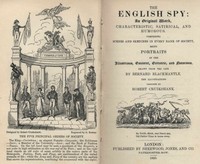
Is intended to convey a general idea of the nature of the work; combining, in rich classic taste, a variety of subjects illustrative of the polished as well as the more humble scenes of real life. It represents a Gothic Temple, into which the artist, Mr. Robert Cruikshank, has introduced a greater variety of characteristic subject than was ever before compressed into one design. In the centre compartment, at the top, we have a view of a Terrestrial Heaven, where Music, Love, and gay Delight are all united to lend additional grace to Fashion, and increase the splendour of the revels of Terpsichore. In the niches, on each side, are the twin genii, Poetry and Painting; while the pedestals, right and left, present the protectors of their country, the old Soldier and Sailor, retired upon pensions, enjoying and regaling themselves on the bounty of their King. In the centre of the Plate are three divisions representing the King, Lords, and Commons in the full exercise of their prerogatives. The figures on each side are portraits of Bernard Blackmantle (the English Spy), and his friend, Robert Transit (the artist), standing on projecting pedestals, and playing with the world as a ball; not doubting but for this piece of vanity, the world, or the reviewers for them, will knock them about in return. On the front of the pedestals are the arms of the Universities of Oxford and Cambridge; and in the centre armorial shields of the Cities of London and Westminster. The picture of a modern Hell, in the centre, between the pedestals, has the very appropriate emblems of Misery and Death, in the niches on each side. Crowning the whole, the Genius of Wit is seen astride of an eagle, demonstrative of strength, and wielding in his hand the lash of Satire; an instrument which, in the present work, has been used more as a corrective of we than personal ill-nature.
II.
THE FIVE PRINCIPAL ORDERS OF SOCIETY. The King-Corinthian; an elegant Female-Composite; the Nobleman-Doric; a Member of the University-Ionic; and the Buck of Fashion-Tuscan. On the left hand may be seen a specimen of the Exquisite, a new order in high estimation at the west end of the Town; and on the right hand stands an old order of some solidity in the eastern parts of the Metropolis. Fashion, Taste, and Fame, are emblematical of the varied pursuits of life; while the Army and Navy of the country are the capitals that crown the superstructure, combining the ornamental with the useful.
III.
FIRST ABSENCE, OR THE SONS OF OLD ETONA ANSWERING MORNING MUSTER-ROLL. 25 A view of the school-yard, Eton, at the time first Absence is called, and just when the learned Doctor Keat is reviewing the upper school. (Portraits.)
IV.
THE OPPIDAN'S MUSEUM, OR ETON COURT OF CLAIMS AT THE CHRISTOPHER. 49 Bernard Blackmantle and Robert Transit sitting in judge- ment after Election Saturday, apportioning the remuneration money to the different claimants of the surrounding trophies.
V.
ETON MONTEM, AND THE MOUNT, SALT HILL. 96 An accurate sketch of this ancient customary procession made upon the spot.
VI.
THE FIRST BOW TO ALMA MATER. 113 Bernard Blackmantle's Introduction to the Big Wig on his Arrival at Oxford.
VII.
FLOORING OF MERCURY, OR BURNING THE OAKS. 131 A scene in Tom Quadrangle, Oxford.
"If wits aright their tale of terror tell, A little after great Mercurius fell,
The book keeps going
Keep reading, and see it illustrated
Reading is free forever. Sign up and watch scenes appear while you read.
Scenes Storieta drew for other classics.