Public-domain ebook
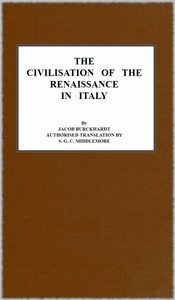
The Civilisation of the Renaissance in Italy
Language: en5,745 downloads on Project Gutenberg
Subjects
In: History - European·History - Early Modern (c. 1450-1750)
Public-domain ebook sourced from Project Gutenberg #2074.
Public-domain ebook
Language: en5,745 downloads on Project Gutenberg
Subjects
In: History - European·History - Early Modern (c. 1450-1750)
Public-domain ebook sourced from Project Gutenberg #2074.
Jacob Burckhardt’s The Civilisation of the Renaissance in Italy is a scholarly survey that treats the Italian Renaissance as a comprehensive cultural phenomenon. The opening pages explain that the English translation, based on the third German edition and enriched with notes by Dr. Ludwig Geiger, aims to make the work accessible to readers who cannot read the original language. The book is organized into six major parts, each divided into detailed chapters that examine political structures, the development of the individual, the revival of antiquity, discoveries in science and travel, social customs, and the moral and religious climate of the period. The contents list reveals a meticulous, encyclopedic approach, ranging from analyses of tyrannies and republics to discussions of art, literature, and the evolving role of the papacy, all framed as an “essay” that invites further investigation.
The prose reflects the nineteenth‑century German historicist tradition, with a formal, reflective tone that balances narrative description and analytical commentary. Burckhardt’s voice is erudite yet conversational, often addressing the reader directly about the challenges of interpreting a civilization that still shapes modern thought. Readers who enjoy dense, interdisciplinary studies, particularly those interested in political history, cultural theory, or the intellectual roots of modern Europe, will find this work rewarding. Its exhaustive scope and scholarly apparatus make it especially suitable for students, academics, and informed general readers seeking a deep, source‑rich exploration of Italy’s Renaissance era.
The opening · free to read
PREFACE.
Dr. BURCKHARDT’S work on the Renaissance in Italy is too well known, not only to students of the period, but now to a wider circle of readers, for any introduction to be necessary. The increased interest which has of late years, in England, been taken in this and kindred subjects, and the welcome which has been given to the works of other writers upon them, encourage me to hope that in publishing this translation I am meeting a want felt by some who are either unable to read German at all, or to whom an English version will save a good deal of time and trouble.
The translation is made from the third edition of the original, recently published in Germany, with slight additions to the text, and large additions to the notes, by Dr. LUDWIG GEIGER, of Berlin. It also contains some fresh matter communicated by Dr. BURCKHARDT to Professor DIEGO VALBUSA of Mantua, the Italian translator of the book. To all three gentlemen my thanks are due for courtesy shown, or help given to me in the course of my work.
In a few cases, where Dr. GEIGER’S view differs from that taken by Dr. BURCKHARDT, I have called attention to the fact by bracketing Dr. GEIGER’S opinion and adding his initials.
THE TRANSLATOR.
CONTENTS.
The book keeps going
Reading is free forever. Sign up and watch scenes appear while you read.



Scenes Storieta drew for other classics.
New illustrated classics
Once or twice a month: the latest books to get full character casts, scene art, and free comic editions. No account needed.