Public-domain ebook
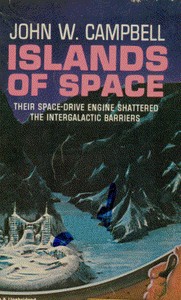
Islands of Space
English3,719 downloads on Project GutenbergDownload EPUB
Public-domain ebook sourced from Project Gutenberg #20988.
Public-domain ebook
English3,719 downloads on Project GutenbergDownload EPUB
Public-domain ebook sourced from Project Gutenberg #20988.
Islands of Space is a hard‑science adventure that launches its readers aboard an Earth‑built faster‑than‑light vessel racing through an “island universe” of distant stars. The opening scene places Dr. Richard Arcot, his mathematician assistant Robert Morey, and engineer John Fuller at the helm of a ship that can cover twenty‑nine light‑years in ten seconds, a feat achieved by cranking the drive to full power and feeling the crackle of raw energy in the control room. Their triumph is immediately interrupted by the appearance of two alien ships that shadow them, prompting Morey’s bewildered question about their origin. The narrative then shifts to a prologue that situates the story in the early twenty‑second century, introducing the “molecular motion drive” and the eclectic team’s quest to capture an Air Pirate, while also hinting at broader interplanetary politics involving Venusians, a dead black star, and the looming threat of the Nigran civilization.
The novel bears the unmistakable voice of John W. Campbell, whose 1930s‑era scientific background informs a prose style that blends meticulous technical exposition with brisk, dialogue‑driven banter. Readers who enjoy classic Golden Age SF, where speculative engineering, spirited debates among scientists, and the occasional wry sarcasm drive the plot, will find this work rewarding. Its blend of speculative physics, interstellar intrigue, and a touch of humor makes it a good match for fans of early space‑opera and for those who appreciate stories that treat the mechanics of faster‑than‑light travel as central to the adventure.
The opening · free to read
Produced by Bruce Thomas, Greg Weeks and the Online Distributed Proofreading Team at http://www.pgdp.net
As Earth's faster-than-light spaceship hung in the void between galaxies, Arcot, Wade, Morey and Fuller could see below them, like a vast shining horizon, the mass of stars that formed their own island universe. Morey worked a moment with his slide rule, then said, "We made good time! Twenty-nine light years in ten seconds! Yet you had it on at only half power...."
Arcot pushed the control lever all the way to full power. The ship filled with the strain of flowing energy, and sparks snapped in the air of the control room as they raced at an inconceivable speed through the darkness of intergalactic space.
But suddenly, far off to their left and far to their right, they saw two shining ships paralleling their course! They held grimly to the course of the Earth ship, bracketing it like an official guard.
The Earth scientists stared at them in wonder. "Lord," muttered Morey, "where can they have come from?"
John W. Campbell first started writing in 1930 when his first short story, When the Atoms Failed, was accepted by a science-fiction magazine. At that time he was twenty years old and still a student at college. As the title of the story indicates, he was even at that time occupied with the significance of atomic energy and nuclear physics.
For the next seven years, Campbell, bolstered by a scientific background that ran from childhood experiments, to study at Duke University and the Massachusetts Institute of Technology, wrote and sold science-fiction, achieving for himself an enviable reputation in the field.
In 1937 he became the editor of Astounding Stories magazine and applied himself at once to the task of bettering the magazine and the field of s-f writing in general. His influence on science-fiction since then has been great. Today he still remains as the editor of that magazine's evolved and redesigned successor, Analog.
The book keeps going
Reading is free forever. Sign up and watch scenes appear while you read.



Scenes Storieta drew for other classics.
New illustrated classics
Once or twice a month: the latest books to get full character casts, scene art, and free comic editions. No account needed.