Public-domain ebook
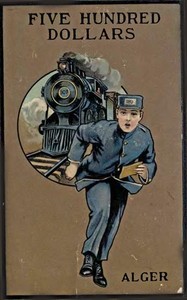
Five Hundred Dollars; or, Jacob Marlowe's Secret
Language: en4,001 downloads on Project Gutenberg
Subjects
In: Novels·American Literature
Public-domain ebook sourced from Project Gutenberg #21270.
Public-domain ebook
Language: en4,001 downloads on Project Gutenberg
Subjects
In: Novels·American Literature
Public-domain ebook sourced from Project Gutenberg #21270.
The novel opens with a weary traveler, Jacob Marlowe, returning to his hometown of Lakeville after twenty‑five years away. His first encounter is with a sturdy fifteen‑year‑old boy, Bert Barton, whose modest attire and polite greeting set a tone of ordinary small‑town life. Through their conversation we learn that the town’s chief industry is a shoe factory owned by the affluent Squire Albert Marlowe, who is also Jacob’s nephew. The dialogue quickly reveals a web of family connections, Jacob is the uncle of Albert’s son Percy, and the cousin of Bert’s mother, while hinting at the financial disparity between the prosperous Marlowe household and the Bartons’ modest existence. The scene moves from a brief, courteous exchange to a minor mishap with a buggy, establishing both the social dynamics and the underlying curiosity about Jacob’s long‑absent wealth.
The narrative is rendered in a colloquial, late‑nineteenth‑century American voice, mixing regional dialect with a straightforward, dialogue‑driven style. Its focus on family ties, modest ambition, and the contrast between appearance and fortune will appeal to readers who enjoy domestic dramas set against a rural‑industrial backdrop, as well as those interested in the social mores of post‑Civil‑War America. The humor that arises from misunderstandings and the subtle critique of pretensions make it a satisfying read for anyone who likes character‑centered stories that explore honesty, conduct, and the quirks of small‑town life.
The opening · free to read
Here a boy appeared on the scene, a boy of fifteen, with a sturdy figure and a pleasant face, whose coarse suit indicated narrow means, if not poverty. Seeing the old man, with instinctive politeness he doffed his hat and with a pleasant smile bade him good-morning.
"Good-morning," returned the traveller, won by the boy's pleasant face and manner. "If you are not in a hurry won't you sit down by me and answer a few questions?"
"With pleasure, sir; my business isn't driving."
"This is Lakeville, isn't it?"
"Yes, sir."
"I used to know the place--a good many years since. It hasn't grown much."
"No, sir; it's rather quiet."
"Chiefly a farming region, isn't it?"
"Yes, sir; but there is a large shoe manufactory here, employing a hundred hands."
"Who is the owner?"
"Squire Marlowe."
"Ha!" ejaculated the old man, evidently interested. "Albert Marlowe, isn't it?"
"Yes, sir; do you know him?"
"I haven't met him for twenty years, but we are acquainted. I suppose he is prosperous."
"He is considered a rich man, sir. He is a relation of mine."
"Indeed! What then is your name?" asked the old man, eagerly.
"Herbert Barton--most people call me Bert Barton."
Bert was surprised at the keen scrutiny which he received from the traveller.
"Was your mother Mary Marlowe?" the latter asked.
"Yes, sir," returned Bert. "Did you know her, too?"
"I ought to; she is my niece, as the man you call Squire Marlowe is my nephew."
"Then you must be Uncle Jacob, who has lived so many years in California?" said Bert, excitedly.
"The same."
"Mother will be very glad to see you," added Bert, cordially.
"Thank you, my boy. Your kind welcome does me good. I hope your mother is well and happy."
"She is a widow," answered Bert soberly.
"When did your father die?"
"Two years ago."
"I hope he left your mother in comfortable circumstances."
Bert shook his head.
"He only left the small house we live in, and that is mortgaged for half its value."
"Then how do you live?"
"Mother covers base-balls for a firm in the next town, and I am working in the big shoe shop."
"Doesn't Squire Marlowe do anything for your mother?"
"He gave me a place in the shop--that is all."
"Yet he is rich," said the old man, thoughtfully.
"Yes, he lives in a fine house. You can see it down the street on the other side that large one with a broad piazza. He keeps two horses and two handsome carriages, and I am sure he must have plenty of money."
"I am glad to hear it. I have been a long time among strangers. It will be pleasant to come to anchor at the house of a rich relation. Where does your mother live?"
"In a small cottage at the other end of the street. Won't you come home with me, Uncle Jacob? Mother will be glad to see you."
"I must call at Albert Marlowe's first. What family has he?"
The book keeps going
Reading is free forever. Sign up and watch scenes appear while you read.



Scenes Storieta drew for other classics.
New illustrated classics
Once or twice a month: the latest books to get full character casts, scene art, and free comic editions. No account needed.