
Public-domain ebook
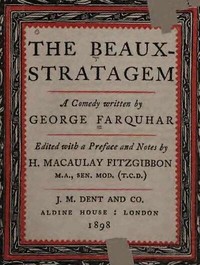
The Beaux-Stratagem
Language: en1,024 downloads on Project Gutenberg
Subjects
In: Humour·Plays/Films/Dramas·British Literature
Public-domain ebook sourced from Project Gutenberg #21334.
Public-domain ebook
Language: en1,024 downloads on Project Gutenberg
Subjects
In: Humour·Plays/Films/Dramas·British Literature
Public-domain ebook sourced from Project Gutenberg #21334.
The Beaux‑Stratagem is a Restoration comedy by George Farquhar, first staged in March 1707 at the Queen’s Theatre. The opening passage frames the work as the product of a desperate yet prolific playwright, pressed by debt and encouraged by his friend the actor Robert Wilks to “write” a new play in six weeks. Farquhar’s own biography, Irish birth, brief army service, poverty, and a sudden burst of theatrical success, provides the backdrop for a plot that unfolds briskly from evening to midnight, promising a rapid succession of “amusing and sensational incidents.” The drama’s central device is the clever ruse of Aimwell, who pretends to be a wealthy nobleman, a stratagem that drives the action forward without lapsing into extravagance. The play’s reputation rests on its vivacity, tight construction, and natural dialogue, qualities highlighted by contemporary critics who praised its “sprightly lively” quality and its lasting popularity on the stage.
Written in the lively, conversational style of the early‑18th‑century stage, the play balances wit with a straightforward moral tone. Its characters, rambunctious footmen, a boozy squire, and a quick‑witted heroine, are drawn with a realism that avoids the harsher cynicism of some of Farquhar’s peers. Readers who enjoy fast‑moving, dialogue‑driven comedies with clever disguises and a touch of sentimental warmth will find this work rewarding. It especially appeals to those interested in Restoration theatre, the evolution of English comedy, or the lineage that leads to later playwrights such as Goldsmith. The play’s energetic pacing and natural speech make it an engaging glimpse into the theatrical culture of Farquhar’s time.
The opening · free to read
The Author. 'It is surprising,' says Mr. Percy Fitzgerald, 'how much English Comedy owes to Irishmen.' Nearly fifty years ago Calcraft enumerated eighty-seven Irish dramatists in a by no means exhaustive list, including Congreve, Southerne, Steele, Kelly, Macklin, and Farquhar--the really Irish representative amongst the dramatists of the Restoration, the true prototype of Goldsmith and Sheridan. Thoroughly Irish by birth and education, Captain George Farquhar (1677-1707) had delighted the town with a succession of bright, rattling comedies--Love and a Bottle (1698), The Constant Couple (1699), Sir Harry Wildair (1701), The Inconstant (1702), The Twin Rivals (1702), The Recruiting Officer (1706). In an unlucky moment, when hard pressed by his debts, he sold out of the army on the strength of a promise by the Duke of Ormond to gain him some preferment, which never came. In his misery and poverty, with a wife and two helpless girls to support, Farquhar was not forsaken by his one true friend, Robert Wilks. Seeking out the dramatist in his wretched garret in St Martin's Lane, the actor advised him no longer to trust to great men's promises, but to look only to his pen for support, and urged him to write another play. 'Write!' said Farquhar, starting from his chair; 'is it possible that a man can write with common-sense who is heartless and has not a shilling in his pockets?' 'Come, come, George,' said Wilks, 'banish melancholy, draw up your drama, and bring your sketch with you to-morrow, for I expect you to dine with me. But as an empty purse may cramp your genius, I desire you to accept my mite; here is twenty guineas.' Farquhar set to work, and brought the plot of his play to Wilks the next day; the later approved the design, and urged him to proceed without delay. Mostly written in bed, the whole was begun, finished, and acted within six weeks. The author designed to dedicate it to Lord Cadogan, but his lordship, for reasons unknown, declined the honour; he gave the dramatist a handsome present, however. Thus was The Beaux-Stratagem written. Farquhar is said to have felt the approaches of death ere he finished the second act. On the night of the first performance Wilks came to tell him of his great success, but mentioned that Mrs. Oldfield wished that he could have thought of some more legitimate divorce in order to secure the honour of Mrs. Sullen. 'Oh,' said Farquhar, 'I will, if she pleases, solve that immediately, by getting a real divorce; marrying her myself, and giving her my bond that she shall be a widow in less than a fortnight' Subsequent events practically fulfilled this prediction, for Farquhar died during the run of the play: on the day of his extra benefit, Tuesday, 29th April 1707, the plaudits of the audience resounding in his ears, the destitute, broken-hearted dramatist passed to that bourne where stratagems avail not any longer.
Criticism of The Beaux-Stratagem. Each play that Farquhar produced was an improvement on its predecessors, and all critics have been unanimous in pronouncing The Beaux-Stratagem his best, both in the study and on the stage, of which it retained possession much the longest. Except The Recruiting Officer and The Inconstant, revived at Covent Garden in 1825, and also by Daly in America in 1885, non of Farquhar's other plays has been put on the stage for upwards of a century. Hallam says: 'Never has Congreve equalled The Beaux-Stratagem in vivacity, in originality of contrivance, or in clear and rapid development of intrigue'; and Hazlitt considers it 'sprightly lively, bustling, and full of point and interest: the assumed disguise of Archer and Aimwell is a perpetual amusement to the mind.' The action--which commences, remarkably briskly, in the evening and ends about midnight the next day--never flags for an instant. The well-contrived plot is original and simple (all Farquhar's plots are excellent), giving rise to a rapid succession of amusing and sensational incidents; though by no means extravagant or improbable, save possibly the mutual separation of Squire Sullen and his wife in the last scene--the weak point of the whole. Farquhar was a master in stage-effect. Aimwell's stratagem of passing himself off as the wealthy nobleman, his brother (a device previously adopted by Vanbrugh in The Relapse and subsequently by Sheridan in his Trip to Scarborough), may perhaps be a covert allusion to the romantic story of the dramatist's own deception by the penniless lady who gave herself out to be possessed of a large fortune, and who thus induced him to marry her.
The style adopted is highly dramatic, the dialogue being natural and flowing; trenchant and sprightly, but not too witty for a truthful reflex of actual conversation. The humour is genial and unforced; there is no smell of the lamp about it, no premeditated effort at dragging in jests, as in Congreve. As typical examples of Farquhar's vis comica I Would cite the description of Squire Sullen's home-coming, and his 'pot of ale' speech, Aimwell's speech respecting conduct at church, the scene between Cherry and Archer about the L2000, and the final separation scene--which affords a curious view of the marriage tie and on which Leigh Hunt has founded an argument for divorce. This play contains several examples of Farquhar's curious habit of breaking out into a kind of broken blank verse occasionally for a few lines in the more serious passages. Partaking as it does of the elements of both comedy and force, it is the prototype of Goldsmith's She Stoops to Conquer, which it resembles in many respects. It will be remembered that Miss Hardcastle compares herself to Cherry (Act III.), and young Marlow and Hastings much resemble Archer and Aimwell. Goldsmith was a great admirer of the works of his fellow-countryman, especially The Beaux-Stratagem, and refers to them several times (Citizen of the World, letter 93; History of England, letter 16; Vicar of Wakefield, ch. 18), and in the Literary Magazine for 1758 he drew up a curious poetical scale in which he classes the Restoration dramatists thus:-- Congreve--Genius 15, Judgment 16, Learning 14, Versification 14; Vanbrugh--14, 15,14,10; Farquhar--15, 15, 10, io. Unlike Goldsmith, unhappily, Farquhar's moral tone is not high; sensuality is confounded with love, ribaldry mistaken for wit The best that can be said of him that he contrasts favourably with his contemporary dramatists; Virtue is not always uninteresting in his pages. He is free from their heartlessness, malignity, and cruelty. The plot of The Beaux-Stratagem is comparatively inoffensive, and the moral of the whole is healthy. Although a wit rather than a thinker, Farquhar in this play shows himself capable of serious feelings. It is remarkable how much Farquhar repeats himself. Hardly an allusion or idea occurs in this play that is not to be found elsewhere in his works. In the Notes I have pointed out many of these coincidences.
The Characters. This play has added several distinct original personages to our stock of comedy characters, and it affords an excellent and lifelike picture of a peculiar and perishing phase of the manners of the time, especially those obtaining in the country house, and the village inn frequented by highwaymen. The sly, rascally landlord, Boniface (who has given his name to the class), is said to have been drawn from life, and his portrait, we are told, was still to be seen at Lichfield in 1775. The inimitable 'brother Scrub,' that 'indispensable appendage to a country gentleman's kitchen' (Hazlitt), with his ignorance and shrewd eye to the main chance, is likewise said to have been a well-known personage who survived till 1759, one Thomas Bond, servant to Sir Theophilus Biddulph; others say he died at Salisbury in 1744. Although Farquhar, like Goldsmith, undoubtedly drew his incidents and personages from his own daily associations, there is probably no more truth in these surmises than in the assertion (repeatedly made, though denied in his preface to The Inconstant) that Farquhar depicts himself in his young heroes, his rollicking 'men about town,' Roebuck, Mirabel, Wildair, Plume, Archer. Archer (copied by Hoadley in his character of Ranger in The Suspicious Husband) is a decided improvement on his predecessors, and is the best of all Farquhar's creations; he is assuredly the most brilliant footman that ever was, eminently sociable and, with all his easy, rattling volubility, never forgetful of his self-respect and never indifferent to the wishes or welfare of others. As Hunt has pointed out, the characters of Archer and Aimwell improve as the play progresses; they set out as mere intriguers, but prove in the end true gentlemen. They are sad rogues, no doubt, but they have no bitter cynicism, no meanness; Aimwell refuses to marry Dorinda under any deception. They thoroughly good fellows at bottom, manly, accomplished his spirited, eloquent, generous--the forerunners of Charles Surfor. Marriage retrieves them and turns them into respectable and adoring husbands. Though rattle-brained, much given to gallantry, and somewhat lax in morality, they are not knaves or monsters; they do not inspire disgust. Even the lumpish blockhead, Squire Sullen--according to Macaulay a type of the main strength of the Tory party for half a century after the Revolution--contrasts favourably with his prototype Sir John Brute in Vanbrugh's Provoked Wife, He is a sodden sot, who always goes to bed drunk, but he is not a demon; he does not beat his wife in public; he observes common decency somewhat. His wife is a witty, attractive, warm-hearted woman, whose faults are transparent; the chief one being that she has made the fatal mistake of marrying for fortune and position instead of for love. There is something pathetic in her position which claims our sympathy. She is well contrasted with her sister-in-law, the sincere, though somewhat weakly drawn, Dorinda; whilst their mother-in-law, Lady Bountiful, famed for her charity, is an amusing and gracious figure, which has often been copied. Cherry, with her honest heart and her quickness of perception, is also a distinct creation. Strange to say, the only badly drawn character is Foigard, the unscrupulous Irish Jesuit priest. Farquhar is fond of introducing an Irishman into each of his plays, but I cannot say that I think he is generally successful; certainly not in this instance. They are mostly broad caricatures, and speak an outlandish jargon, more like Welsh than Irish, supposed to be the Ulster dialect: anything more unlike it would be difficult to conceive. The early conventional stage Irishman, tracing him from Captain. Macmorris in Henry V.,through Ben Jonson's Irish Masque and New Inn, Dekker's Bryan, Ford's Mayor of Cork, Shadwell's O'Divelly (probably Farquhar's model for Foigard), is truly a wondrous savage, chiefly distinguished by his use of the expletives 'Dear Joy!' and 'By Creesh!' This character naturally rendered the play somewhat unpopular in Ireland, and its repulsiveness is unrelieved (as it is in the case of Teague in The Twin Rivals) by a single touch of humour or native comicality. It is an outrage.
The book keeps going
Reading is free forever. Sign up and watch scenes appear while you read.



Scenes Storieta drew for other classics.
New illustrated classics
Once or twice a month: the latest books to get full character casts, scene art, and free comic editions. No account needed.
![Cover of William Wycherley [Four Plays]](/covers/55426.jpg)