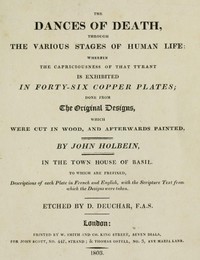
"_Les Simulachres & Historiees Faces de la Mort avtant elegamtment pourtraictes, que artificiellement imaginees._" This may be Englished as follows: The Images and Storied Aspects of Death, as elegantly delineated as [they are] ingeniously imagined. Such is the literal title of the earliest edition of the famous book now familiarly known as "_Holbein's Dance of Death._" It is a small quarto, bearing on its title-page, below the French words above quoted, a nondescript emblem with the legend Vsus me Genuit, and on an open book, Gnothe seauton. Below this comes again, "_A Lyon, Soubz l'escu de Coloigne_: M. D. XXXVIII," while at the end of the volume is the imprint "_Excvdebant Lvgdvni Melchoir et Gaspar Trechsel fratres: 1538_,"--the Trechsels being printers of German origin, who had long been established at Lyons. There is a verbose "Epistre" or Preface in French to the "_moult reuerende Abbesse du religieux conuent S. Pierre de Lyon, Madame Iehanne de Touszele_," otherwise the Abbess of Saint Pierre les Nonnains, a religious house containing many noble and wealthy ladies, and the words, "_Salut d'un vray Zele_," which conclude the dedicatory heading, are supposed to reveal indirectly the author of the "Epistre" itself, namely, Jean de Vauzelles, Pastor of St. Romain and Prior of Monrottier, one of three famous literary brothers in the city on the Rhone, whose motto was "_D'un vray Zelle_." After the Preface comes "_Diuerses Tables de Mort, non painctes, mais extraictes de l'escripture saincte, colorees par Docteurs Ecclesiastiques, & umbragees par Philosophes_." Then follow the cuts, forty-one in number, each having its text from the Latin Bible above it, and below, its quatrain in French, this latter being understood to be from the pen of one Gilles Corozet. To the cuts succeed various makeweight Appendices of a didactic and hortatory character, the whole being wound up by a profitable discourse, De la Necessite de la Mort qui ne laisse riens estre pardurable. Various editions ensued to this first one of 1538, the next or second of 1542 (in which Corozet's verses were translated into Latin by Luther's brother-in-law, George Oemmel or Aemilius), being put forth by Jean and Francois Frellon, into whose hands the establishment of the Trechsels had fallen. There were subsequent issues in 1545, 1547, 1549, 1554, and 1562. To the issues of 1545 and 1562 a few supplementary designs were added, some of which have no special bearing upon the general theme, although attempts, more or less ingenious, have been made to connect them with the text. After 1562 no addition was made to the plates.
=The Artist=
From the date of the editio princeps it might be supposed that the designs were executed at or about 1538--the year of its publication. But this is not the case; and there is good evidence that they were not only designed but actually cut on the wood some eleven years before the book itself was published. There are, in fact, several sets of impressions in the British Museum, the Berlin Museum, the Basle Museum, the Imperial Library at Paris, and the Grand Ducal Cabinet at Carlsruhe, all of which correspond with each other, and are believed to be engraver's proofs from the original blocks. These, which include every cut in the edition of 1538, except "The Astrologer," would prove little of themselves as to the date of execution. But, luckily, there exists in the Cabinet at Berlin a set of coarse enlarged drawings in Indian ink, on brownish paper, of twenty-three of the series. These are in circular form; and were apparently intended as sketches for glass painting. That they are copied from the woodcuts is demonstrable, first, because they are not reversed as they would have been if they were the originals; and, secondly, because one of them, No. 36 ("The Duchess"), repeats the conjoined "H.L." on the bed, which initials are held to be the monogram of the woodcutter, and not to be part of the original design. The Berlin drawings must therefore have been executed subsequently to the woodcuts; and as one of them, that representing the Emperor, is dated "1527," we get a date before which both the woodcuts, and the designs for the woodcuts, must have been prepared. It is generally held that they were so prepared circa 1524 and 1525, the date of the Peasants' War, of the state of feeling excited by which they exhibit evident traces. In the Preface to this first edition, certain ambiguous expressions, to which we shall presently refer, led some of the earlier writers on the subject to doubt as to the designer of the series. But the later researches of Wornum and Woltmann, of M. Paul Mantz and, more recently, of Mr. W. J. Linton leave no doubt that they were really drawn by the artist to whom they have always been traditionally assigned, to wit, Hans Holbein the younger. He was resident in Basle up to the autumn of 1526, before which time, according to the above argument, the drawings must have been produced; he had already designed an Alphabet of Death; and, moreover, on the walls of the cemetery of the Dominican monastery at Basle there was a famous wall-painting of the Dance of Death, which would be a perpetual stimulus to any resident artist. Finally, and this is perhaps the most important consideration of all, the designs are in Holbein's manner.
=The Woodcutter=
But besides revealing an inventor of the highest order, the Dance of Death also discloses an interpreter in wood of signal, and even superlative, ability. The designs are cut--to use the word which implies the employment of the knife as opposed to that of the graver--in a manner which has never yet been excelled. In this matter there could be no better judge than Mr. W. J. Linton; and he says that nothing, either by knife or by graver, is of higher quality than these woodcuts. Yet the woodcutter's very name was for a long time doubtful, and even now the particulars which we possess with regard to him are scanty and inconclusive. That he was dead when the Trechsels published the book in 1538, must be inferred from the "Epistre" of Jean de Vauzelles, since that "Epistre" expressly refers to "_la mort de celluy, qui nous en a icy imagine si elegantes figures_"; and without entering into elaborate enquiry as to the exact meaning of "_imaginer_" in sixteenth-century French, it is obvious that, although the deceased is elsewhere loosely called "_painctre_," this title cannot refer to Holbein, who was so far from being dead that he survived until 1543. The only indication of the woodcutter's name is supplied by the monogram, "HL" upon the bedstead in No. 36 ("The Duchess"); and these initials have been supposed to indicate one Hans Lutzelburger, or Hans of Luxemburg, "otherwise Franck," a form-cutter ("formschneider"), whose full name is to be found attached to the so-called "Little Dance of Death," an alphabet by Holbein, impressions of which are in the British Museum. His signature ("H. L. F. 1522") is also found appended to another alphabet; to a cut of a fight in a forest, dated also 1522; and to an engraved title-page in a German New Testament of the year following. This is all we know with certainty concerning his work, though the investigations of Dr. Edouard His have established the fact that a "formschneider" named Hans, who had business transactions with the Trechsels of Lyons, had died at Basle before June, 1526; and it is conjectured, though absolute proof is not forthcoming, that this must have been the "H. L.," or Hans of Luxemburg, who cut Holbein's designs upon the wood. In any case, unless we must assume another woodcutter of equal merit, it is probable that the same man cut the signed Alphabet in the British Museum and the initialed Dance of Death. But why the cuts of the latter, which, as we have shown above, were printed circa 1526, were not published at Lyons until 1538; and why Holbein's name was withheld in the Preface to the book of that year, are still unexplained. The generally accepted supposition is that motives of timidity, arising from the satirical and fearlessly unsparing character of the designs, may be answerable both for delay in the publication and mystification in the "Preface." And if intentional mystification be admitted, the doors of enquiry, after three hundred and fifty years, are practically sealed to the critical picklock.
=The Present Issue=
The copies given in the present issue are impressions from the blocks engraved in 1833 for Douce's Holbein's Dance of Death. They are the best imitations in wood, says Mr. Linton. It is of course true, as he also points out, that a copy with the graver can never quite faithfully follow an original which has been cut with the knife,--more especially, it may be added, when the cutter is a supreme craftsman like him of Luxemburg. But against etched, lithographed, phototyped and otherwise-processed copies, these of Messrs. Bonner and John Byfield have one incontestable advantage: they are honest attempts to repeat by the same method,--that is, in wood,--the original and incomparable woodcuts of Hans Lutzelburger.
He is the despots' Despot. All must bide, Later or soon, the message of his might; Princes and potentates their heads must hide, Touched by the awful sigil of his right; Beside the Kaiser he at eve doth wait And pours a potion in his cup of state; The stately Queen his bidding must obey; No keen-eyed Cardinal shall him affray; And to the Dame that wantoneth he saith-- "Let be, Sweet-heart, to junket and to play." There is no king more terrible than Death.
The lusty Lord, rejoicing in his pride, He draweth down; before the armed Knight With jingling bridle-rein he still doth ride; He crosseth the strong Captain in the fight; The Burgher grave he beckons from debate; He hales the Abbot by his shaven pate, Nor for the Abbess' wailing will delay; No bawling Mendicant shall say him nay; E'en to the pyx the Priest he followeth, Nor can the Leech his chilling finger stay ... There is no king more terrible than Death.
All things must bow to him. And woe betide The Wine-bibber,--the Roisterer by night; Him the feast-master, many bouts defied, Him 'twixt the pledging and the cup shall smite; Woe to the Lender at usurious rate, The hard Rich Man, the hireling Advocate; Woe to the Judge that selleth right for pay; Woe to the Thief that like a beast of prey With creeping tread the traveller harryeth:-- These, in their sin, the sudden sword shall slay ... There is no king more terrible than Death.
He hath no pity,--nor will be denied. When the low hearth is garnished and bright, Grimly he flingeth the dim portal wide, And steals the Infant in the Mother's sight; He hath no pity for the scorned of fate:-- He spares not Lazarus lying at the gate, Nay, nor the Blind that stumbleth as he may; Nay, the tired Ploughman,--at the sinking ray,-- In the last furrow,--feels an icy breath, And knows a hand hath turned the team astray ... There is no king more terrible than Death.
He hath no pity. For the new-made Bride, Blithe with the promise of her life's delight, That wanders gladly by her Husband's side, He with the clatter of his drum doth fright; He scares the Virgin at the convent grate;