Public-domain ebook
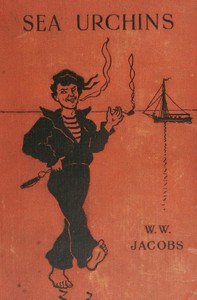
Sea urchins
by W. W. Jacobs
Language: en4,800 downloads on Project Gutenberg
Subjects
In: Short Stories·Humour·Adventure
Public-domain ebook sourced from Project Gutenberg #21931.
Public-domain ebook
by W. W. Jacobs
Language: en4,800 downloads on Project Gutenberg
Subjects
In: Short Stories·Humour·Adventure
Public-domain ebook sourced from Project Gutenberg #21931.
Sea urchins is a bawdy, episodic tale of a rag‑tag crew and a mischievous youngster thrust aboard their vessel. The story opens with a coarse, dock‑side conversation about a boy named Ralph, whose appetite for penny dreadfuls and reckless imagination has earned him a reputation as a “dreadful ’andful.” The skipper, mate, and a handful of seamen, Bill Dobbs, Jem Smithers, and the cook, debate how to discipline him as the ship pulls away, while Ralph’s own bluster and the crew’s rough humor set the tone for a series of chaotic exchanges, petty fights, and absurd instructions that quickly plunge the reader into the cramped, salty world of a low‑budget sailing life.
The narrative is rendered in a thick, late‑Victorian colloquialism, peppered with dialect spellings and the rhythmic chatter of a seafaring gang. Its humor is broad, its dialogue rapid, and its setting unmistakably maritime, offering a glimpse of 19th‑century sailor culture filtered through comic exaggeration. Readers who enjoy irreverent, character‑driven sketches of life at sea, especially those who appreciate the rough charm of period slang and the occasional slapstick, will find this work an entertaining diversion.
The opening · free to read
“I’ll pirate him,” said the mate, rubbing his hands.
“He’s a dreadful ’andful, by all accounts,” continued the other; “got his ’ed stuffed full o’ these ’ere penny dreadfuls till they’ve turned his brain almost. He started by being an Indian, and goin’ off on ’is own with two other kids. When ’e wanted to turn cannibal the other two objected, and gave ’im in charge. After that he did a bit o’ burgling, and it cost ’is old man no end o’ money to hush it up.”
“Well, what did you want him for?” grumbled the mate.
“I’m goin’ to knock the nonsense out of him,” said the skipper softly, as the boat grazed the side. “Just step for’ard and let the hands know what’s expected of ’em. When we get to sea it won’t matter.”
The mate moved off grumbling, as the small fare stood on the thwarts and scrambled up over the side. The waterman passed up the chest, and dropping the coppers into his pocket, pushed off again without a word.
“Well, you’ve got here all right, Ralph?” said the skipper. “What do you think of her?”
“She’s a rakish-looking craft,” said the boy, looking round the dingy old tub with much satisfaction; “but where’s your arms?”
“Hush!” said the skipper, and laid his finger on his nose.
“Oh, all right,” said the youth testily, “but you might tell me.”
“You shall know all in good time,” said the skipper patiently, turning to the crew, who came shuffling up, masking broad grins with dirty palms.
“Here’s a new shipmate for you, my lads. He’s small, but he’s the right stuff.”
The new-comer drew himself up, and regarded the crew with some dissatisfaction. For desperadoes they looked far too good-tempered and prone to levity.
“What’s the matter with you, Jem Smithers?” inquired the skipper, scowling at a huge fair-haired man, who was laughing discordantly.
“I was thinkin’ o’ the last party I killed, sir,” said Jem, with sudden gravity. “I allers laugh when I think ’ow he squealed.”
“You laugh too much,” said the other sternly, as he laid a hand on Ralph’s shoulder. “Take a lesson from this fine feller; he don’t laugh. He acts. Take ’im down below an’ show him ’is bunk.”
“Will you please to follow me, sir?” said Smithers, leading the way below. “I dessay you’ll find it a bit stuffy, but that’s owing to Bill Dobbs. A regler old sea-dog is Bill, always sleeps in ’is clothes and never washes.”
“I don’t think the worse of him for that,” said Ralph, regarding the fermenting Dobbs kindly.
“You’d best keep a civil tongue in your ’ed, my lad,” said Dobbs shortly.
“Never mind ’im,” said Smithers cheerfully; “nobody takes any notice o’ old Dobbs. You can ’it ’im if you like. I won’t let him hurt you.”
“I don’t want to start by quarrelling,” said Ralph seriously.
“You’re afraid,” said Jem tauntingly; “you’ll never make one of us. ’It ’im; I won’t let him hurt you.”
Thus aroused, the boy, first directing Dobbs’ attention to his stomach by a curious duck of the head, much admired as a feint in his neighbourhood, struck him in the face. The next moment the forecastle was in an uproar and Ralph prostrate on Dobbs’ knees, frantically reminding Jem of his promise.
“All right, I won’t let him ’urt you,” said Jem consolingly.
“But he is hurting me,” yelled the boy. “He’s hurting me now.”
“Well, wait till I get ’im ashore,” said Jem, “his old woman won’t know him when I’ve done with him.”
The boy’s reply to this was a torrent of shrill abuse, principally directed to Jem’s facial shortcomings.
“Now don’t get rude,” said the seaman, grinning.
“Squint-eyes,” cried Ralph fiercely.
“When you’ve done with that ’ere young gentleman, Dobbs,” said Jem, with exquisite politeness, “I should like to ’ave ’im for a little bit to teach ’im manners.”
“’E don’t want to go,” said Dobbs, grinning, as Ralph clung to him. “He knows who’s kind to him.”
“Wait till I get a chance at you,” sobbed Ralph, as Jem took him away from Dobbs.
“Lord lumme,” said Jem, regarding him in astonishment. “Why, he’s actooaly cryin’. I’ve seen a good many pirates in my time, Bill, but this is a new sort.”
“Leave the boy alone,” said the cook, a fat, good-natured man. “Here, come ’ere, old man. They don’t mean no ’arm.”
Glad to escape, Ralph made his way over to the cook, grinding his teeth with shame as that worthy took him between his knees and mopped his eyes with something which he called a handkerchief.
“You’ll be all right,” he said kindly. “You’ll be as good a pirate as any of us before you’ve finished.”
“Wait till the first engagement, that’s all,” sobbed the boy. “If somebody don’t get shot in the back it won’t be my fault.”
The two seamen looked at each other. “That’s wot hurt my ’and then,” said Dobbs slowly. “I thought it was a jack-knife.”
He reached over, and unceremoniously grabbing the boy by the collar, pulled him towards him, and drew a small cheap revolver from his pocket. “Look at that, Jem.”
“Take your fingers orf the blessed trigger and then I will,” said the other, somewhat sourly.
“I’ll pitch it overboard,” said Dobbs.
The book keeps going
Reading is free forever. Sign up and watch scenes appear while you read.



Scenes Storieta drew for other classics.
New illustrated classics
Once or twice a month: the latest books to get full character casts, scene art, and free comic editions. No account needed.