Public-domain ebook
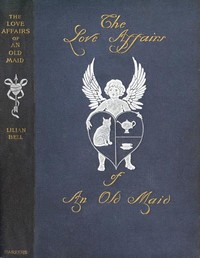
The Love Affairs of an Old Maid
by Lilian Bell
Language: en2,093 downloads on Project Gutenberg
Subjects
Public-domain ebook sourced from Project Gutenberg #22047.
Public-domain ebook
by Lilian Bell
Language: en2,093 downloads on Project Gutenberg
Subjects
Public-domain ebook sourced from Project Gutenberg #22047.
The work is a late‑nineteenth‑century American novel that treats the social life of single women with a blend of satire and introspection. It opens with a philosophic musing on the power of names, then moves quickly into the narrator’s self‑portrait as an “old maid” on the brink of turning thirty. From that point the author launches a series of loosely linked essays, each chapter titled with a witty phrase such as “Matrimony in Harness” or “The Heart of a Coquette”, that explore the narrator’s own anxieties about aging, the expectations of marriage, and the gossip she gathers from friends and acquaintances. The opening passages already reveal a narrator who is both self‑critical and observant, using humor and a touch of melodrama to examine the precarious position of unmarried women in 1890s society.
The voice is distinctly Victorian, marked by elaborate sentences, frequent allusions to poets such as Milton and Byron, and a conversational tone that feels at once earnest and ironic. Its style mirrors the moral‑philosophical essays of the period, while the narrator’s candid diary‑like reflections give the text a personal immediacy. Readers who enjoy works that combine social commentary with character study, especially those interested in the constraints placed on women before the twentieth‑century suffrage movement, will find this novel’s blend of wit, melancholy, and cultural observation rewarding.
The opening · free to read
Names are covertly responsible for many overt acts. Carlyle, when he said, "The name is the earliest garment you wrap around the earth-visiting me. Names? Not only all common speech, but Science, Poetry itself, if thou consider it, is no other than a right naming," sounded a wonderful note in Moral Philosophy, which rings false many a time in real life, when to ring true would change the whole face of affairs.
Thus I boldly affirm, that were there a proper sounding title to cover the class of unmarried women, many a marriage which now takes place, with either moderate success or distinct failure, would remain in pleasing embryo.
Of the three evils among names for my book, therefore, I leave you to determine whether I have chosen the greatest or least. The writing of it came about in this way.
In a conversation concerning modern marriage, the unwisdom people display in choice, and the complicated affair it has come to be from a pastoral beginning, I said lightly, "I shall write a book upon this subject some fine day, and I shall call it 'The Love Affairs of an Old Maid,' because popular prejudice decrees that the love affairs of an old maid necessarily are those of other people."
No sooner had the name suggested in broad jest taken form in my mind than straightway every thought I possessed crystallized around it, and I found myself impelled by a malevolent Fate to begin it.
It became a fixed intention on a Sunday morning in church during a most excellent sermon, the text and substance of which I have forgotten. Doubtless more of real worth and benefit to mankind was pent up in that sermon than four books of my own writing could accomplish. But, with the delightful candor of John Kendrick Bangs, I explain my lapse of memory thus--
"I dote on Milton and on Robert Burns; I love old Marryat--his tales of pelf; I live on Byron; but my heart most yearns Towards those sweet things that I've penned myself."
So the book has been written. The existence of the Old Maid often has been a precarious one; she has been surrounded by danger, once narrowly escaping cremation. But my humanity towards dumb brutes saved her. I might have sacrificed a woman, but I could not kill a cat. So she lives, unconsciously owing her life to her cat.
Thus she comes to you, bearing her friends in her heart. I should scarcely dare ask you to welcome her, did I not suspect that her friends are yours. You have your Flossy and your Charlie Hardy without doubt. Pray Heaven you have a Rachel to outweigh them.
CHICAGO, March, 1893.
The book keeps going
Reading is free forever. Sign up and watch scenes appear while you read.



Scenes Storieta drew for other classics.
New illustrated classics
Once or twice a month: the latest books to get full character casts, scene art, and free comic editions. No account needed.