Public-domain ebook
The Mathematicall Praeface to Elements of Geometrie of Euclid of Megara
by John Dee
Language: en910 downloads on Project Gutenberg
Subjects
In: Mathematics
Public-domain ebook sourced from Project Gutenberg #22062.
Public-domain ebook
by John Dee
Language: en910 downloads on Project Gutenberg
Subjects
In: Mathematics
Public-domain ebook sourced from Project Gutenberg #22062.
The opening · free to read
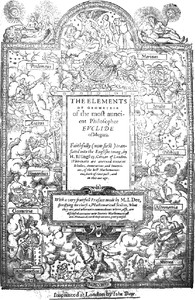
Whereunto are annexed certaine Scholies, Annotations, and Inuentions, of the best Mathematiciens, both of time past, and in this our age.
_With a very fruitfull Præface made by M. I. Dee, specifying the chiefe Mathematicall Sciẽces, what they are, and wherunto commodious: where, also, are disclosed certaine new Secrets Mathematicall and Mechanicall, vntill these our daies, greatly missed._
Imprinted at London by Iohn Daye.
❧ The Translator to the Reader.
_There is (gentle Reader) nothing (the word of God onely set apart) which so much beautifieth and adorneth the soule and minde of mã, as doth the knowledge of good artes and sciences: as the knowledge of naturall and morall Philosophie. The one setteth before our eyes, the creatures of God, both in the heauens aboue, and in the earth beneath: in which as in a glasse, we beholde the exceding maiestie and wisedome of God, in adorning and beautifying them as we see: in geuing vnto them such wonderfull and manifolde proprieties, and naturall workinges, and that so diuersly and in such varietie: farther in maintaining and conseruing them continually, whereby to praise and adore him, as by S. Paule we are taught. The other teacheth vs rules and preceptes of vertue, how, in common life amongest men, we ought to walke vprightly: what dueties pertaine to our selues, what pertaine to the gouernment or good order both of an housholde, and also of a citie or common wealth. The reading likewise of histories, conduceth not a litle, to the adorning of the soule & minde of man, a studie of all men cõmended: by it are seene and knowen the artes and doinges of infinite wise men gone before vs. In histories are contained infinite examples of heroicall vertues to be of vs followed, and horrible examples of vices to be of vs eschewed. Many other artes also there are which beautifie the minde of man: but of all other none do more garnishe & beautifie it, then those artes which are called Mathematicall. Unto the knowledge of which no man can attaine, without the perfecte knowledge and instruction of the principles, groundes, and Elementes of Geometrie. But perfectly to be instructed in them, requireth diligent studie and reading of olde auncient authors. Amongest which, none for a beginner is to be preferred before the most auncient Philosopher Euclide of Megara. For of all others he hath in a true methode and iuste order, gathered together whatsoeuer any before him had of these Elementes written: inuenting also and adding many thinges of his owne: wherby he hath in due forme accomplished the arte: first geuing definitions, principles, & groundes, wherof he deduceth his Propositions or conclusions, in such wonderfull wise, that that which goeth before, is of necessitie required to the proufe of that which followeth. So that without the diligent studie of Euclides Elementes, it is impossible to attaine vnto the perfecte knowledge of Geometrie, and consequently of any of the other Mathematicall sciences. Wherefore considering the want & lacke of such good authors hitherto in our Englishe tounge, lamenting also the negligence, and lacke of zeale to their countrey in those of our nation, to whom God hath geuen both knowledge, & also abilitie to translate into our tounge, and to publishe abroad such good authors, and bookes (the chiefe instrumentes of all learninges): seing moreouer that many good wittes both of gentlemen and of others of all degrees, much desirous and studious of these artes, and seeking for them as much as they can, sparing no paines, and yet frustrate of their intent, by no meanes attaining to that which they seeke: I haue for their sakes, with some charge & great trauaile, faithfully translated into our vulgare toũge, & set abroad in Print, this booke of Euclide. Whereunto I haue added easie and plaine declarations and examples by figures, of the definitions. In which booke also ye shall in due place finde manifolde additions, Scholies, Annotations, and Inuentions: which I haue gathered out of many of the most famous & chiefe Mathematiciẽs, both of old time, and in our age: as by diligent reading it in course, ye shall well perceaue. The fruite and gaine which I require for these my paines and trauaile, shall be nothing els, but onely that thou gentle reader, will gratefully accept the same: and that thou mayest thereby receaue some profite: and moreouer to excite and stirre vp others learned, to do the like, & to take paines in that behalfe. By meanes wherof, our Englishe tounge shall no lesse be enriched with good Authors, then are other straunge tounges: as the Dutch, French, Italian, and Spanishe: in which are red all good authors in a maner, found amongest the Grekes or Latines. Which is the chiefest cause, that amongest thẽ do florishe so many cunning and skilfull men, in the inuentions of straunge and wonderfull thinges, as in these our daies we see there do. Which fruite and gaine if I attaine vnto, it shall encourage me hereafter, in such like sort to translate, and set abroad some other good authors, both pertaining to religion (as partly I haue already done) and also pertaining to the Mathematicall Artes. Thus gentle reader farewell._ (?¿)
❧ TO THE VNFAINED LOVERS of truthe, and constant Studentes of Noble _Sciences, IOHN DEE of London, hartily_ wisheth grace from heauen, and most prosperous successe in all their honest attemptes and exercises.
Diuine Plato, the great Master of many worthy Philosophers, and the constant auoucher, and pithy perswader of Vnum, Bonum, and Ens: in his Schole and Academie, sundry times (besides his ordinary Scholers) was visited of a certaine kinde of men, allured by the noble fame of Plato, and the great commendation of hys profound and profitable doctrine. But when such Hearers, after long harkening to him, perceaued, that the drift of his discourses issued out, to conclude, this Vnum, Bonum, and Ens, to be Spirituall, Infinite, Æternall, Omnipotent, &c. Nothyng beyng alledged or expressed, How, worldly goods: how, worldly dignitie: how, health, Strẽgth or lustines of body: nor yet the meanes, how a merueilous sensible and bodyly blysse and felicitie hereafter, might be atteyned: Straightway, the fantasies of those hearers, were dampt: their opinion of Plato, was clene chaunged: yea his doctrine was by them despised: and his schole, no more of them visited. Which thing, his Scholer, Aristotle, narrowly cõsidering, founde the cause therof, to be, “For that they had no forwarnyng and information, in generall,” whereto his doctrine tended. For, so, might they haue had occasion, either to haue forborne his schole hauntyng: (if they, then, had misliked his Scope and purpose) or constantly to haue continued therin: to their full satisfaction: if such his finall scope & intent, had ben to their desire. Wherfore, Aristotle, euer, after that, vsed in brief, to forewarne his owne Scholers and hearers, “both of what matter, and also to what ende, he tooke in hand to speake, or teach.” While I consider the diuerse trades of these two excellent Philosophers (and am most sure, both, that Plato right well, otherwise could teach: and that Aristotle mought boldely, with his hearers, haue dealt in like sorte as Plato did) I am in no little pang of perplexitie: Bycause, that, which I mislike, is most easy for me to performe (and to haue Plato for my exãple.) And that, which I know to be most commendable: and (in this first bringyng, into common handling, the Artes Mathematicall) to be most necessary: is full of great difficultie and sundry daungers. Yet, neither do I think it mete, for so straunge matter (as now is ment to be published) and to so straunge an audience, to be bluntly, at first, put forth, without a peculiar Preface: Nor (Imitatyng Aristotle) well can I hope, that accordyng to the amplenes and dignitie of the State Mathematicall, I am able, either playnly to prescribe the materiall boundes: or precisely to expresse the chief purposes, and most wonderfull applications therof. And though I am sure, that such as did shrinke from Plato his schole, after they had perceiued his finall conclusion, would in these thinges haue ben his most diligent hearers (so infinitely mought their desires, in fine and at length, by our Artes Mathematicall be satisfied) yet, by this my Præface & forewarnyng, Aswell all such, may (to their great behofe) the soner, hither be allured: as also the Pythagoricall, and Platonicall perfect scholer, and the constant profound Philosopher, with more ease and spede, may (like the Bee,) gather, hereby, both wax and hony.
[The intent of this Preface.]
Wherfore, seyng I finde great occasion (for the causes alleged, and farder, in respect of my Art Mathematike generall) to vse “a certaine forewarnyng and Præface, whose content shalbe, that mighty, most plesaunt, and frutefull Mathematicall Tree, with his chief armes and second (grifted) braunches: Both, what euery one is, and also, what commodity, in generall, is to be looked for, aswell of griff as stocke: And forasmuch as this enterprise is so great, that, to this our tyme, it neuer was (to my knowledge) by any achieued: And also it is most hard, in these our drery dayes, to such rare and straunge Artes, to wyn due and common credit:” Neuertheles, if, for my sincere endeuour to satisfie your honest expectation, you will but lend me your thãkefull mynde a while: and, to such matter as, for this time, my penne (with spede) is hable to deliuer, apply your eye or eare attentifely: perchaunce, at once, and for the first salutyng, this Preface you will finde a lesson long enough. And either you will, for a second (by this) be made much the apter: or shortly become, well hable your selues, of the lyons claw, to coniecture his royall symmetrie, and farder propertie. Now then, gentle, my frendes, and countrey men, Turne your eyes, and bend your myndes to that doctrine, which for our present purpose, my simple talent is hable to yeld you.
All thinges which are, & haue beyng, are found vnder a triple diuersitie generall. For, either, they are demed Supernaturall, Naturall, or, of a third being. Thinges Supernaturall, are immateriall, simple, indiuisible, incorruptible, & vnchangeable. Things Naturall, are materiall, compounded, diuisible, corruptible, and chaungeable. Thinges Supernaturall, are, of the minde onely, comprehended: Things Naturall, of the sense exterior, ar hable to be perceiued. In thinges Naturall, probabilitie and coniecture hath place: But in things Supernaturall, chief demõstration, & most sure Science is to be had. By which properties & comparasons of these two, more easily may be described, the state, condition, nature and property of those thinges, which, we before termed of a third being: which, by a peculier name also, are called Thynges Mathematicall. For, these, beyng (in a maner) middle, betwene thinges supernaturall and naturall: are not so absolute and excellent, as thinges supernatural: Nor yet so base and grosse, as things naturall: But are thinges immateriall: and neuerthelesse, by materiall things hable somewhat to be signified. And though their particular Images, by Art, are aggregable and diuisible: yet the generall Formes, notwithstandyng, are constant, vnchaungeable, vntrãsformable, and incorruptible. Neither of the sense, can they, at any tyme, be perceiued or iudged. Nor yet, for all that, in the royall mynde of man, first conceiued. But, surmountyng the imperfectiõ of coniecture, weenyng and opinion: and commyng short of high intellectuall cõceptiõ, are the Mercurial fruite of Dianœticall discourse, in perfect imagination subsistyng. A meruaylous newtralitie haue these thinges Mathematicall, and also a straunge participatiõ betwene thinges supernaturall, immortall, intellectual, simple and indiuisible: and thynges naturall, mortall, sensible, compounded and diuisible. Probabilitie and sensible prose, may well serue in thinges naturall: and is commendable: In Mathematicall reasoninges, a probable Argument, is nothyng regarded: nor yet the testimony of sense, any whit credited: But onely a perfect demonstration, of truthes certaine, necessary, and inuincible: vniuersally and necessaryly concluded: is allowed as sufficient for “an Argument exactly and purely Mathematical.”
The book keeps going
Reading is free forever. Sign up and watch scenes appear while you read.



Scenes Storieta drew for other classics.
New illustrated classics
Once or twice a month: the latest books to get full character casts, scene art, and free comic editions. No account needed.