Public-domain ebook
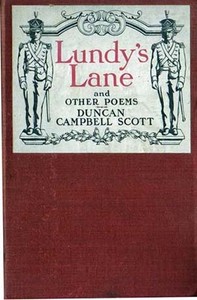
Lundy's Lane, and Other Poems
Language: en4,702 downloads on Project Gutenberg
Subjects
In: Poetry
Public-domain ebook sourced from Project Gutenberg #22717.
Public-domain ebook
Language: en4,702 downloads on Project Gutenberg
Subjects
In: Poetry
Public-domain ebook sourced from Project Gutenberg #22717.
Lundy’s Lane, and Other Poems is a volume of early‑twentieth‑century Canadian verse by Duncan Campbell Scott, best known for his vivid recollections of the 1812 war. The book opens with a sprawling, rhythm‑driven poem that places the speaker in the Lincoln Militia, recalling the night‑long clash at Lundy’s Lane. Through a cascade of battle images, duck‑guns, flashing fire, the roar of Niagara, the poet weaves personal loss, the grief of a mother over her son Abner, and the fierce camaraderie of the soldiers. The narrative is unbroken, moving from the heat of combat to the quiet of a maple wood, and finally to a solemn reflection on sacrifice and the lingering echo of the conflict.
Scott’s voice is unmistakably that of a soldier‑poet, blending colloquial speech with a heightened, almost epic diction. The style is dense, with long, breathless lines that echo oral storytelling, while the language retains the diction of early‑1900s poetry. Readers who enjoy historic war poetry, especially those interested in Canadian perspectives on the War of 1812, will find the work’s vivid battlefield tableau and its reflective, lyrical after‑thoughts compelling.
The opening · free to read
Yes,--in the Lincoln Militia,--in the war of eighteen-twelve; Many's the day I've had since then to dig and delve-- But those are the years I remember as the brightest years of all, When we left the plow in the furrow to follow the bugle's call. Why, even our son Abner wanted to fight with the men! "Don't you go, d'ye hear, sir!"--I was angry with him then. "Stay with your mother!" I said, and he looked so old and grim-- He was just sixteen that April--I couldn't believe it was him; But I didn't think--I was off--and we met the foe again, Five thousand strong and ready, at the hill by Lundy's Lane. There as the night came on we fought them from six to nine, Whenever they broke our line we broke their line, They took our guns and we won them again, and around the levels Where the hill sloped up--with the Eighty-ninth,--we fought like devils Around the flag;--and on they came and we drove them back, Until with its very fierceness the fight grew slack.
It was then about nine and dark as a miser's pocket, When up came Hercules Scott's brigade swift as a rocket, And charged,--and the flashes sprang in the dark like a lion's eyes; The night was full of fire--groans, and cheers, and cries; Then through the sound and the fury another sound broke in-- The roar of a great old duck-gun shattered the rest of the din; It took two minutes to charge it and another to set it free. Every time I heard it an angel spoke to me; Yes, the minute I heard it I felt the strangest tide Flow in my veins like lightning, as if, there, by my side, Was the very spirit of Valor. But 'twas dark--you couldn't see-- And the one who was firing the duck-gun fell against me And slid down to the clover, and lay there still; Something went through me--piercing--with a strange, swift thrill; The noise fell away into silence, and I heard as clear as thunder The long, slow roar of Niagara: O the wonder Of that deep sound. But again the battle broke And the foe, driven before us desperately--stroke upon stroke, Left the field to his master, and sullenly down the road Sounded the boom of his guns, trailing the heavy load Of his wounded men and his shattered flags, sullen and slow, Setting fire in his rage to Bridgewater mills and the glow Flared in the distant forest. We rested as we could, And for a while I slept in the dark of a maple wood: But when the clouds in the east were red all over, I came back there to the place we made the stand in the clover; For my heart was heavy then with a strange deep pain, As I thought of the glorious fight, and again and again I remembered the valiant spirit and the piercing thrill; But I knew it all when I reached the top of the hill,-- For there, there with the blood on his dear, brave head, There on the hill in the clover lay our Abner--dead!-- No--thank you--no, I don't need it; I'm solid as granite rock, But every time that I tell it I feel the old, cold shock, I'm eighty-one my next birthday--do you breed such fellows now? There he lay with the dawn cooling his broad fair brow, That was no dawn for him; and there was the old duck-gun That many and many's the time,--just for the fun, We together, alone, would take to the hickory rise, And bring home more wild pigeons than ever you saw with your eyes. Up with Hercules Scott's brigade, just as it came on night-- He was the angel beside me in the thickest of the fight-- Wrote a note to his mother--He said, "I've got to go; Mother what would home be under the heel of the foe!" Oh! she never slept a wink, she would rise and walk the floor; She'd say this over and over, "I knew it all before!" I'd try to speak of the glory to give her a little joy. "What is the glory to me when I want my boy, my boy!" She'd say, and she'd wring her hands; her hair grew white as snow-- And I'd argue with her up and down, to and fro, Of how she had mothered a hero, and his was a glorious fate, Better than years of grubbing to gather an estate. Sometimes I'd put it this way: "If God was to say to me now 'Take him back as he once was helping you with the plow,' I'd say, 'No, God, thank You kindly; 'twas You that he obeyed; You told him to fight and he fought, and he wasn't afraid; You wanted to prove him in battle, You sent him to Lundy's Lane, 'Tis well!" But she only would answer over and over again, "Give me back my Abner--give me back my son!" It was so all through the winter until the spring had begun, And the crocus was up in the dooryard, and the drift by the fence was thinned, And the sap drip-dropped from the branches wounded by the wind, And the whole earth smelled like a flower,--then she came to me one night-- "Rufus!" she said, with a sob in her throat,--"Rufus, you're right." I hadn't cried till then, not a tear--but then I was torn in two-- There, it's all right--my eyes don't see as they used to do!
But O the joy of that battle--it was worth the whole of life, You felt immortal in action with the rapture of the strife, There in the dark by the river, with the flashes of fire before, Running and crashing along, there in the dark, and the roar Of the guns, and the shrilling cheers, and the knowledge that filled your heart That there was a victory making and you must do your part, But--there's his grave in the orchard where the headstone glimmers white: We could see it, we thought, from our window even on the darkest night; It is set there for a sign that what one lad could do Would be done by a hundred hundred lads whose hearts were stout and true. And when in the time of trial you hear the recreant say, Shooting his coward lips at us, "You shall have had your day: For all your state and glory shall pass like a cloudy wrack, And here some other flag shall fly where flew the Union Jack,"-- Why tell him a hundred thousand men would spring from these sleepy farms, To tie that flag in its ancient place with the sinews of their arms; And if they doubt you and put you to scorn, why you can make it plain, With the tale of the gallant Lincoln men and the fight at Lundy's Lane.
1908.
Far in the east the rain-clouds sweep and harry, Down the long haggard hills, formless and low, Far in the west the shell-tints meet and marry, Piled gray and tender blue and roseate snow; East--like a fiend, the bolt-breasted, streaming Storm strikes the world with lightning and with hail; West--like the thought of a seraph that is dreaming, Venus leads the young moon down the vale.
Through the lake furrow between the gloom and bright'ning Firm runs our long canoe with a whistling rush, While Potan the wise and the cunning Silver Lightning Break with their slender blades the long clear hush; Soon shall I pitch my tent amid the birches, Wise Potan shall gather boughs of balsam fir, While for bark and dry wood Silver Lightning searches; Soon the smoke shall hang and lapse in the moist air.
Soon shall I sleep--if I may not remember One who lives far away where the storm-cloud went; May it part and starshine burn in many a quiet ember, Over her towered city crowned with large content; Dear God, let me sleep, here where deep peace is, Let me own a dreamless sleep once for all the years, Let me know a quiet mind and what heart ease is, Lost to light and life and hope, to longing and to tears.
Here in the solitude less her memory presses, Yet I see her lingering where the birches shine, All the dark cedars are sleep-laden like her tresses, The gold-moted wood-pools pellucid as her eyen; Memories and ghost-forms of the days departed People all the forest lone in the dead of night; While Potan and Silver Lightning sleep, the happy-hearted, Troop they from their fastnesses upon my sight.
Once when the tide came straining from the Lido, In a sea of flame our gondola flickered like a sword, Venice lay abroad builded like beauty's credo, Smouldering like a gorget on the breast of the Lord: Did she mourn for fame foredoomed or passion shattered That with a sudden impulse she gathered at my side? But when I spoke the ancient fates were flattered, Chill there crept between us the imperceptible tide.
Once I well remember in her twilight garden, She pulled a half-blown rose, I thought it meant for me, But poising in the act, and with half a sigh for pardon, She hid it in her bosom where none may dare to see: Had she a subtle meaning?--would to God I knew it, Where'er I am I always feel the rose leaves nestling there, If I might know her mind and the thought which then flashed through it, My soul might look to heaven not commissioned to despair.
Though she denied at parting the gift that I besought her, Just a bit of ribbon or a strand of her hair; Though she would not keep the token that I brought her, Proud she stood and calm and marvellously fair; Yet I saw her spirit--truth cannot dissemble-- Saw her pure as gold, staunch and keen and brave, For she knows my worth and her heart was all atremble, Lest her will should weaken and make her heart a slave.
If she could be here where all the world is eager For dear love with the primal Eden sway, Where the blood is fire and no pulse is thin or meagre, All the heart of all the world beats one way! There is the land of fraud and fame and fashion, Joy is but a gaud and withers in an hour, Here is the land of quintessential passion, Where in a wild throb Spring wells up with power.
She would hear the partridge drumming in the distance, Rolling out his mimic thunder in the sultry noons; Hear beyond the silver reach in ringing wild persistence Reel remote the ululating laughter of the loons; See the shy moose fawn nestling by its mother, In a cool marsh pool where the sedges meet; Rest by a moss-mound where the twin-flowers smother With a drowse of orient perfume drenched in light and heat:
She would see the dawn rise behind the smoky mountain, In a jet of colour curving up to break, While like spray from the iridescent fountain, Opal fires weave over all the oval of the lake: She would see like fireflies the stars alight and spangle All the heaven meadows thick with growing dusk, Feel the gipsy airs that gather up and tangle The woodsy odours in a maze of myrrh and musk:
There in the forest all the birds are nesting, Tells the hermit thrush the song he cannot tell, While the white-throat sparrow never resting, Even in the deepest night rings his crystal bell: O, she would love me then with a wild elation, Then she must love me and leave her lonely state, Give me love yet keep her soul's imperial reservation, Large as her deep nature and fathomless as fate:
Then, if she would lie beside me in the even, On my deep couch heaped of balsam fir, Fragrant with sleep as nothing under heaven, Let the past and future mingle in one blur; While all the stars were watchful and thereunder Earth breathed not but took their silent light, All life withdrew and wrapt in a wild wonder Peace fell tranquil on the odorous night:
She would let me steal,--not consenting or denying-- One strong arm beneath her dusky hair, She would let me bare, not resisting or complying, One sweet breast so sweet and firm and fair; Then with the quick sob of passion's shy endeavour, She would gather close and shudder and swoon away, She would be mine for ever and for ever, Mine for all time and beyond the judgment day.
The book keeps going
Reading is free forever. Sign up and watch scenes appear while you read.



Scenes Storieta drew for other classics.
New illustrated classics
Once or twice a month: the latest books to get full character casts, scene art, and free comic editions. No account needed.