The opening · free to read
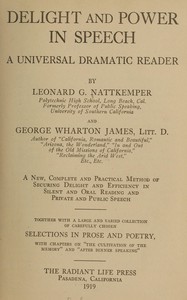
As the book is intended for the teaching of oral reading it contains an introductory chapter on the Principles of Reading, and selections for practice, with appended notes. An effort has also been made to grade the selections in the order of their difficulty. Accordingly, a number of selections, each illustrating in a marked degree only one, or at most two, of the various elements of Vocal Expression, have been placed at the beginning; these should, of course, be taught before the more complex selections are attempted.
It is not intended that the pupil shall master the chapter on the principles before beginning to read the selections; he should become familiar with each topic as it is illustrated in the lesson. In dealing with each lesson the teacher should first ascertain the elements of vocal expression that it best exemplifies. He should then discuss these elements with the pupils, using the necessary paragraphs of the Introduction, and such black-board exercises as he may deem necessary, until he is satisfied that the pupils are ready to undertake the study of the selection. At the oral reading the pupils should be able to show their mastery of the principles thus taught. Toward the close of the course, they will naturally read connectedly the various sections of the Introduction, in order to obtain a comprehensive and systematic view of the principles.
To secure good reading, systematic drill on the exercises in Vowel Sounds and in Articulation is also necessary.
Elements of Vocal Expression 7 Pause, Grouping, Time, Inflection, Pitch, Force, Stress, Emphasis, Shading, Perspective, Quality.
The book keeps going
Keep reading, and see it illustrated
Reading is free forever. Sign up and watch scenes appear while you read.
Scenes Storieta drew for other classics.