
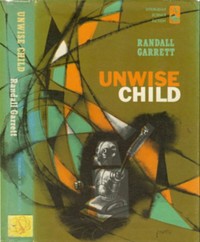
Public-domain ebook
Unwise Child
Language: en3,375 downloads on Project Gutenberg
Subjects
In: Science Fiction·Science-Fiction & Fantasy·Crime, Thrillers and Mystery
Public-domain ebook sourced from Project Gutenberg #23335.
Public-domain ebook
Language: en3,375 downloads on Project Gutenberg
Subjects
In: Science Fiction·Science-Fiction & Fantasy·Crime, Thrillers and Mystery
Public-domain ebook sourced from Project Gutenberg #23335.
The novel opens in a vividly rendered slice of mid‑century Manhattan, where the bustling “Radio Row” of antique electronics serves as the backdrop for a high‑tech showdown. Garrett introduces us to Mike the Angel, a towering, gold‑haired executive of the Interstellar Commission, who slips down from his lofty office to the cramped, labyrinthine shop of Old Harry MacDougal. The shop, a chaotic museum of obsolete vacuum‑tube radios and cathode‑ray sets, doubles as a secret laboratory where only the knowledgeable are allowed to test their gear. When a pair of teenage intruders armed with humming vibroblades burst in, Mike’s quick thinking and a concealed magnetic device set off a rapid, razor‑sharp confrontation that blends street‑level grit with speculative gadgetry. The opening establishes a world where vintage hardware coexists with interstellar bureaucracy, and the action pivots on the tension between seasoned expertise and youthful recklessness.
Garrett’s prose is brisk and colloquial, peppered with period‑specific slang and a dry, almost sardonic humor that captures the flavor of 1950s pulp science‑fiction. The narrative voice shifts smoothly between detailed description of the shop’s cluttered interior and the kinetic immediacy of the fight, creating a rhythm that feels both cinematic and novelistic. Readers who enjoy fast‑paced, gadget‑laden adventures, particularly those who appreciate a blend of noir atmosphere, retro‑futurist tech, and a touch of sardonic commentary on human behavior, will find this story engaging. It appeals especially to fans of classic American sci‑fi who relish vivid urban settings and clever, technically grounded conflict.
The opening · free to read
But, once or twice a week, Mike the Angel liked to take off and prowl around Radio Row, just shopping around. Usually, he didn't work too late, but, on this particular afternoon, he'd been in his office until after six o'clock, working on some papers for the Interstellar Commission. So, by the time he got down to Radio Row, the only shop left open was Harry MacDougal's.
That didn't matter much to Mike the Angel, since Harry's was the place he had intended to go, anyway. Harry MacDougal's establishment was hardly more than a hole in the wall--a narrow, long hallway between two larger stores. Although not a specialist, like the proprietor of Ye Quainte Olde Elecktronicks Shoppe, Harry did carry equipment of every vintage and every make. If you wanted something that hadn't been manufactured in decades, and perhaps never made in quantity, Harry's was the place to go. The walls were lined with bins, all unlabeled, filled helter-skelter with every imaginable kind of gadget, most of which would have been hard to recognize unless you were both an expert and a historian.
Old Harry didn't need labels or a system. He was a small, lean, bony, sharp-nosed Scot who had fled Scotland during the Panic of '37, landed in New York, and stopped. He solemnly declared that he had never been west of the Hudson River nor north of 181st Street in the more than fifty years he had been in the country. He had a mind like that of a robot filing cabinet. Ask him for a particular piece of equipment, and he'd squint one eye closed, stare at the end of his nose with the other, and say:
"An M-1993 thermodyne hexode, eh? Ah. Um. Aye, I got one. Picked it up a couple years back. Put it-- Let ma see, now...."
And he'd go to his wall ladder, push it along that narrow hallway, moving boxes aside as he went, and stop somewhere along the wall. Then he'd scramble up the ladder, pull out a bin, fumble around in it, and come out with the article in question. He'd blow the dust off it, polish it with a rag, scramble down the ladder, and say: "Here 'tis. Thought I had one. Let's go back in the back and give her a test."
On the other hand, if he didn't have what you wanted, he'd shake his head just a trifle, then squint up at you and say: "What d'ye want it for?" And if you could tell him what you planned to do with the piece you wanted, nine times out of ten he could come up with something else that would do the job as well or better.
In either case, he always insisted that the piece be tested. He refused either to buy or sell something that didn't work. So you'd follow him down that long hallway to the lab in the rear, where all the testing equipment was. The lab, too, was cluttered, but in a different way. Out front, the stuff was dead; back here, there was power coursing through the ionic veins and metallic nerves of the half-living machines. Things were labeled in neat, accurate script--not for Old Harry's benefit, but for the edification of his customers, so they wouldn't put their fingers in the wrong places. He never had to worry about whether his customers knew enough to fend for themselves; a few minutes spent in talking was enough to tell Harry whether a man knew enough about the science and art of electronics and sub-electronics to be trusted in the lab. If you didn't measure up, you didn't get invited to the lab, even to watch a test.
But he had very few people like that; nobody came into Harry MacDougal's place unless he was pretty sure of what he wanted and how he wanted to use it.
On the other hand, there were very few men whom Harry would allow into the lab unescorted. Mike the Angel was one of them.
Meet Mike the Angel. Full name: Michael Raphael Gabriel. (His mother had tagged that on him at the time of his baptism, which had made his father wince in anticipated compassion, but there had been nothing for him to say--not in the middle of the ceremony.)
Naturally, he had been tagged "Mike the Angel." Six feet seven. Two hundred sixty pounds. Thirty-four years of age. Hair: golden yellow. Eyes: deep blue. Cash value of holdings: well into eight figures. Credit: almost unlimited. Marital status: highly eligible, if the right woman could tackle him.
Mike the Angel pushed open the door to Harry MacDougal's shop and took off his hat to brush the raindrops from it. Farther uptown, the streets were covered with clear plastic roofing, but that kind of comfort stopped at Fifty-third Street.
There was no one in sight in the long, narrow store, so Mike the Angel looked up at the ceiling, where he knew the eye was hidden.
"Harry?" he said.
"I see you, lad," said a voice from the air. "You got here just in time. I'm closin' up. Lock the door, would ye?"
"Sure, Harry." Mike turned around, pressed the locking switch, and heard it snap satisfactorily.
"Okay, Mike," said Harry MacDougal's voice. "Come on back. I hope ye brought that bottle of scotch I asked for."
Mike the Angel made his way back between the towering tiers of bins as he answered. "Sure did, Harry. When did I ever forget you?"
And, as he moved toward the rear of the store, Mike the Angel casually reached into his coat pocket and triggered the switch of a small but fantastically powerful mechanism that he always carried when he walked the streets of New York at night.
He was headed straight into trouble, and he knew it. And he hoped he was ready for it.
Mike the Angel kept his hand in his pocket, his thumb on a little plate that was set in the side of the small mechanism that was concealed therein. As he neared the door, the little plate began to vibrate, making a buzz which could only be felt, not heard. Mike sighed to himself. Vibroblades were all the rage this season.
He pushed open the rear door rapidly and stepped inside. It was just what he'd expected. His eyes saw and his brain recorded the whole scene in the fraction of a second before he moved. In that fraction of a second, he took in the situation, appraised it, planned his strategy, and launched into his plan of action.
Harry MacDougal was sitting at his workbench, near the controls of the eye that watched the shop when he was in the lab. He was hunched over a little, his small, bright eyes peering steadily at Mike the Angel from beneath shaggy, silvered brows. There was no pleading in those eyes--only confidence.
Next to Old Harry was a kid--sixteen, maybe seventeen. He had the JD stamp on his face: a look of cold, hard arrogance that barely concealed the uncertainty and fear beneath. One hand was at Harry's back, and Mike knew that the kid was holding a vibroblade at the old man's spine.
At the same time, the buzzing against his thumb told Mike the Angel something else. There was a vibroblade much nearer his body than the one in the kid's hand.
That meant that there was another young punk behind him.
All this took Mike the Angel about one quarter of a second to assimilate. Then he jumped.
Had the intruders been adults, Mike would have handled the entire situation in a completely different way. Adults, unless they are mentally or emotionally retarded, do not usually react or behave like children. Adolescents can, do, and _must_--for the very simple reason that they have not yet had time to learn to react as adults.
Had the intruders been adults, and had Mike the Angel behaved the way he did, he might conceivably have died that night. As it was, the kids never had a chance.
Mike didn't even bother to acknowledge the existence of the punk behind him. He leaped, instead, straight for the kid in the dead-black suede zipsuit who was holding the vibroblade against Harry MacDougal's spine. And the kid reacted exactly as Mike the Angel had hoped, prayed, and predicted he would.
The kid defended himself.
An adult, in a situation where he has one known enemy at his mercy and is being attacked by a second, will quickly put the first out of the way in order to leave himself free to deal with the second. There is no sense in leaving your flank wide open just to oppose a frontal attack.
If the kid had been an adult, Harry MacDougal would have died there and then. An adult would simply have slashed his vibroblade through the old man's spine and brought it to bear on Mike the Angel.
But not the kid. He jumped back, eyes widening, to face his oncoming opponent in an open space. He was no coward, that kid, and he knew how to handle a vibroblade. In his own unwise, suicidal way, he was perfectly capable of proving himself. He held out the point of that shimmering metal shaft, ready to parry any offensive thrust that Mike the Angel might make.
If Mike had had a vibroblade himself, and if there hadn't been another punk at his back, Mike might have taken care of the kid that way. As it was, he had no choice but to use another way.
He threw himself full on the point of the scintillating vibroblade.
A vibroblade is a nasty weapon. Originally designed as a surgeon's tool, its special steel blade moves in and out of the heavy hilt at speeds from two hundred to two thousand vibrations per second, depending on the size and the use to which it is to be put. Make it eight inches long, add serrated, diamond-pointed teeth, and you have the man-killing vibroblade. Its danger is in its power; that shivering blade can cut through flesh, cartilage, and bone with almost no effort. It's a knife with power steering.
But that kind of power can be a weakness as well as a strength.
The little gadget that Mike the Angel carried did more than just detect the nearby operation of a vibroblade. It was also a defense. The gadget focused a high-density magnetic field on any vibroblade that came anywhere within six inches of Mike's body.
In that field, the steel blade simply couldn't move. It was as though it had been caught in a vise. The blade no longer vibrated; it had become nothing more than an overly fancy bread knife.
The book keeps going
Reading is free forever. Sign up and watch scenes appear while you read.



Scenes Storieta drew for other classics.
New illustrated classics
Once or twice a month: the latest books to get full character casts, scene art, and free comic editions. No account needed.