The opening · free to read
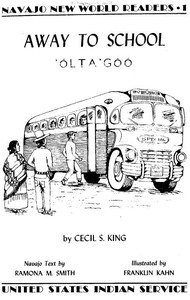
Navajo New World Readers
At this writing (1951) there are approximately 26,000 children of school age on the Navajo reservation. About 40 percent of these are between the ages of 12 and 18. The great majority have never been inside a school, and do not speak English. Recently the government has provided space for more than 4,000 of these non-English-speaking adolescents in ten of its off-reservation boarding schools. A five-year intensive educational program is provided designed to teach these children to speak, read, write, and think in English; to do simple arithmetic, to know the facts of American history, world geography, civics and health; and to provide the basic skills which will enable them to obtain and hold a permanent job away from the reservation. The reservation resources will support only about half the present population.
We have learned how to teach these non-English-speaking Navajos to speak and read English very rapidly. However, there isn't much material for them to read. They are maturing adolescents with adolescent interests. Primers and first readers prepared for use by six-year-old school children don't have much interest for them. Because most non-Indians learn to read when they are young, very few books are published in which the ideas are mature, but the vocabularies simple enough for beginning readers. The Bureau of Indian Affairs, therefore, has undertaken the preparation and printing of booklets written by the leaders who are working directly with these children. Because the children are entering a new culture, and their success will depend upon the degree to which they make the basic ideas of this culture their own, these new books will rely on the material of this new culture for their content. They will present to these young people a new and different world from that through which they have grown during their early years on the reservation.
Willard W. Beatty Chief, Branch of Education
I am a Navajo boy.
Naabeehó 'ashkii nish[l-][í,].
This is my home.
Díí shighan 'át'é.
My home is in Arizona.
Arizona bii' shighan.
Arizona is in the United States.
Arizona 'éí kéyah dízdiin dóó ba'aan tseebíí sinilígíí bii'.
The United States is my country.
Kéyah dízdiin dóó ba'aan tseebíí sinilígíí shikéyah 'át'é.
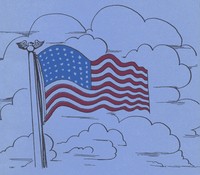
This is the flag of the United States.
This is the flag of my country.
This is my flag.
Dii dah na'at'a'í Kéyah dízdiin dóó ba'aan tseebíí sinilígíí bá 'át'é.
Dii dah na'at'a'í shikéyah bá 'át'é.
Dii shi dah na'at'a'í.
I look at my flag.
Shi dah na'at'a'í nísh'[í,].
I think of my home.
I think of my mother.
I think of my baby brother.
Shighan baa nitséskees.
Shimá baa nitséskees.
'Awéé' sitsilí baa nitséskees.
I think of my father.
I help my father.
Shizhé'é baa nitséskees.
Shizhé'é bíká 'anáshwo'.
I think of the sheep.
I take care of the sheep.
I can herd the sheep.
Dibé baa nitséskees.
Dibé baa 'áháshy[á,].
Shí na'nishkaad yiishch[í,][í,]h.
I think of the lambs.
I take care of the lambs.
The lambs can run.
The book keeps going
Keep reading, and see it illustrated
Reading is free forever. Sign up and watch scenes appear while you read.
Scenes Storieta drew for other classics.