Public-domain ebook
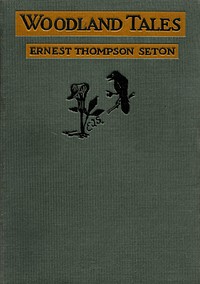
Woodland Tales
Language: en5,226 downloads on Project Gutenberg
Subjects
In: Children's Instructional Books·Children & Young Adult Reading·Mythology, Legends & Folklore
Public-domain ebook sourced from Project Gutenberg #23667.
Public-domain ebook
Language: en5,226 downloads on Project Gutenberg
Subjects
In: Children's Instructional Books·Children & Young Adult Reading·Mythology, Legends & Folklore
Public-domain ebook sourced from Project Gutenberg #23667.
Ernest Thompson Seton’s Woodland Tales is a collection of nature sketches and fables aimed at children six and up, though the author explicitly invites a parent or “Guide” to share the reading. The book opens with a reverent meditation on a pine the writer planted himself, describing its green fronds, jewel‑like buds and sturdy trunk as a metaphor for the stories that follow. From that opening, Seton promises chapters that will teach “things to see, things to do, things to know, things to remember,” each linked to the outdoors and to the practice of woodcraft. The contents list reveals a parade of seasonal stories, blue‑eyed snow‑children, the chickadee’s madness, the birth of the violet, interwoven with practical notes on tracking, bird‑nesting and plant uses, all presented as a guide for young explorers.
The voice is that of an early‑20th‑century naturalist who blends lyrical description with didactic instruction, echoing the prose of his contemporary nature writers. Seton’s language is richly ornamental yet clear, employing mythic names such as Mother Carey and El Sol to frame ordinary flora and fauna in a larger, almost spiritual context. Readers who enjoy immersive, almost poetic natural history, especially those who appreciate a gentle moral undercurrent and a parent‑child reading partnership, will find this work both educational and enchanting.
The opening · free to read
As I write, I look from a loved window, across a landscape that I love, and my eye rests on a tall beautiful pine planted with my own hands years ago. It is a mass of green fringes, with gem-like tips of buds and baby cones, beautiful, exquisitely beautiful, whether seen from afar as a green spire, or viewed close at hand as jewellery. It is beautiful, fragile and--unimportant, as the world sees it; yet through its wind-waved mass one can get little glimpses of the thing that backs it all, the storm-defying shaft, the enduring rigid living growing trunk of massive timber that gives it the nobility of strength, and adds value to the rest; sometimes it must be sought for, but it always surely is there, ennobling the lesser pretty things.
I hope this tree is a fair image of my fairy tale. I know my child friends will love the piney fringes and the jewel cones, and they can find the unyielding timber in its underlying truth, if they seek for it. If they do not, it is enough to have them love the cones.
All are not fairy tales. Other chapters set forth things to see, thing to do, things to go to, things to know, things to remember. These, sanctified in the blue outdoors, spell "Woodcraft," the one pursuit of man that never dies or palls, the thing that in the bygone ages gifted him and yet again will gift him with the seeing eye, the thinking hand, the body that fails not, the winged soul that stores up precious memories.
It is hoped that these chapters will show how easy and alluring, and how good a thing it is.
While they are meant for the children six years of age and upward, it is assumed that Mother (or Father) will be active as a leader; therefore it is addressed, first of all, to the parent, whom throughout we shall call the "Guide."
Some of these stories date back to my school days, although the first actually published was "Why the Chicadee Goes Crazy Twice a Year." This in its original form appeared in "Our Animal Friends" in September, 1893. Others, as "The Fingerboard Goldenrod," "Brook-Brownie," "The Bluebird," "Diablo and the Dogwood," "How the Violets Came," "How the Indian Summer Came," "The Twin Stars," "The Fairy Lamps," "How the Littlest Owl Came," "How the Shad Came," appeared in slightly different form in the Century Magazine, 1903 and 1904.
My thanks are due to the Authorities of the American Museum who have helped me with specimens and criticism; to the published writings of Dr. W. J. Holland and Clarence M. Weed for guidance in insect problems; to Britton and Browne's "Illustrated Flora, U. S. and Canada"; and to the Nature Library of Doubleday, Page & Co., for light in matters botanic; to Mrs. Daphne Drake and Mrs. Mary S. Dominick for many valuable suggestions, and to my wife, Grace Gallatin Seton, for help with the purely literary work.
Also to Oliver P. Medsger, the naturalist of Lincoln High School, Jersey City, N. J., for reading with critical care those parts of the manuscript that deal with flowers and insects, as well as for the ballad of the Ox-eye, the story of its coming to America, and the photograph of the Mecha-meck.
The book keeps going
Reading is free forever. Sign up and watch scenes appear while you read.



Scenes Storieta drew for other classics.
New illustrated classics
Once or twice a month: the latest books to get full character casts, scene art, and free comic editions. No account needed.