Public-domain ebook
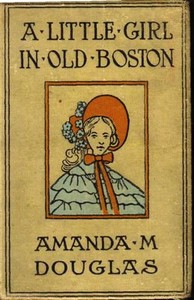
A Little Girl in Old Boston
Language: en5,627 downloads on Project Gutenberg
Subjects
In: Historical Novels·Children & Young Adult Reading·American Literature
Public-domain ebook sourced from Project Gutenberg #23786.
Public-domain ebook
Language: en5,627 downloads on Project Gutenberg
Subjects
In: Historical Novels·Children & Young Adult Reading·American Literature
Public-domain ebook sourced from Project Gutenberg #23786.
The work is a juvenile‑fiction tale set in early‑nineteenth‑century Boston, revolving around the arrival of a young English‑American girl named Doris. The opening scene gathers a group of Boston ladies, Aunt Priscilla, Mrs. Leverett, Betty, and others, around a tea table, their conversation drifting from taxes and the cost of painting a hall door to the recent war and the legacy of the city’s founding fathers. Their banter is peppered with references to genealogy, religious disputes, and the practicalities of household management, establishing a domestic backdrop that soon expands when Doris, a small, cloaked figure, is ushered in by her brother Warren and the family’s ship captain. The narrative immediately juxtaposes the familiar, bustling household with the newcomer’s quiet curiosity, hinting at how her presence will intersect with the established rhythms of Boston life.
The prose reflects a late‑Victorian sensibility, with long, descriptive sentences and a penchant for dialogue that reveals character through dialect and social commentary. The voice is earnest yet occasionally satirical, especially in Aunt Priscilla’s sharp observations about fashion and propriety. Readers who enjoy richly detailed historical settings, layered family dynamics, and a gentle coming‑of‑age thread will find this novel appealing. It suits young readers interested in period pieces as well as adult readers who appreciate a snapshot of early American domestic culture rendered with both humor and affection.
The opening · free to read
"But think of the expense and the taxes! You can't put a bit of improvement on anything but the taxes eat it up. I want my hall door painted, and the cornishes,"--Aunt Priscilla always would pronounce it that way,--"but I mean to wait until the assessor has been round. It's the best time to paint in cool weather, too. I can't afford to pay a man for painting and then pay the city for the privilege."
No one controverted Mrs. Perkins. She broke off her bread in bits and sipped her tea.
"Why didn't they give her some kind of a Christian name?" she began suddenly. "Don't you suppose it is French for the plain, old-fashioned, sensible name of Dorothy?"
Betty laughed. "Oh, Aunt Priscilla, it's pure Greek. Doris and Phyllis and Chloe----"
"Phyllis and Chloe are regular nigger names," with the utmost disdain.
"But Greek, all the same. Ask Uncle Winthrop."
"Well, I shall call her Dorothy. I'm neither Greek nor Latin nor a college professor. There's no law against my being sensible, fursisee"--which really meant "far as I see." "And the idea of appointing Winthrop Adams her guardian! I did think second-cousin Charles had more sense. Winthrop thinks of nothing but books and going back to the Creation of the World, just as if the Lord couldn't have made things straight in the beginning without his help. I dare say he will find out what language they talked before the dispersion of Babel. People are growing so wise nowadays, turning the Bible inside out!" and she gave her characteristic sniff. "I'll have another cup of tea, Elizabeth. Now that we're through with the war, and settled solid-like with a President at the helm, we can look forward to something permanent, and comfort ourselves that it was worth trying for. Still, I've often thought of that awful waste of tea in Boston harbor. Seems as though they might have done something else with it. Tea will keep a good long while. And all that wretched stuff we used to drink and call it Liberty tea!"
"I don't know as we regret many of the sacrifices, though it came harder on the older people. We have a good deal to be proud of," said Mrs. Leverett.
"And a grandfather who was at Bunker Hill," appended Betty.
Aunt Priscilla never quite knew where she belonged. She had come over with the Puritans, at least her ancestors had, but then there had been a title in the English branch; and though she scoffed a little, she had great respect for royalty, and secretly regretted they had not called the head of the government by a more dignified appellation than President. Her mother had been a Church of England member, but rather austere Mr. Adams believed that wives were to submit themselves to their husbands in matters of belief as well as aught else. Then Priscilla Adams, at the age of nineteen, had wedded the man of her father's choice, Hatfield Perkins, who was a stanch upholder of the Puritan faith. Priscilla would have enjoyed a little foolish love-making, and she had a carnal hankering for fine gowns; and, oh, how she did long to dance in her youth, when she was slim and light-footed!
In spite of all, she had been a true Puritan outwardly, and had a little misgiving that the prayers of the Church were vain repetitions, the organ wickedly frivolous, and the ringing of bells suggestive of popery. There had been no children, and a bad fall had lamed her husband so that volunteering for a soldier was out of the question, but he had assisted with his means; and some twelve years before this left his widow in comfortable circumstances for the times.
She kept to her plain dress, although it was rich; and her housemaid was an elderly black woman who had been a slave in her childhood. She devoted a good deal of thought as to who should inherit her property when she was done with it. For those she held in the highest esteem were elderly like herself, and the young people were flighty and extravagant and despised the good old ways of prudence and thrift.
They were having early tea at Mrs. Leverett's. Aunt Priscilla's mother had been half-sister to Mrs. Leverett's mother. In the old days of large families nearly everyone came to be related. It was always very cozy in Sudbury Street, and Foster Leverett was in the ship chandlery trade. Aunt Priscilla did love a good cup of tea. Whether the quality was finer, or there was some peculiar art in brewing it, she could never quite decide; or whether the social cream of gentle Elizabeth Leverett, and the spice of Betty, added to the taste and heightened the flavor beyond her solitary cup.
Early October had already brought chilling airs when evening set in. A century or so ago autumn had the sharpness of coming winter in the early morning and after sundown. There was a cheerful wood fire on the hearth, and its blaze lighted the room sufficiently, as the red light of the sunset poured through a large double window.
The house had a wide hall through the center that was really the keeping-room. The chimney stood about halfway down, a great stone affair built out in the room, tiled about with Scriptural scenes, with two tiers of shelves above, whereon were ranged the family heirlooms--so high, indeed, that a stool had to be used to stand on when they were dusted. Just below this began a winding staircase with carved spindles and a mahogany rail and newel, considered quite an extravagance in that day.
This lower end was the living part. In one of the corners was built the buffet, while a door opposite led into the wide kitchen. Across the back was a porch where shutters were hung in the winter to keep out the cold.
The great dining table was pushed up against the wall. The round tea table was set out and the three ladies were having their tea, quite a common custom when there was a visitor, as the men folk were late coming in and a little uncertain.
On one side the hall opened in two large, well-appointed rooms. On the other were the kitchen and "mother's room," where, when the children were little, there had been a cradle and a trundle bed. But one son and two daughters were married; one son was in his father's warehouse, and was now about twenty; the next baby boy had died; and Betty, the youngest, was sixteen, pretty, and a little spoiled, of course. Yet Aunt Priscilla had a curious fondness for her, which she insisted to herself was very reprehensible, since Betty was such a feather-brained girl.
"It is to be hoped the ship did get in to-day," Aunt Priscilla began presently. "If there's anything I hate, it's being on tenterhooks."
"She was spoken this morning. There's always more or less delay with pilots and tides and what not," replied Mrs. Leverett.
"The idea of sending a child like that alone! The weather has been fine, but we don't know how it was on the ocean."
"Captain Grier is a friend of Uncle Win's, you know," appended Betty.
"Betty, do try and call your relatives by their proper names. An elderly man, too! It does sound so disrespectful! Young folks of to-day seem to have no regard for what is due other people. Oh----"
There was a kind of stamping and shuffling on the porch, and the door was flung open, letting in a gust of autumnal air full of spicy odors from the trees and vines outside. Betty sprang up, while her mother followed more slowly. There were her father and her brother Warren, and the latter had by the hand the little girl who had crossed the ocean to come to the famous city of the New World, Boston. Almost two hundred years before an ancestor had crossed from old Boston, in the ship Arabella, and settled here, taking his share of pilgrim hardships. Doris' father, when a boy, had been sent back to England to be adopted as the heir of a long line. But the old relative married and had two sons of his own, though he did well by the boy, who went to France and married a pretty French girl. After seven years of unbroken happiness the sweet young wife had died. Then little Doris, six years of age, had spent two years in a convent. From there her father had taken her to Lincolnshire and placed her with two elderly relatives, while he was planning and arranging his affairs to come back to America with his little daughter. But one night, being out with a sailing party, a sudden storm had caught them and swept them out of life in an instant.
Second-cousin Charles Adams had been in correspondence with him, and advised him to return. Being in feeble health, he had included him and his heirs in his will, appointing his nephew Winthrop Adams executor, and died before the news of the death of his distant relative had reached him. The Lincolnshire ladies were too old to have the care and rearing of a child, so Mr. Winthrop Adams had sent by Captain Grier to bring over the little girl. Her father's estate, not very large, was in money and easily managed. And now little Doris was nearing ten.
"Oh!" cried Betty, hugging the slim figure in the red camlet cloak, and peering into the queer big hat tied down over her ears with broad ribbons that, what with the big bow and the wide rim, almost hid her face; but she saw two soft lovely eyes and cherry-red lips that she kissed at once, though kissing had not come in fashion to any great extent, and was still considered by many people rather dubious if not positively sinful.
"Oh, little Doris, welcome to Boston and the United Colonies and the whole of America! Let me see how you look," and she untied the wide strings.
The head that emerged was covered with fair curling hair; the complexion was clear, but a little wind-burned from her long trip; the eyes were very dark, but of the deepest, softest blue, that suggested twilight. There was a dimple in the dainty chin, and the mouth had a half-frightened, half-wistful smile.
"Captain Grier will send up her boxes to-morrow. They got aground and were delayed. I began to think they would have to stay out all night. The captain will bring up a lot of papers for Winthrop, and everything," explained Mr. Leverett. "Are you cold, little one?"
Doris gave a great shiver as her cloak was taken off, but it was more nervousness than cold, and the glances of the strange faces. Then she walked straight to the fireplace.
"Oh, what a beautiful fire!" she exclaimed. "No, I am not cold"--and the wistful expression wandered from one to the other.
"This is my daughter Betty, and this is--why, you may as well begin by saying Aunt Elizabeth at once. How are you, Aunt Priscilla? This is our little French-English girl, but I hope she will turn into a stanch Boston girl. Now, mother, let's have a good supper. I'm hungry as a wolf."
Doris caught Betty's hand again and pressed it to her cheek. The smiling face won her at once.
"Did you have a pleasant voyage?" asked Mrs. Leverett, as she was piling up the cups and saucers, and paused to smile at the little stranger.
"There were some storms, and I was afraid then. It made me think of papa. But there was a good deal of sunshine. And I was quite ill at first, but the captain was very nice, and Mrs. Jewett had two little girls, so after a while we played together. And then I think we forgot all about being at sea--it was so like a house, except there were no gardens or fields and trees."
The book keeps going
Reading is free forever. Sign up and watch scenes appear while you read.



Scenes Storieta drew for other classics.
New illustrated classics
Once or twice a month: the latest books to get full character casts, scene art, and free comic editions. No account needed.