Public-domain ebook
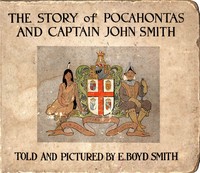
The story of Pocahontas and Captain John Smith
Language: en543 downloads on Project Gutenberg
Subjects
In: Historical Novels·Romance·Adventure
Public-domain ebook sourced from Project Gutenberg #24487.
Public-domain ebook
Language: en543 downloads on Project Gutenberg
Subjects
In: Historical Novels·Romance·Adventure
Public-domain ebook sourced from Project Gutenberg #24487.
The opening · free to read
He journeyed across France to join the armies fighting the Turks, but was robbed on the way by false companions, and suffered much hardship. At last he reached Marseilles, where he took ship with a party of pilgrims going to the East. A great storm arising, the pilgrims superstitiously blamed him for it, and threw him overboard. By good fortune he was able to swim to a small island, whence he was soon rescued by a Breton ship. He stayed for some time on this ship, taking part in a sea fight with a Venetian vessel, and received, after the victory, a share of the spoils.
Now, with money again in his pocket, he wandered through Italy, and then crossed over to Styria. Here he joined the army of the Emperor Rudolph and was appointed captain of a company of cavalry, and did good service.
During the siege of the town of Regal, the Turks, who held it, challenged any captain among the besiegers to come out and fight one of their champions.
Captain John Smith was chosen to meet the Turk, and on a field before the town they fought, and the Turk was beaten and lost his head. On the next day another Turk challenged the victor and was also overthrown. And then came still a third, who, after a desperate battle, met the same fate as the other two. For this brave service Prince Sigismund gave the Captain a coat-of-arms with three Turks' heads as the device. And thus Captain John Smith won his spurs.
But after this he was less fortunate, for, being wounded, he was taken prisoner by the Turks and made a slave. In time, however, he escaped and fled to Russia, and from thence at last found his way home to England again.
Meanwhile Pocahontas, now grown to be a girl of some twelve years, often listened eagerly to the stories of the old men of her tribe, who, on these warm spring days, sat and smoked together, and told of the things they had done and seen long ago. Some remembered a white-faced people who, nearly twenty years before, had come to Roanoke Island from no one knew where,--men with yellow hair, dressed from head to foot in cumbrous garments, and bearing wonderful weapons which spat out fire, with much noise. Many believed them gods, while others thought they were devils. And Pocahontas listened in wonder, ever curious to hear of this strange people so unlike her own. The old priest mournfully prophesied that the strangers, being of some mighty race, would come again from out the great waters and overrun the whole land.
And scarcely had he spoken when it seemed that his warning had come true, for runners, wildly excited, cried out that a fleet of mighty winged canoes had been seen afar on the ocean, advancing like great clouds.
Then Pocahontas, with many of her people, hurried to the hills, and there, overlooking the sea, they saw in truth three strange craft slowly sailing up the bay.
These were the ships from England, bringing a new colony, a band of pioneers, and adventurers in search of gold, to take possession of the broad lands of America.
That night the ships dropped anchor in the bay. On the morrow the colonists disembarked, and Captain Gosnold, their leader, claimed the land in the king's name. Among the first, as one of the Council, was Captain John Smith, who had again left home in quest of adventure and glory, this time in the new world. To the eyes of the weary travelers, after their long voyage across the sea, Virginia, on that bright April day, seemed a land of promise. With great hopes and renewed courage they set to work to build the town which they called Jamestown, in honor of their king,--a town which lives to this day.
But after a time they grew dissatisfied, for they failed to find the gold mines they had hoped for. And they became discouraged, and quarreled, and things began to go ill with them.
To make matters worse Captain Gosnold after a few months sickened and died.
Fortunately for the good of the colonists, who had completely lost heart and were anxious to give up the undertaking, Captain John Smith soon became their leader. Ever active and enterprising, he inspired the others by his example. He vigorously put things in order, and set the idlers to work to complete their half-finished houses, and to build the forts to protect them from the Indians, who now showed a warlike spirit.
Next he went off to explore the country, and to trade with the natives for corn, for the settlers began to lack food.
On one of these expeditions, when he had gone ashore with an Indian guide, a band of hostile braves, who had been on the watch among the trees, lay in wait to attack him, led by Opekankano, Pocahontas's uncle, while he, unconscious of their presence, gave orders to his men to stay by the boat and keep a sharp lookout for danger.
Suddenly, in the heart of the deep woods, the stealthy redskins sprang upon him, shrieking like fierce beasts of prey. And in a moment the arrows flew thick and fast.
Captain John, though taken unawares, made a brave fight, gravely wounding two of his enemies with his pistols, and protecting himself from the arrows by holding his Indian guide in front of him, as a buckler.
But there were too many against him, and as he could not beat them off he tried to retreat to the boat, always shielding himself with the guide. Unfortunately, just as escape seemed near, he stumbled into a swamp and was held fast by the heavy bog, and chilled by the cold water. Being thus helpless he was forced to surrender, and the triumphant Indians seized him as their prisoner.
At first they decided to kill him at once, then some thought it better to lead him to their village, that the whole tribe might rejoice in the triumph. But, as one of the Indians shot by the Captain had in the meantime died, the more impatient clamored for speedy vengeance. So they bound him to a tree to use as a target.
Now, as the arrows began to strike dangerously near, Captain John, ever quick-witted and resourceful, brought forth his pocket compass and showed the Indians the dancing needle; and when they found they could not touch it, because of the glass, they were amazed, for of course they had never seen glass before, and could not understand it. A feeling of awe crept over them; they thought him a magician, and were afraid to kill him. So at last they marched him off in their midst, through the forest, to consult with the rest of the tribe as to what should be done with him.
They carried their prisoner from village to village, while at every moment he looked for death, until at last they came to their great town, Werowacomo, where king Powhatan lived. And here they celebrated their victory by savage pomps and conjurations. They tied the Captain to the ceremonial stake, then, all painted and decorated in their fiercest and most hideous war paint and trappings, they danced their wild dance of triumph. Shouting and jumping, they brandished their war clubs in his face, whirling round and round their captive, like so many demons, each more frightful than the other. But, since they did not kill him at once, Captain John, nothing daunted, kept them wondering, by telling strange stories of the sun, the stars, and the world over the sea, and though the Indians could understand but little they hesitated, one day feasting him, and the next threatening to kill.
Now Pocahontas felt sorry for the handsome young stranger, and was drawn to him, and taught him many words of the Indian tongue, and he told her of his people beyond the sea, as best he could, and so they became good friends.
11-12. POCAHONTAS SAVES CAPTAIN JOHN SMITH'S LIFE
At last, after long deliberation, the Indians decided that, since he had killed one of their tribe, Captain John must die, for this was their law. So they dragged him, bound, before the great chief Powhatan, who sat in mighty state surrounded by his warriors. They stretched the prisoner on the ground with his head on a large stone, to beat out his brains with their cruel clubs. And it seemed as though at last the gallant Captain's time had come. But just as the Indian brave was about to strike, his great war club swinging high in the air, Pocahontas rushed forward and threw herself between him and his victim. With her own body she shielded the Captain from harm, for her heart was moved to pity for the stranger, and she could not bear that he should die. And now aroused, with flashing eyes she waved the executioner back. Then she pleaded with her father that the captive's life be spared.
At once there was wild confusion of shouting and threatening, many crying, "Kill, kill!" while but few were willing to spare his life, for the Indians feared the white men, and wished to drive them from the land.
But Pocahontas, as Princess of the tribe, claimed her right, and would not yield them up their victim. Then Powhatan, who ruled them all, raised his hand and stopped their clamor. In sullen silence the angry warriors awaited his decision. For a moment he hesitated, and the fate of Captain John hung wavering in the balance. Then, to please his favorite daughter, whom he dearly loved, he decreed that she should have her will.
"Let Pocahontas keep the stranger as her own, to make her toys," he said, for Captain John, during the idle days of weary captivity, had often whittled curious playthings for the little maid.
And thus was Captain John Smith's life saved by the gentle Indian girl, and with it the Jamestown colony, for without their sturdy and resourceful leader the settlers would have lost courage and abandoned the town.
Now, after much feasting, and with savage rite and ceremony, Powhatan adopted the Captain into the tribe, and made him a chief, and told him that he might come and go in safety, as one of them; then gave him guides to take him back to Jamestown, that the red man and the white should henceforth be friends, since Pocahontas willed it so.
And Captain John thanked the maiden for the great service she had done him, and, like a gallant knight of old, bent his knee and kissed her hand as he bade her good-by.
Once again in Jamestown, he found the colony in disorder and panic. All were on the point of sailing for home, completely disheartened, for they thought him dead, and feared the Indians. But again he put life into the enterprise, and set the faint-hearted to work, freed from the fear of Indian attack, since Pocahontas stood his friend.
14. POCAHONTAS BRINGS FOOD TO THE COLONISTS
Later, when the settlers were in sore straits for food, for they were improvident, and managed badly, Pocahontas, always generous and friendly, learning of their needs, came with her brother Nantaquaus and her Indians bringing corn, and kept them from starving, while their own was growing. Captain John in return gave her beads and trinkets to deck herself, and called her his child, and a firm friendship grew between them. Often she came and went, bringing peace and welcome food, quite at home in the little streets of Jamestown. And Captain John Smith in his writings has said that without her help in times of dire need, and without her influence for peace, the feeble colony must surely have perished, either by famine or by the hands of her savage kindred. Much we owe to the Indian maid who helped so greatly in the early struggles of the founders of this great nation.
The book keeps going
Reading is free forever. Sign up and watch scenes appear while you read.



Scenes Storieta drew for other classics.
New illustrated classics
Once or twice a month: the latest books to get full character casts, scene art, and free comic editions. No account needed.