Public-domain ebook
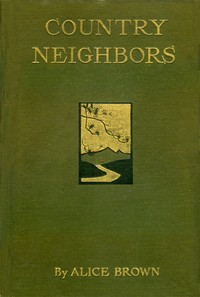
Country Neighbors
by Alice Brown
Language: en3,924 downloads on Project Gutenberg
Subjects
In: Novels·American Literature
Public-domain ebook sourced from Project Gutenberg #24540.
Public-domain ebook
by Alice Brown
Language: en3,924 downloads on Project Gutenberg
Subjects
In: Novels·American Literature
Public-domain ebook sourced from Project Gutenberg #24540.
Country Neighbors is a quiet slice of early‑twentieth‑century American fiction that opens in the modest front‑chamber of a great house, where Amelia Maxwell, a solitary woman in her early forties, reflects on a life marked by loss, routine work for old lady Knowles, and fleeting memories of a past romance. The narrative moves swiftly from her solitary reverie to the sudden arrival of Jared Beale, a familiar yet aged figure whose unexpected visit sets the stage for a conversation that intertwines recollections, lingering grief, and the comforting rituals of domestic life.
The novel’s voice is rooted in the regional dialect and domestic detail of its era, blending gentle humor with a measured, almost lyrical prose that captures the rhythms of country living. Readers who appreciate character‑driven stories, gentle nostalgia, and the subtle interplay of memory and everyday chores will find Amelia’s world resonant, while those drawn to brisk plot twists may prefer a more action‑oriented work.
The opening · free to read
Amelia Maxwell sat by the front-chamber window of the great house overlooking the road, and her own "story-an'-a-half" farther toward the west. Every day she was alone under her own roof, save at the times when old lady Knowles of the great house summoned her for work at fine sewing or braiding rags. All Amelia's kin were dead. Now she was used to their solemn absence, and sufficiently at one with her own humble way of life, letting her few acres at the halves, and earning a dollar here and there with her clever fingers. She was but little over forty, yet she was aware that her life, in its keener phases, was already done. She had had her romance and striven to forget it; but out of that time pathetic voices now and then called to her, and old longings awoke, to breathe for a moment and then sleep again.
Amelia seemed, even to old lady Knowles, who knew her best, a cheerful, humorous body; but only Amelia saw the road by which her serenity had come. Chiefly it was through an inexplicable devotion to the great house. She could not remember a time when it was not wonderful to her. While she was a little girl, living alone with her mother, she used to sit on the doorstone with her bread and milk at bedtime, and think of the great house, how grand it was and large. There was a wonderful way the sun had of falling, at twilight, across the pillars of its porch where the elm drooped sweetly, and in the moonlight it was like a fairy city. But the morning was perhaps the best moment of all. The great house was painted a pale yellow, and when Amelia awoke with the sun in her little unshaded chamber, she thought how dark the blinds were there, with such a solemn richness in their green. The flower-beds in front were beautiful to her; but the back garden, lying alongside the orchard, and stretching through tangles of sweet-william and rose, was an enchanted spot to play in. The child that was, used to wander there and feel very rich. Now, a woman, she sat in the great house sewing, and felt rich again. As it happened, for one of the many times it came to her, she was thinking what the great house had done for her. Old lady Knowles had, in her stately way, been a kind of patron saint, and in that summer, years ago, when Amelia's romance died and she had drooped like a starving plant, Rufus, the old lady's son, had seemed to see her trouble and stood by her. He did not speak of it. He only took her for long drives, and made his cheerful presence evident in many ways, and when he died, with a tragic suddenness, Amelia used selfishly to feel that he had lived at least long enough to keep her from failing of that inner blight.
On this day when old lady Knowles had gone with Ann, her faithful help, to see the cousin to whom she made pilgrimage once a year, Amelia resolved to enjoy herself to the full. She laid down her sewing, from time to time, to look about her at the poppy-strewn paper, the four-post bed and flowered tester, the great fireplace with its shining dogs, and the Venus and Cupid mirror. Over and over again she had played that the house was hers, and to-day, through some heralding excitement in the air, it seemed doubly so. She sat in a dream of housewifely possession, conning idly over the pleasant things she might do before the day was over. There was cold tongue for her dinner, Ann had told her, and a clear soup, if she liked to heat it. She might cook vegetables if she chose. And there was the best of tea to be made out of the china caddy, and rich cake in the parlor crock. After one such glad deliberation, she caught her sewing guiltily up from her lap and began to set compensating stitches. But even then her conscience slept unstirred. Old lady Knowles was in no hurry for the work, she knew, and she would make up for her dreaming in the account of her day.
There was a sound without. The gate swung softly shut and a man came up the path. Amelia, at the glance, rose quickly, dropped her sewing, and hurried out and down the stairs. The front door was open, she knew, and though there was never anything to be afraid of, still the house was in her charge. At the door she met him, just lifting his hand to touch the knocker. He was a tall, weedy fellow of something more than her own age, with light hair and blue eyes and a strangely arrested look, as if he obstinately, and against his own advantage, continued to keep young.
Amelia knew him at once, as he did her, though it was twenty years since they had met.
"Why, Jared Beale!" she faltered.
He was much moved. The flush came quickly to his face in a way she had known, and his eyes softened.
"I should ha' recognized ye anywheres, Milly," he asserted.
She still stood looking at him, unable to ask him in or to make apology for the lack.
"I went straight to your house from the train," he said. "'Twas all shut up. Don't anybody live there now?"
"Yes," answered Amelia, "somebody lives there." The red had come into her cheeks, and her eyes burned brightly. Then as he looked at her hesitatingly, in the way he used to look, she trembled a little.
"Come in, Jared," she said, retreating a hospitable space. "Come right in."
She stood aside, and then, when he stepped over the sill, led the way into the dining-room, where there was a cool green light from the darkened blinds, and the only window open to the sun disclosed a trembling grapevine and a vista down the garden path. Amelia drew forward a chair, with a decided motion.
"Sit down," she said, and busied herself with opening a blind.
When she took her own chair opposite him, she found that he had laid his hat beside him on the floor, and, with the tips of his fingers together, was bending forward in an attitude belonging to his youth. He was regarding her with the slightly blurred look of his near-sighted eyes, and she began hastily to speak.
"You stayin' round these parts?"
"No," said Jared, "no. I had to come east on business. There was some property to be settled up in Beulah, so I thought I'd jest step down here an' see how things were."
"Beulah!" she repeated. "Why, that's fifty miles from here!"
"Yes," returned Jared. "It's a matter o' fifty mile. Fact is," he said uneasily, "I didn't know how you was fixed. It's kinder worried me."
A flush ran into her face, to the roots of her pretty hair; yet her frank eyes never left him. Then her evasive speech belied her look.
"I get along real well. I s'pose you knew mother wa'n't with me now?"
"I ain't heard a word from here for seventeen year," he said, half bitterly, as if the silence had been hard to bear. "There's no way for me to hear now. The last was from Tom Merrick. He said you'd begun to go with Rufus Knowles."
Amelia trembled over her whole body.
"That was a good while ago," she ventured.
"Yes, 'twas. A good many things have come an' gone. An' now Rufus is dead--I see his death in an old paper--an' here you be, his widder, livin' in the old house."
"Why!" breathed Amelia, "why!" She choked upon the word, but before she could deny it he had begun again, in gentle reminiscence.
"'Twon't harm nobody to talk over old times a mite, Amelia. Mebbe that's what I come on for, though I thought 'twas to see how you was fixed. I thought mebbe I should find you livin' kinder near the wind, an' mebbe you'd let me look out for you a mite."
The tears came into Amelia's eyes. She looked about her as if she owned the room, the old china, and the house.
"That's real good of you, Jared," she said movingly. "I sha'n't ever forget it. But you see for yourself. I don't want for nothin'."
"I guess we should ha' thought 'twas queer, when you went trottin' by to school," he said irrelevantly, "if anybody'd told you you'd reign over the old Knowles house."
"Yes," said Amelia softly, again looking about her, this time with love and thankfulness, "I guess they would. You leave your wife well?" she asked suddenly, perhaps to suggest the reality of his own house of life.
Jared shook his head.
"She ain't stepped a step for seven year."
"Oh, my!" grieved Amelia. "Won't she ever be any better?"
"No. We've had all the doctors, eclectic an' herb besides, an' they don't give her no hope. She was a great driver. We laid up money steady them years before she was took down. She knew how to make an' she knew how to save."
His face settled into lines of brooding recollection. Immediately Amelia was aware that those years had been bitter to him, and that the fruit of them was stale and dry. She cut by instinct into a pleasant by-path.
"You play your fiddle any now?"
He started out of his maze at life.
"No," he owned, "no!" as if he hardly remembered such a thing had been. "I dropped that more'n fifteen year ago."
"Seems if my feet never could keep still when you played 'Money Musk,'" avowed Amelia, her eyes shining. "'The Road to Boston,' too! My! wa'n't that grand!"
The book keeps going
Reading is free forever. Sign up and watch scenes appear while you read.



Scenes Storieta drew for other classics.
New illustrated classics
Once or twice a month: the latest books to get full character casts, scene art, and free comic editions. No account needed.