Public-domain ebook
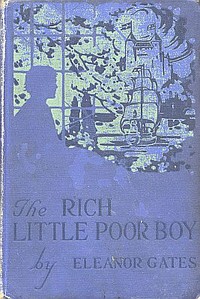
The Rich Little Poor Boy
Language: en1,027 downloads on Project Gutenberg
Subjects
In: Children & Young Adult Reading·Novels·American Literature
Public-domain ebook sourced from Project Gutenberg #24663.
Public-domain ebook
Language: en1,027 downloads on Project Gutenberg
Subjects
In: Children & Young Adult Reading·Novels·American Literature
Public-domain ebook sourced from Project Gutenberg #24663.
The Rich Little Poor Boy is a juvenile‑fiction tale set in a cramped New York tenement, where a ten‑year‑old orphan named Johnnie Smith endures the harsh discipline of his foster father, the dock‑worker Big Tom Barber. The opening passage introduces Johnnie through a vivid physical description, oversized, patched clothing, bright unruly hair, and thin, labor‑worn limbs, that immediately signals his poverty and the demanding chores he performs in the kitchen. The narrative then shifts to a tense exchange between Johnnie and Barber, whose brutal commands and violent gestures establish a world of child abuse and survival, while the brief appearance of Johnnie’s sister Cis hints at a fragile network of silent communication among the children.
Written in a richly detailed, realist style typical of early twentieth‑century American juvenile literature, the prose combines precise, almost anatomical description with a colloquial, gritty dialogue. Readers who appreciate gritty urban settings, strong character sketches, and stories that explore the resilience of children in oppressive environments will find this novel compelling. It especially appeals to those interested in historical portrayals of immigrant‑community life and the stark social realities that shaped early American fiction for young readers.
The opening · free to read
HE was ten. But his clothes were forty. And it was this difference in the matter of age, and, consequently, in the matter of size, that explained why, at first sight, he did not show how thin-bodied he was, but seemed, instead, to be rather a stout little boy. For his faded, old shirt, with its wide sleeves lopped off just above his elbows, and his patched trousers, shortened by the scissors to knee length, were both many times too large for him, so that they lay upon him, front, back and sides, in great, overlapping pleats that were, in turn, bunched into heavy tucks; and his kitchen apron, worn with the waistband about his neck, the strings being tied at the back, also lent him--if viewed from the front--an appearance both of width and weight.
But he was not stout. His frame was not even fairly well covered. From the apron hem in front, the two legs that led down to the floor were scarcely larger than lead piping. From the raveling ends of his short sleeves were thrust out arms that matched the legs--bony, skinny arms, pallid as to color, and with hardly any more shape to them than there was to the poker of the cookstove. But while the lead-pipe legs ended in the sort of hard, splinter-defying boy's feet that could be met with on any stretch of pavement outside the tenement, the bony arms did not end in boyish hands. The hands that hung, fingertips touching halfway to the knee, were far too big for a boy of ten. They were red, too, as if all the blood of his thin shoulders had run down his arms and through his wrists, and stayed there. And besides being red, fingers, palms and backs were lined and crinkled. They looked like the hands of a hard-working, grown girl. That was because they knew dish washing and sweeping, bed making and cooking, scrubbing and laundering.
But his head was all that a boy's head should be, showing plenty of brain room above his ears. While it was still actually--and naturally--large for his body, it looked much too large; not only because the body that did its bidding was undersized, but because his hair, bright and abundant, added to his head a striking circumference.
He hated his hair, chiefly because it had a hint of wave in it, but also because its color was yellow, with even a touch of green! He had been taunted about it--by boys. But what was worse, women and girls had admired it, and laid hands upon it--or wanted to. And small wonder; for in thick undulations it stood away from forehead and temples as if blown by the wind. A part it had not, nor any sort of neat arrangement. He saw strictly to that. Whenever his left hand was not busy, which was less often than he could wish, he tugged at his locks, so that they reared themselves on end, especially at the very top, where they leaned in various directions and displayed what appeared to be several cowlicks. At every quarter that shining mop was uneven, because badly cut by Big Tom Barber, his foster father, whose name belied his tonsorial ability.
Below that wild shock of colorful hair was a face that, when clean, could claim attention on its own account. It was a square-jawed little face over which the red was quick to come, though, unhappily, it did not stay. Its center was a nose that seemed a trifle small in proportion to its surroundings. But the top line of it was straight, and the nostrils were well carved, and had a way of lifting and swelling whenever his interest was caught.
Under them was a mouth that was wide yet noticeably beautiful--not with the soft beauty of a baby's mouth, or a girl's, and not because it could boast even a touch of scarlet. It had been cut as carefully as his nose, the lips full yet firm, their lines drawn delicately, but with strength. It was sensitive, with a little quirk at each corner which betrayed its humor. Above all things, its expression was sweet.
Colorless as were his cheeks and lips, nevertheless he did not seem a pale boy, this because his brows were a misty yellow-white, and his thick lashes flaxen; while his eyes were an indescribable mixture of glowing gray and blue plentifully flecked with yellow. Perfectly adjusted were these straight-looking eyes, and set far apart. By turns they were quick, and bold, and open, and full of eager inquiry; or they were thoughtfully half covered by their heavy lids, very still, and far sighted. And when he laughed, what with the shine of his hair and brows and light lashes, and the flash of his eyes and his teeth, the effect was as if sunlight were upon his face--though the sun so seldom shone upon him that he had not one boyish freckle.
Such was Johnnie Smith.
Just now he was looking smaller and less sunlit than usual. This was because Big Tom bulked in front of him, delivering the final orders for the day before going down the three flights of stairs, out into the brick-paved area, thence through a dank, ground-floor hall which bored its way from end to end of another tenement, and into the crowded East Side street, and so to his work on the docks.
Barber was a huge-shouldered, long-armed slouch of a man, with a close-cropped head (flat at the back) upon which great hairy ears stood out like growths. His eyes were bloodshot and bulging, the left with an elusive cast in it that showed only now and then, when it testified to the kink in his brain. His nose, uneven in its downward trend, was so fat and wide and heavy that it fairly sprawled upon his face; and its cavernous, black nostrils made it seem to possess something that, to Johnnie, was like a personality--as if it were a queer sort of snakish thing, carefully watched over by the bulging, bloodshot eyes.
For Barber's nose had the power of moving itself as Johnnie had seen no other nose move. Slowly and steadily it went up and down whenever Barber ate or talked--as even Johnnie's small, straight nose would often do. But whenever Big Tom laughed--sneeringly or boastfully or in ugly triumph--the nose would make a sudden, sidewise twist.
But something besides its power to move made it seem a live and separate thing: the longshoreman troubled himself to shave only of a Sunday morning, when, with all the stiff, dark growth cleared away to right and left--for Barber's beard grew almost to his eyes--his nose, though bent and purplish, was fairly like a nose. But with Monday, again the nose took on that personality; and seemed to be crouching and writhing at the center of its mat of stubble.
But Barber's mouth was his worst feature, with its great, pushed-out underlip, which showed his complete satisfaction in himself. So big was that lip that it seemed to have acquired its size through the robbing of the chin just beneath--for Big Tom had little enough chin.
But his neck was massive, and an angry red, sprinkled with long, wiry hairs. It fastened his flat-backed head to a body that was like a gorilla's, thick and wide and humped. And his arms gave an added touch of the animal, for they were so long that his great palms reached to his knees; and so sprung out at the shoulder, and so curved in at the wrist, that when they met at the fingers they formed a pair of mammoth, muscled tongs--tongs that gave Barber his boasted value in and out of ships.
His legs were big, too. As he stood over Johnnie now, it was plain to see where the boy's shaggy trousers had come from (the grotesquely big shirt as well). Each of those legs was almost as big as Johnnie's skimped little body. And they turned up at the bottom in great broganned feet that Barber was fond of using as instruments of punishment. More than once Johnnie had felt those feet. And if he could ever have decided how pain was to be inflicted upon him, he would always have chosen the long, thick, pliant strap that belted in, and held together, his baggy clothes. For the strap left colorful tracks that stung only in the making; but the mark of one of those feet went black, and ached to the bone.
Johnnie hated Big Tom worse than he hated his own yellow hair. But he feared him, too. And now listened attentively as the longshoreman, his cutty pipe smoking in one knotted fist, his dinner pail in the other, his cargo hook slung to his burly neck, glowered down upon him.
"Git your dishes done," admonished Barber. "Don't let the mush dry on 'em, and draw the flies."
There being no question to answer, Johnnie said nothing. Final orders of a morning were the usual thing. If he was careful not to reply, if he waited, taking care where he looked, the longshoreman would have his say out and go--pressed by time. So the boy, almost holding his breath, fastened his eyes upon a patch of wall where the smudged plaster was broken and some laths showed. And not a muscle of him moved, except one big toe, which he curled and uncurled across a crack in the rough, worn kitchen floor.
"Git everything else done, too," went on Big Tom. "You don't scrub till to-morrow, so the day's clear for stringin' beads, or makin' vi'lets. And don't let me come home t'night and find no hot supper. You hear me." He chewed once or twice--on nothing.
Johnnie continued silent, counting the laths--from the top down, from the bottom up. But his toe moved a shade faster. For there was a note of rising irritation in that You hear me.
"I say, you hear me!" repeated Big Tom (replies always angered him: this time silence had). He thrust the whole of the short stem of his "nose-warmer" into his mouth. Then, with the free hand, he seized Johnnie by one thin shoulder and gave him a rough, forward jerk.
"Yes," acknowledged the boy, realizing too late that this was one occasion when speech would have been safest. He still concentrated on the laths, hoping that matters would go no further.
But that single jerk, far from satisfying Barber's rancor, only added to it--precisely as if he had tasted something which had whetted his appetite for more. He gripped Johnnie's shoulder again, this time driving him back a step. "Now, no sass!" he warned.
The blood came rushing to Johnnie's face, darkening it so that the misty yellow-white brows stood out grotesquely. And his chest began to heave. He loathed the touch of Barber's hand. He despised the daily orders that only turned him against his work. But most of all he shrank from the indignity of being jerked when it was wholly undeserved.
Big Tom marked the boy's rising color. And the sight spurred his ill-humor. "What do you do for your keep?" he demanded. "_Stop_ pullin' your hair!" He struck Johnnie's hand down with a sweaty palm that touched the boy's forehead. "Pullin' and hawlin' all the time, but don't earn the grub y' swallow!"
Just as one jerk always led to another, so one blow was usually the prelude to a thrashing. Johnnie saw that he must stop the thing right there; must have instant help in diverting Barber. Taking a quick, deep breath, he sounded his call for aid--a loud, croupy cough.
It was instantly answered. The door beside the cookstove swung wide, and Cis came hurrying in from the tiny, windowless closet--this her "own room"--where she had been listening anxiously. "Oh, Mr. Barber," she began, trying to keep her young voice from trembling, "this week can I have enough out of my wages for some more shoe-whitening?"
The book keeps going
Reading is free forever. Sign up and watch scenes appear while you read.



Scenes Storieta drew for other classics.
New illustrated classics
Once or twice a month: the latest books to get full character casts, scene art, and free comic editions. No account needed.