Public-domain ebook
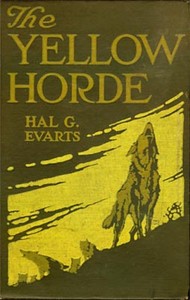
The Yellow Horde
Language: en3,941 downloads on Project Gutenberg
Subjects
Public-domain ebook sourced from Project Gutenberg #25082.
Public-domain ebook
Language: en3,941 downloads on Project Gutenberg
Subjects
Public-domain ebook sourced from Project Gutenberg #25082.
The Yellow Horde is a wilderness adventure that opens with a lyrical night‑scene in the foothills, where the wolfer Collins listens to a chorus of plovers, nighthawks and a thousand prairie wolves. From this vivid soundscape emerges his sardonic commentary on the “little yellow devils” – the coyotes that he, as the self‑styled Coyote Prophet, has long predicted will outlive the men who hunt them. The narrative quickly shifts to the strange, half‑coyote, half‑wolf creature known as Breed, whose yellow fur marks him as a “breed‑wolf.” As he prowls the sage‑brush and stalks a lone steer, the story weaves together his hunger, his yearning for companionship, and the uneasy truce between the coyote and wolf tribes, setting up a tense encounter that promises both survival and solitude.
Written in a richly descriptive, early‑20th‑century style, the prose balances naturalistic detail with a wry, almost philosophical tone. Readers who enjoy immersive frontier settings, animal‑centric perspectives, and a blend of folklore with rugged realism will find this tale compelling. It appeals especially to fans of classic westerns and to those who appreciate a narrative that treats the wild as a character in its own right.
The opening · free to read
The wolfer lay in his cabin and listened to the first few night sounds of the foothills. The clear piping notes of migrating plover floated softly down to him, punctuated by the rasping cry of a nighthawk. A coyote raised his voice, a perfect tenor note that swept up to a wild soprano, then fell again in a whirl of howls which carried amazing shifts of inflection, tearing up and down the coyote scale. One after another added his voice to the chorus until it seemed that the swelling volume could be produced by no less than a full thousand musical prairie wolves scattered through the foothills for a score of miles.
Wild music to the ears of most men, the song of flat wastes and deserts and limitless horizons, freighted with a loneliness which is communicated to man in a positive ache for companionship,--and which carries a wealth of companionship in itself for those who have lived so long under the open skies that the song of the desert choir comes to them as a lullaby.
It moved Collins, the wolfer, to quiet mirth. Always it affected him that way, this first clamorous outburst of the night. He read in it a note of deep-seated humor, the jeering laughter of the whole coyote tribe mocking the world of men who had sworn to exterminate their kind.
"The little devils!" Collins chuckled. "The little yellow devils! Men can't wipe 'em out. There'll be a million coyotes left to howl when the last man dies."
From this oft-repeated prophecy Collins was known to every stockman in three States as the Coyote Prophet, the title a jeering one at first, then bestowed with increasing respect as men saw many of his prophecies fulfilled. The coyote's larger cousin, the wolf, ranged the continent over while the coyote himself was strictly a prairie dweller. For twenty years Collins had predicted that wolves would disappear in settled districts while the coyote would survive; not only survive but increase his range to include the hills and spread over the continent from the Arctic to the Gulf. There were rumors of coyotes turning up in Indiana. Then came the tale that a strange breed of small yellow wolves had appeared in Michigan. Those sheepmen who summered their sheep in the high valleys of the western mountains complained that stray coyotes quit the flats and followed them into the hills to prey upon the flocks. The buffalo wolves that had once infested the range country were gone and it was seldom that any of the big gray killers turned up on the open range except when the pinch of cold and famine drove a few timber wolves down from the north. Men saw these things and wondered if all of Collins' sweeping prophecies would come to pass. In the face of conditions that had placed a value on the coyote's pelt and a bounty on his scalp, there was no apparent decrease in the numbers of the yellow horde from year to year.
Collins listened to the coyote clamor and knew that they had come to stay. The concert was suddenly hushed as a long-drawn wolf howl, faint from distance, drifted far out across the range. Collins turned in his blankets and peered through the window at the black bulk of the mountains to the north of him, towering clear and distinct in the brilliant moonlight.
"If you come down out of those hills I'll stretch your pelt," the wolfer stated. "I'll pinch your toes in a number four."
The wolf whose howl had occasioned this assertion was even then considering the possibilities of which Collins spoke. Men called those of his kind breed-wolves, half coyote and half wolf. He stood on the high divide which was the roughly separating line between the haunts of the two tribes whose blood flowed in his veins,--all wolf except for the yellow fur that marked him for a breed. The coyote voices lifted to him and Breed read them as the call of kind; for although he had spent the past ten months with the wolf tribe of his father his first friendships had been formed among his mother's people on the open range. The acrid spice of the sage drifted to his nostrils and combined with the coyote voices to fill him with a homesick urge to revisit the land of his birth.
But he would not go down. Breed knew well the dangers of the open range; the devilish riders who made life one long gamble for every wolf that appeared; he had gruesome recollections of the many coyotes he had seen in traps. But those things gave him small concern. It was still another menace--the poison baits put out by wolfers--which held him back. Not that he feared poison for himself, but coyotes writhing in convulsions and frothing at the mouth had always filled him with a terrible dread. It was an epidemic of this sort which had driven him to leave the sagebrush land of the coyotes for the heavily timbered country of the wolves. The memory of it lingered with him now. Would he find these stricken, demented creatures there?
Breed moved down the south slope of the hills at last, the sage scent luring the coyote in him, but moved slowly and with many halts occasioned by the wolf suspicion which urged him to turn back. When dawn lifted the shadows from the low country, Breed was prowling along the first rim of the hills.
Two dirt-roofed log cabins showed as toy houses, small from distance, and he could see the slender threads of smoke ascending from others, the houses themselves beyond the scope of his vision. The range was taking on fall shades, the gray of the sage relieved by brown patches of open grasslands and splotches of color where early frosts had touched the birch and willow thickets that marked each side-hill spring. Tiny dark specks moved through it all. Meat! It had been long since Breed had tasted beef, and his red tongue lolled out and dripped in anticipation of the coming feast.
But he would not go down until night. Twice during the early evening Breed howled, and Collins, down in the choppy country below, turned his glasses toward the spot to see what manner of wolf this was who howled in the broad light of day. The second time he located Breed. The yellow wolf stood on the rims half a mile above, looming almost life-size in the twelve-power lens. Collins noted the yellow fur.
"A breed-wolf," he said. "The most cunning devil that ever made a track. He'll never take on a feed of poison bait or plant his foot on a trap pan. He'll come down--and I'll ride him out on the first tracking snow."
Just at dusk Breed howled again and dropped down to the broken country at the base of the hills, skirting the flats and holding to the roughest brakes, then swung out across the rolling foothills.
The wind soon brought him the message that coyotes were just ahead and he traced the scent upwind, anxious for the first sight of his former running mates. Two coyotes scattered swiftly before his approach, each carrying his own piece of a jack rabbit which the pair had caught and torn apart. Breed did not follow but held steadily on in search of more. The urge for companionship was even stronger than hunger, and he sought to satisfy the stronger craving first. Twice more he veered into the wind, and both times the coyotes slipped away as he advanced. He followed the line of one's retreat and the coyote whirled and fled like a yellow streak in the moonlight. Breed was puzzled by all this, but the craving for food had grown so strong as to crowd out all else, and he abandoned the hunt for friends to hunt for meat instead.
Out in the center of a broad flat bench a mile across Breed made out a group of slowly moving specks which he knew for cows, and he headed toward them, taking advantage of the cover afforded by every clump of sage as he crept up to a yearling steer that lagged behind the rest. He had hunted heavy game animals with the wolves, animals with every sense alert to detect the approach of the big gray killers, and he fully expected the steer to break into full flight at the first warning of his presence. He had almost forgotten the stupidity of the cows on the open range and the ease with which he had torn them down when hunting them with his wolf father long before. He made his final rush and drove his teeth deep into one hind leg before his prey had even quickened his gait. The steer lurched into an awkward gallop and bawled with fright as the savage teeth cut through muscles and hide. Breed lunged for the same spot again; once more and the leg was useless, the hamstrings cut, and it sagged loosely with every step. He slashed at the other leg. Within a hundred yards of the start the steer pitched down, bracing his foreparts off the ground with his two front feet, and even as he fell the yellow wolf drove for his throat.
Then Breed circled his kill, looking off in all directions to make sure that there was no route by which men might approach unseen. He stretched forth his head and cupped his lips as he sent his tribal call rolling across the range, the message that here was meat for all of his kind who would come and feed. A score of coyote voices answered from far and near.
Collins heard the dread cry and knew that the wolf had made a kill. He knew too that whenever the wolf note was heard, all other sounds were stilled as if every living creature expected to hear an answering cry and waited for it to come before resuming their own communications. The fact that the coyotes answered the cry assured Collins that it was the breed-wolf that had howled; that coyote ears had read a note of their own kind in the sound, a note which even his experienced ears could not detect.
The yellow wolf tore at the warm meat and waited,--waited for his coyote kinsmen to join him at the feast. He howled again and they answered, reading invitation to coyote as well as to wolf in the sound, but they would not come in. An old dog coyote trotted up and down the crest of a slight rise of ground two hundred yards downwind. Another joined him, then a third, and in less than an hour there was a half score of coyotes circling the spot. Breed could see dim shapes moving across the open places and padding on silent feet over the cow trails that threaded the sage. Surely they would come in. The shadowy forms were restless, never still, and prowled round and round him, but they would not join him at the kill.
Breed was mystified by this strange thing. Here was meat yet the meat-eaters would not come in and feed. Coyotes had fed with him long ago but shunned him now. Breed could not know that then he had been accepted as one of them, having grown to maturity among them and so become known to every coyote on his range; that they had forgotten him as an individual, as he had also forgotten them. If there were any old friends among those who circled round him now he did not know them as such, only as a companionable whole; and they knew him for a wolf,--a wolf at least in size and strength. There was a coyote note in his call but not one of them would venture in to feed with the great yellow beast that was tearing the steer.
At last a grizzled old dog coyote drew up to within ten yards. He had lived to the limit of all experiences which a coyote can pass through and still survive. He had even known the crushing grip of a double-spring trap, a Newhouse four. This misadventure had occurred in midwinter when the range was gripped by bitter frost. The cold had numbed the pain and congealed the flesh to solid ice. He had cut through the meat with his keen-pointed teeth, and one desperate wrench had snapped the frozen bone and freed him. There were many of his kind so maimed, and the wolfers, abbreviating the term peg-legs, called these three-footed ones "pegs."
The book keeps going
Reading is free forever. Sign up and watch scenes appear while you read.



Scenes Storieta drew for other classics.
New illustrated classics
Once or twice a month: the latest books to get full character casts, scene art, and free comic editions. No account needed.