Public-domain ebook
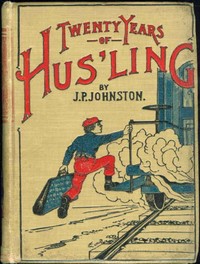
Twenty Years of Hus'ling
Language: en13,867 downloads on Project Gutenberg
Subjects
In: Biographies·American Literature·Business/Management
Public-domain ebook sourced from Project Gutenberg #25087.
Public-domain ebook
Language: en13,867 downloads on Project Gutenberg
Subjects
In: Biographies·American Literature·Business/Management
Public-domain ebook sourced from Project Gutenberg #25087.
Twenty Years of Hus'ling is a first‑person memoir of entrepreneurial hustle written by James Perry Johnston, a 19th‑century businessman whose career spanned insurance, government‑goods sales, jewelry, and even a brief stint as a newspaper reporter. The opening chapter thrusts the reader into the narrator’s restless pursuit of profit, beginning with a chance meeting that lands him a commission as an insurance agent, a rapid succession of lucrative contracts, and an abrupt departure when he doubts the industry’s riches. Johnston’s account then follows his cash‑rich exit to Chicago, his foray into government surplus merchandise, and the inevitable pitfalls of over‑extension, all narrated in a brisk, episodic style that mirrors his restless ventures.
The voice is unapologetically candid, peppered with colloquial turns of phrase and the occasional self‑deprecating humor that reflects its post‑Civil War setting. Its straightforward, anecdotal prose captures the optimism and volatility of the Gilded Age’s commercial frontier. Readers who relish gritty business chronicles, period‑specific social observation, or the raw energy of a self‑made man’s trial‑and‑error will find this work both instructive and entertaining.
The opening · free to read
He then took me to his office and after giving me a few instructions, gave me the necessary papers and sent me out.
The very first day I took three applications. The company insured on the installment plan, by issuing a policy for five years, the first payment of forty cents a hundred per year, was to be paid when the application was taken, and the balance made payable in equal annual installments.
The agent's commission was the first installment, or twenty per cent. of the gross amount.
I was not long in learning that the rate charged by this company was just double that of any other in existence, but the people readily fell in with the idea of paying their insurance by installments.
I gave it a week's trial and was immensely successful, and turned my applications over to Mr. Forster, but was careful to sign my name to them in full, as sub-agent.
He made an equal division of commission with me, which I was not satisfied with. I then quit, when Mr. Forster called in about a week to see why I didn't keep "hus'ling," as I had been doing so nicely.
"Well," said I, "Mr. Forster, it's against my principles to steal and give some one else half. I can't afford to go out and rob my neighbors and acquaintances, and give you any part of it."
He had no more to say. A few days later, I received a letter from the secretary of this company, asking if I would like to become their agent. I answered that I would, and on receipt of my certificate went to work in earnest.
Before two weeks had elapsed, I was the agent for three other first-class fire companies, whose rates were as low as the lowest. I also had a first-class life and accident company. I commenced in the morning, and worked until late at night.
The first intimation I had that I was doing an extra good business, was when I received a letter from the secretary of one of the companies saying: "Go for them, Johnston, you have sent in more applications under one date, and made a larger thirty days' average, than has ever been made by any agent of our company," and added that I might consider that as a compliment, as they always had hundreds of agents, and in all parts of the United States. This letter was received from him after I had been working at the business some months. And I decided at once to quit the business forthwith.
"Now it is certain I can never get rich working at the insurance business." At least, I could not recall to my mind a single instance, where anyone had ever made more than a living, especially in a country town, and I argued, that if I had proved myself so far superior to all other insurance agents, I couldn't see why it wasn't possible for me also to excel in a better paying business.
I therefore desired to sell out, the first chance I got, which I soon did, receiving five hundred dollars for my business, horse and buggy.
I also had four hundred dollars' worth of notes I had taken for insurance, which belonged to me as commissions. These I got discounted, receiving in cash three hundred and twenty-five dollars. I then collected my note against the man to whom I had sold the jewelry.
Now I had over one thousand dollars in cash, and was ready to start for Chicago. I called on those creditors who held my notes, which were not yet due, and assured them I was on the right road to success, and that with the use of the money I then had, I was certain to win, as I thought of investing in jewelry as a jobber, which business, I had from my first experience, always determined to try again if I ever succeeded in getting money enough.
During this same summer, Mr. Keefer traded his fine farm three miles from town for a house and lot in town, and a small fruit farm one mile out, and received some cash besides. They had moved in town about the time I was ready to start for Chicago.
My mother said, that while I had so much money, it would be a good to pay back some I had borrowed of them, before I lost it all.
Mr. Keefer said there was no hurry about that, he knew I would pay it all back some day, because I had always told him I would, and he believed now I was going to make lots of money.
I bade them good-bye, and left for Chicago, where I arrived the following morning, when I immediately set out to investigate the jewelry business. I very soon became satisfied that the few wholesalers I had called upon were "wolves," and convinced that there was a wolf for every lamb, I "hus'led" away "to try the jewelry another day."
I then began scanning the "wants" and "business chances" in the different daily papers, when I noticed an advertisement from Colonel O. Lippencott, who was the United States agent for the sale of government goods, such as guns, saddles, harnesses, blankets, soldiers' clothing, etc., which had been left over after the late war.
I called on him, and he convinced me that with a stock of twenty-five hundred dollars, I could make money fast.
I asked how about one thousand dollars' worth. He said it wouldn't pay with so small a stock, and said I could pay one thousand dollars down, and give a bond for the other fifteen hundred dollars. I told him about Mr. Keefer, and he very soon ascertained that his bond would be good. He then filled one out and I sent it to him marked "confidential," along with a letter explaining "just how it was."
It was promptly returned to me with his signature attached.
The goods were soon packed and shipped to a point in Michigan. I hired a young man to go with me as clerk.
Our success was better than I anticipated.
I would rent a room in a fair-sized town and advertise extensively, and remain three or four weeks.
The young man I had with me was about my own age, a jolly good fellow, a sharp salesman and hard worker, but he had many extravagant habits which I had never yet fallen into.
He was fond of billiards, and insisted that I should learn the game, which I was foolish enough to do. In less than one week I was dreaming every night of ivory balls of all sizes and colors, of billiard cues of all weights and shapes, and tables of all styles. My clerk declared I had gotten up in the night and walked round and round our bed, with an old broom in my hand, trying to play billiards and talking in my sleep about carrom and masse shots and pocketing balls.
I had no reason to doubt his statement, for it was a fact that I had become so infatuated with the game that it was almost impossible to resist it, and in fact I had no desire to do so.
I enjoyed it greatly, so much so that I got into the habit of leaving the store during business hours to indulge in it. And there never was an evening that we were not in the billiard room till it closed for the night. My clerk was a good player, and enjoyed playing with me no doubt, because he could easily beat me, and because I had plenty of money with which to pay the bills.
He was fond of balls and parties, and like myself, enjoyed ladies' society, and we were both susceptible to their influence. We soon fell in with the "jolly good fellows" of every town, many of whom were able to indulge in a lavish expenditure of money, while by rights neither of us could afford anything better than a plain, comfortable living; but as we had joined them, we must be "good fellows" also. Consequently I very soon found my business running behind.
There was no day when the profits were not large, but my expenses were enormous. I realized that the billiard game was dragging me down, and every night after settling my bills I would say that I didn't think I would ever play any more. I was very careful however, not to declare myself against it entirely, because I loved it too well.
We traveled from town to town constantly running behind. Towards spring we made a stop at Bronson, Michigan, where we continued to "fly high," as we used to express it, and at this place while attending a ball, I met a young lady who afterwards became my wife. We remained there six weeks, when my clerk left for home.
As my contract with Colonel Lippencott would expire on March first, at which time I was to return all unsold goods, for which I would receive credit, or cash refunded, I packed and shipped my remaining stock to him, with instructions to send me a statement of account to White Pigeon, Michigan. There I went with a view to meeting an old friend, who I found had left for the West a few days prior to my arrival. Finding, however, a comfortable stopping place, I remained there to await the statement from Colonel Lippencott.
I of course realized, from my rude system of book-keeping, and the way the goods invoiced, that I was a considerable loser. The way I figured it, I would have at least one hundred dollars my due on settlement. But imagine my surprise, when I received a statement showing a shortage of seventy-five dollars, which Mr. Keefer would be obliged to pay. I was then owing a week's board bill, and had not a cent to my name.
After carefully examining Colonel Lippencott's statement, I was satisfied that he was correct.
I saw where I had failed to charge myself up and credit him with nearly two hundred dollars' worth of goods, at a time, no doubt, when I had an engagement with some "dude" to play billiards.
I immediately wrote Colonel Lippencott that I would return home soon, when the deficit would be made good.
I was now at a loss to know how to "make a raise." While sitting in the hotel office one afternoon contemplating matters most seriously, and feeling silly and foolish over my winter's exploit, a young, despondent-looking chap came into the office carrying a valise and bag, about half filled with something. He registered, and after making rates with the landlord, took a seat near me. He had a woe-begone look, and seemed nervous and anxious.
I immediately opened up conversation with him, and learned he was from a small town in Illinois, whence he had started as a canvasser, selling nutmeg-graters.
I asked how he was doing. He said he had been out three days, and hadn't sold a grater.
The book keeps going
Reading is free forever. Sign up and watch scenes appear while you read.



Scenes Storieta drew for other classics.
New illustrated classics
Once or twice a month: the latest books to get full character casts, scene art, and free comic editions. No account needed.
![Cover of Business Administration: Theory, Practice and Application. [Vol. 1] Business Economics](/covers/56018.jpg)