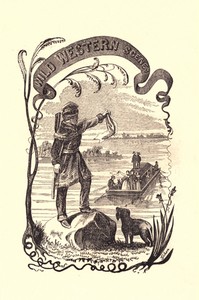
A light wind blew over the great, primeval wilderness of Kentucky, the dense, green foliage rippling under it like the waves of the sea. In every direction forest and canebrake stretched in countless miles, the trees, infinite in variety, and great in size, showing that Nature had worked here with the hand of a master. Little streams flashing in silver or gold in the sunlight, flowed down to the greater rivers, and on a bush a scarlet tanager fluttered like a flash of flame.
A youth, uncommon in size and bearing, stepped into a little opening, and looked about with the easy, natural caution belonging to the native of the forest who knows that danger is always near. His eyes pierced the foliage, and would have noticed anything unusual there, his ear was so keen that he would have heard at once any sound not a part of the woods.
Eye and ear and the indefinable powers of primitive man told him no enemy was at hand, and he stood on the green hill, breathing the fresh, crisp air, with a delight that only such as he could feel. Mighty was the wilderness, majestic in its sweep, and depth of color, and the lone human figure fitted into it perfectly, adding to it the last and finishing touch.
He blended, too, with the forest. His dress, wholly of fine, tanned deerskin, was dyed green, the hunting shirt fringed, hunting shirt, leggings and moccasins alike adorned with rows of little beads. Fitting thus so completely into his environment, the ordinary eye would not have observed him, and his footsteps were so light that the rabbits in the bush did not stir, and the flaming bird on the bough was not frightened.
Henry Ware let the stock of his rifle rest upon the ground and held it by the barrel, while he gazed over the green billows of the forest, rolling away and away to every horizon. He was a fortunate human being who had come into his own kingdom, one in which he was fitted supremely to reign, and he would not have exchanged his place for that of any titular sovereign on his throne.
His eyes gleamed with pleasure as he looked upon his world. None knew better than he its immense variety and richness. He noted the different shades of the leaves and he knew by contrast the kind of tree that bore them. His eye fell upon the tanager, and the deep, intense scarlet of its plumage gave him pleasure. It seemed fairly to blaze against the background of woodland green, but it still took no alarm from the presence of the tall youth who neither stirred nor made any sound.
Another bird, hidden behind an immense leaf, began to pour forth the full notes of a chattering, mocking song, almost like the voice of a human being. Henry liked it, too, although he knew the bird was flinging him a pretty defiance. It belonged in his world. It was fitting that one singer, many singers, should live in his wilderness and sing for him.
A gray squirrel, its saucy tail curved over its back, ran lightly up an oak, perched on a bough and gazed at him with a challenging, red eye. Henry gave back his look, and laughed in the silent manner of the border. He had no wish to hurt the swaggering little fellow. His heart was bare of ill will against anything.
A deep, clear creek flowed at the base of the hill, and a fish, snapping at a fly, leaped clear of the water, making a silver streak in the air, gone in an instant as he fell back into the stream. The glimpse pleased Henry. It, too, was a part of his kingdom, stocked with fur, fin and feather, beyond that of any other king, and far more vast.
The brilliant sunlight over his head began to dim and darken. He looked up. The van of a host, the wild pigeons flying northward appeared, and then came the great wide column, millions and millions of birds, returning from their winter in the south. He had seen the huge flights before, but the freshness and zest of the sight never wore away. No matter how far they came nor how far they went they would still be flying over his forest empire. And then would come the great flocks of wild ducks and wild geese, winging swiftly like an arrow toward the north. They, too, were his, and again he took long, deep breaths of a delight so keen that it made his pulses leap.
From the wood at the base of the hill came a crackling sound as of something breaking, and then the long crash of a tree falling. He went a little way down the slope and his moccasins made no sound in the grass. Gently pulling aside the bough of a sheltering bush he saw the beavers at work. Already they were measuring for lengths the tree they had cut through at the base with their long, sharp teeth.
The creek here received a tributary brook of considerable volume, and the dam erected by the beavers had sent the waters far back in a tiny sheet like a little lake. But as Henry saw, they were going to raise the dam higher, and they were working with the intelligence and energy that belong so peculiarly to the beaver. Four powerful fellows were floating a log in the water, ready to put it into place, and others on the bank were launching another.
It was one of the largest beaver colonies he had ever seen, and he watched it with peculiar enjoyment. He killed the beaver now and then--the cap upon his head was made of its skin--but only when it was needful. The industrious animals were safe from his rifle now, and he felt that his wilderness had no more useful people.
He looked at them a long time, merely for the pleasure of looking. They showed so much skill, so much quickness and judgment that he was willing to see and learn from them. He felt, in a sense, that they were comrades. He wished them well in their work, and he knew that they would have snug houses, when the next winter came.
He left them in their peace, returned to the brow of the hill, and then walked slowly down the other side. He heard a woof, a sound of scrambling, and a black bear, big in frame, but yet lean from the winter, ran from its lair in the bushes, stopped a moment at fifty or sixty yards to look hard at him, and then, wheeling again in frightened flight disappeared among the trees. Henry once more laughed silently. He would not have harmed the bear either.
A puffing, panting sound attracted his attention, and, walking farther on, he looked into a glade, in which the grass grew high and thick. He had known from the character of the noise that he would find buffaloes there, and they numbered about a dozen, grazing a while, and then breathing heavily in content. He had seen them in countless herds on the western plains, when he was with Black Cloud and his tribe, but south of the Ohio, owing to the heavy forest, they were found only in small groups, although they were plentiful.
The wind was blowing toward him, and standing partially behind a huge oak he watched them. They were the finest and largest inhabitants of his wilderness, splendid creatures, with their leonine manes and huge shoulders, beasts of which any monarch might be proud. He could easily bring down any one of them that he wanted with his rifle, but they were safe from all bullets of his.
He looked at them a while, as a man would gaze at a favorite horse. There was a calf among them, and whenever it wandered from the middle of the glade toward the edge of the forest the mother would push it back. Henry, studying the woods there, saw just within their shadow the long slinking figures of two gray wolves. He knew their purpose, but he knew also that it would not be fulfilled.
He watched the little forest drama with an interest none the less because it was not new to him. He saw the gray shadows creeping nearer and nearer, while the calf persistently sought the woods, probably for shade. Presently the leader of the herd, an immense bull, almost black, caught an odor, wheeled like lightning and rushed upon the wolves. There was a single yelp, as one was trampled to death, and the other fled through the forest to seek easier prey.
The buffaloes returned to their grazing and the foolish calf, warned by the danger from which he had been saved, stayed in the middle of the glade, with his elders as a wall around him. Henry smiled. He had foreseen the result, and it was wholly to his liking. He passed around the opening, not wishing to disturb the animals, and went northward, always on soundless feet.
A stag, catching the human odor on the wind, sprang from a thicket, and crashed away in wild alarm. Henry laughed again and waved his hand at the fleeting figure. The stag did not know that he had no cause to dread him, but Henry admired his speed. A flock of wild turkeys rose from a bough above his head, and uttering preliminary gobbles, sailed away in a low flight among the trees. He waved his hand at them also, and noticed before they disappeared how the sunlight glowed on their bronze feathers.
It was a fine morning in his kingdom, and he was seeing many forms of its life. He remarked a bee tree, and thought it probable that the runaway bear would make a try there some day for honey. Then he stopped and looked at a tiny blue flower, just blooming in the shelter of a bush. He examined it with appreciation and touched the delicate leaf very gently, lest he break it away. Little and fragile, it had its place nevertheless in his realm.
His course led him back to the creek, here very deep and clear and running over a gravelly bottom. After looking and listening for a little while, he undressed, laid his rifle and other weapons on the very edge of the bank, where he could reach them in an instant, and dropped silently into the water. It was cool and he shivered at first, but as he swam the warmth returned to his veins.
He was a splendid swimmer, and he was careful not to splash or make any other sound that could be heard far. It was glorious there in the water, and he was loath to leave it. He lay on his back, floated a little with the current, and then with strokes strong, swift and silent, swam back again.
His eyes looked up into a blue sky, sprinkled with many little white clouds golden at the edge. The huge flight of pigeons had passed and no longer dimmed the sun. He could just see the last of the myriads on the edge of the northern horizon. But there was a sudden flash of black across the blue, and a hawk shot down into the forest. A bald eagle sailed in slow majesty above the trees, and, well within the shelter of the foliage near him, many small birds were twittering. The air over his realm as well as the forests and waters was full of life.
He came out, allowed himself to dry in the sun, while he flexed and tensed his powerful muscles. Then he dressed. The swim had been good, and he was glad that he had taken the risk. He was aware that the forest contained inhabitants much more dangerous than those he had looked upon that morning, but he had not yet seen any sign of them, and he was one who had learned to use his opportunities.
After luxuriating for a little while on the grass, Henry, rifle on shoulder, walked swiftly forward. He had a definite purpose and it was to rejoin his four comrades, Paul Cotter, Shif'less Sol Hyde, Long Jim Hart and Tom Ross, who were not far away in the greenwood, the five, since the repulse of the great attack upon the wagon train, continuing their chosen duties as keepers of the trail, that is, they were continually on guard in the vast forest and canebrake against the Northwestern Indians who were making such a bitter war upon the young Kentucky settlements.