Public-domain ebook
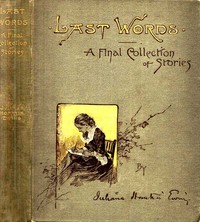
Last Words: A Final Collection of Stories
Language: en4,658 downloads on Project Gutenberg
Subjects
In: Short Stories·Children & Young Adult Reading·British Literature
Public-domain ebook sourced from Project Gutenberg #25710.
Public-domain ebook
Language: en4,658 downloads on Project Gutenberg
Subjects
In: Short Stories·Children & Young Adult Reading·British Literature
Public-domain ebook sourced from Project Gutenberg #25710.
The volume is a modest anthology of juvenile tales by Juliana Horatia Ewing, first assembled after the author’s death and anchored by the serial “Mary’s Meadow,” which originally ran in Aunt Judy’s Magazine between November 1883 and March 1884. The opening story introduces a countryside dispute over a narrow right‑of‑way through a flower‑strewn meadow, narrated through the eyes of a young girl who observes the quarrelling adults, the loyal bull‑dog Saxon, and the whispered folklore of nightingales and garden societies. Ewing’s prose weaves together domestic humor, a sketch of rural life, and a gentle moral about generosity and neighborliness, while the table of contents promises further whimsical episodes such as “Snap‑Dragons,” “The Blind Man and the Talking Dog,” and “The Trinity Flower.”
Ewing’s voice is unmistakably Victorian, marked by a warm, conversational tone that balances earnest instruction with playful dialogue. Her sentences flow with the measured cadence of late‑19th‑century children’s literature, peppered with regional dialect and affectionate caricatures of servants and landowners. Readers who enjoy gentle moral stories, nostalgic garden settings, and the charm of a bygone era’s domestic imagination will find this collection a pleasant companion.
The opening · free to read
PREFACE.
"Mary's Meadow" first appeared in the numbers of Aunt Judy's Magazine from November 1883, to March 1884. It was the last serial story which Mrs. EWING wrote, and I believe the subject of it arose from the fact that in 1883, after having spent several years in moving from place to place, she went to live at Villa Ponente, Taunton, where she had a settled home with a garden, and was able to revert to the practical cultivation of flowers, which had been one of the favorite pursuits of her girlhood.
The Game of the Earthly Paradise was received with great delight by the readers of the story; one family of children adopted the word "Mary-meadowing" to describe the work which they did towards beautifying hedges and bare places; and my sister received many letters of enquiry about the various plants mentioned in her tale. These she answered in the Correspondence columns of the Magazine, and in July 1884, it was suggested that a "Parkinson Society" should be formed, whose objects were "to search out and cultivate old garden flowers which have become scarce; to exchange seeds and plants; to plant waste places with hardy flowers; to circulate books on gardening amongst the Members;" and further, "to try to prevent the extermination of rare wild flowers, as well as of garden treasures."
Reports of the Society, with correspondence on the exchanges of plants and books, and quaint local names of flowers, were given in the Magazine until it was brought to a close after Mrs. EWING'S death: but I am glad to say that the Society itself is still in existence, and any one who wishes to procure a copy of its Rules can do so by sending a stamped envelope to the Secretary, Miss Alice Sargant, 7 Belsize Grove, N. W. Miss SARGANT was the originator of the scheme, so its management remains in the best possible hands, and Professor OLIVER, of Kew Gardens, has consented to become President in Mrs. EWING'S place. She owed to him her first introduction to Paradisi in sole Paradisus terrestris, as well as many other kind acts of help on flower subjects.
HORATIA K. F. GATTY.
May, 1886.
The book keeps going
Reading is free forever. Sign up and watch scenes appear while you read.



Scenes Storieta drew for other classics.
New illustrated classics
Once or twice a month: the latest books to get full character casts, scene art, and free comic editions. No account needed.