Public-domain ebook
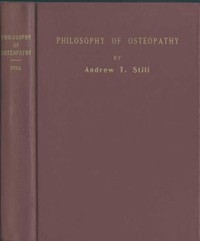
Philosophy of Osteopathy
by A. T. Still
English3,948 downloads on Project GutenbergDownload EPUB
Public-domain ebook sourced from Project Gutenberg #25864.
Public-domain ebook
by A. T. Still
English3,948 downloads on Project GutenbergDownload EPUB
Public-domain ebook sourced from Project Gutenberg #25864.
Andrew Taylor Still’s Philosophy of Osteopathy is a polemical treatise that opens with a candid confession of his doubts about the premature popularity of osteopathic medicine. He frames the discipline as a “great unknown sea,” contrasting his own experiential observations with the prevailing drug‑based approaches of his time. The introductory passage makes clear that the work is not a compilation of other authors’ ideas; instead, Still promises to present principles derived from his own practice, emphasizing anatomy, the fascia, and the natural forces he believes govern health. The table of contents reveals a systematic exploration of the body, from the head and ear to the lymphatics, diaphragm, and even obstetrics, each chapter offering his personal reasoning rather than conventional medical prescriptions.
The voice is unmistakably that of a late‑19th‑century physician‑reformer, marked by earnest rhetoric, frequent appeals to nature and divine order, and a didactic tone aimed at students and fellow practitioners. Its style blends dense, almost sermon‑like prose with detailed anatomical speculation, reflecting the era’s blend of scientific optimism and moral certainty. Readers interested in the historical roots of alternative medicine, the evolution of medical thought, or the fervent advocacy of early osteopathy will find Still’s uncompromising perspective both illuminating and a vivid illustration of the period’s intellectual climate.
The opening · free to read
Copyrighted, 1899, by A. T. STILL.
Lithoprinted by EDWARD BROTHERS, INC. Ann Arbor, Michigan, U.S.A.
Preface.
Many of my friends have been anxious ever since Osteopathy became an established fact, that I should write a treatise on the science. But I was never convinced that the time was ripe for such a production, nor am I even now convinced that this is not a little premature. Osteopathy is only in its infancy, it is a great unknown sea just discovered, and as yet we are only acquainted with its shore-tide.
When I saw others who had not more than skimmed the surface of the science, taking up the pen to write books on Osteopathy, and after having carefully examined their productions, found they were drinking from the fountains of old schools of drugs, dragging back the science to the very systems from which I divorced myself so many years ago, and realized that hungry students were ready to swallow such mental poison, dangerous as it was, I became fully awakened to the necessity of some sort of Osteopathic literature for those wishing to be informed.
This book is free from quotations from medical authors, and differs from them in opinion on almost every important question. I do not expect it to meet their approval; such a thing would be unnatural and impossible.
It is my object in this work to teach principles as I understand them, and not rules. I do not instruct the student to punch or pull a certain bone, nerve or muscle for a certain disease, but by a knowledge of the normal and abnormal, I hope to give a specific knowledge for all diseases.
This work has been written a little at a time for several years, just as I could snatch a moment from other cares to devote to it. I have carefully compiled these thoughts into a treatise. Every principle herein laid down has been fairly well tested by myself, and proven true.
The book has been written by myself in my own way, without any ambition to fine writing, but to give to the world a start in a philosophy that may be a guide in the future.
Owing to the great haste with which the book has been rushed through the press to meet the urgent demand, we will ask the indulgence of the public for any imperfection that may appear. Hoping the world may profit by these thoughts, I am,
Respectfully, A. T. STILL.
Kirksville, Mo., Sept. 1, 1899.
TABLE OF CONTENTS.
The book keeps going
Reading is free forever. Sign up and watch scenes appear while you read.



Scenes Storieta drew for other classics.
New illustrated classics
Once or twice a month: the latest books to get full character casts, scene art, and free comic editions. No account needed.