
Public-domain ebook
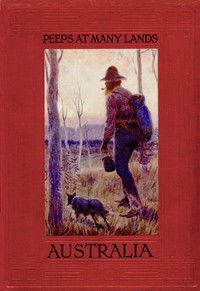
Peeps At Many Lands: Australia
by Frank Fox
Language: en3,078 downloads on Project Gutenberg
Subjects
In: Travel Writing·History - Other·Nature/Gardening/Animals
Public-domain ebook sourced from Project Gutenberg #25976.
Public-domain ebook
by Frank Fox
Language: en3,078 downloads on Project Gutenberg
Subjects
In: Travel Writing·History - Other·Nature/Gardening/Animals
Public-domain ebook sourced from Project Gutenberg #25976.
Frank Fox’s “Peeps At Many Lands: Australia” is a sweeping survey of the continent’s geological birth, its isolation, and the slow arc of human discovery that culminated in British settlement. The opening passages treat Australia as a “curious isolated position,” tracing its ancient separation from Asia through volcanic upheavals and the erosion of a once‑ring‑shaped landmass into the flat plain we recognize today. Fox then sketches a panorama of early explorers, from Marco Polo’s vague rumors to Dutch voyages, the Spanish admiral De Quiros, and finally Captain Cook’s thorough British reconnaissance, before moving on to the hardships of the First Fleet, the struggle to cross the Blue Mountains, and the relentless push into the interior. The narrative weaves geological speculation with a chronicle of colonial ambition, setting the stage for a detailed account of Australia’s transformation from a “sleeping” continent to a thriving British outpost.
The work reads like a late‑Victorian travelogue, its prose dense with earnest description, moral reflection, and a distinctly imperial tone that celebrates British perseverance while occasionally casting a critical eye on the hardships of frontier life. Fox’s voice is that of a knowledgeable, if somewhat didactic, commentator who blends scientific observation with a narrative of heroic settlement. Readers who enjoy expansive historical overviews, especially those interested in early scientific theories of continental drift, colonial exploration, and the rugged challenges faced by 18th‑ and 19th‑century pioneers, will find this book rewarding. It appeals to lovers of detailed geographical essays and to anyone fascinated by the way a distant land was gradually mapped, colonized, and mythologized in the age of empire.
The opening · free to read
How Australia came to be in her curious isolated position in the very beginning is not quite clear. The story of some of the continents is told in their rocks almost as clearly as though written in books. But Australia is very, very old as a continent--much older than Europe or America or Asia--and its story is a little blurred and uncertain partly for that reason.
Look at the map and see its shape--something like that of a pancake with a big bite out of the north-eastern corner. In the very old days Australia was joined to those islands on the north--the East Indies--and through them to Asia; but it was countless ages ago, for the animals and the plants of Australia have not the least resemblance to those of Asia. They represent a class quite distinct in themselves. That proves that for a very long time there has been no land connection between Australia and Asia; if there had been, the types of flower and of beasts would be more nearly kindred. There would be tigers and elephants in Australia and emus in Asia, and the kangaroo and other marsupials would probably have disappeared. The marsupial, it may be explained, is one of the mammalian order, which carries its young about in a pouch for a long time after they are born. With such parental devotion, the marsupials would have little chance of surviving in any country where there were carnivorous animals to hunt them down; but Australia, with the exception of a very few dingoes, had no such animals, so the marsupials survived there whilst vanishing from all other parts of the earth.
When Australia was sundered from Asia, probably by some great volcanic outburst (the East Indies are to this day much subject to terrible earthquakes and volcanic outbreaks, and not so many years ago a whole island was destroyed in the Straits of Sunda), the new continent probably was in the shape somewhat of a ring, with very high mountains facing the sea, and, where now is the great central plain, a lake or inland sea. As time wore on, the great mountains were ground down by the action of the snow and the rain and the wind. The soil which was thus made was in part carried towards the centre of the ring, and in time the sea or lake vanished, and Australia took its present form of a great flat plain, through which flow sluggish rivers--a plain surrounded by a tableland and a chain of coastal mountains. The natives and the animals and plants of Australia, when it first became a continent, were very much the same, in all likelihood, as now.
Thus separated in some sudden and dramatic way, Australia was quite forgotten by the rest of the world. In Asia, near by, the Chinese built up a curious civilization, and discovered, among other things, the use of the mariner's compass, but they do not seem to have ever attempted to sail south to what is now known as Australasia. The Japanese, borrowing culture from the Chinese, framed their beautiful and romantic social system, and, having a brave and enterprising spirit, became seafarers, and are known to have reached as far as the Hawaiian Islands, more than halfway across the Pacific Ocean to America; but they did not come to Australia. The Indian Empire rose to magnificent greatness; the Empires of Babylon, of Nineveh, of Persia, came and went. The Greeks, and the Romans later, penetrated to Hindustan. The Christian era came, and later the opening up of trade with the East Indies and with China.
But still Australia slept, in her out-of-the-way corner, apart from the great streams of human traffic, a rich and beautiful land waiting for her Fairy Prince to waken her to greatness. There had been, though, some vague rumours of a great island in the Southern Seas. A writer of Chios (Greece) 300 years before the Christian era mentions that there existed an island of immense extent beyond the seas washing Europe, Asia, and Africa. It is thought that Greek soldiers who had accompanied Alexander the Great to India had brought rumours from the Indians of this new land. But if the Indians knew of Australia, there is no trace of their having visited the continent.
Marco Polo, the Venetian traveller, who explored the East Indies, speaks of a Java Major as well as a Java Minor, and in that he may refer to Australia; but he made no attempt to reach the land. Some old maps fill up the ocean from the East Indies to the South Pole with a vague continent called Terra Australis; but plainly they were only guessing, and did not have any real knowledge.
In the fifteenth and sixteenth centuries Spanish and Portuguese sailors pushed on bravely with the work of exploring the East Indies, and some of their maps of the period give indications of a knowledge of the existence of the Australian Continent. But the definite discovery did not come until 1605, when De Quiros and De Torres, Spanish Admirals, sailed to the East Indies and heard of the southern continent. They sailed in search of it, but only succeeded in touching at some of the outlying islands. One of the New Hebrides De Quiros called "Terra Australis del Espiritu Santo" (the Southern Land of the Holy Ghost), fancying the island to be Australia. That gave the name "Australia," which is all that survives to remind us of Spanish exploration.
In the sixteenth and seventeenth centuries Dutch sailors set to work to search for the new southern land, and in 1605, 1616, and 1617 undoubtedly touched on points of Australia. In 1642 Tasman--from whom Tasmania, a southern island of Australia, gets its name--made important discoveries as to the southern coast. He called the island first Van Diemen's Land, after Maria Van Diemen, the girl whom he loved; but this name was afterwards changed. Maria Island, off the coast of Tasmania, still, however, keeps fresh the memory of the Dutch sailor's sweetheart.
But none of these nations was destined to be the Fairy Prince to waken Australia out of her long sleep. That privilege was kept for the British race; we cannot but think happily, for no Spanish or Dutch colony has ever reached to the greatness and the happiness of an Australia, a Canada, or a South Africa. It is in the British blood, it seems, to colonize happily. The gardeners of the British race know how to "plant out" successfully. They shelter and protect the young trees in their far-away countries through the perils of infancy, and then let them grow up in healthy and vigorous independence. This wise method is borrowed from family life. If a child is either too much coddled, or too much kept under in its young days, it will rarely grow to the best and most vigorous manhood or womanhood. British colonies grow into healthy nations just as British schoolboys grow into healthy men, because they are, at an early stage, taught to be self-reliant.
It was not until 1688 that Australia was in any way explored by the English Captain, William Dampier. His reports on the new land were not very flattering. He spoke of its dry, sandy soil, and its want of water. This Sleeping Beauty had a way of pretending to be ugly to the new-comer.
From 1769 to 1777 Captain Cook carried on the first thorough British exploration of Australia, and took possession of it and New Zealand for the British Crown. In 1788, just a century after its first exploration by a British seaman, Australia was actually occupied by Great Britain, "the First Fleet" founding a settlement on the shores of Port Jackson, by the side of a little creek called the Tank Stream. That was the beginning of Sydney, at present one of the greatest cities of the British Empire.
A great continent had been thus entered. The Sleeping Beauty was aroused from the slumber of centuries. But very much had yet to be done before she could "marry the Prince and then live happily ever afterwards." The story of how that was done, and how Australia was explored and settled, is one of the most heroic of our British annals. True, no wild animals or warlike tribes had to be faced; but vast distances of land which of itself produced little or no food for man, the long waterless stretches, the savage ruggedness of the mountains, set up obstacles far more awesome because more strange. Man had to contend, not with wild animals, whose teeth and claws he might evade, nor with wild men whose weapons he could overmatch with his own, but with Nature in what seemed always a hostile and unrelenting mood. It almost seemed that Nature, unwilling to give up to civilization the last of the lonely lands of the earth, made a conscious effort to beat back the advance of exploration and civilization.
On the little coastal settlement famine was soon felt. The colonists did not understand how to get crops from the soil. They attempted to follow the times and the manners of England; but here they were in the Antipodes, where everything was exactly opposite to English conditions. There were no natural grain-crops; there were practically no food-animals good to eat. The kangaroo and wallaby provide nowadays a delicious soup (made from the tails of the animals), but the flesh of their bodies is tough and dark and rank. Even so it was in very limited supply. The early settlers ate kangaroo flesh gladly, but they were not able to get enough of it to keep them in meat.
Communication with England, whence all food had to come, was in those days of sailing-ships slow and uncertain. At different times the first settlement was in actual danger of perishing from starvation and of being abandoned in despair at ever making anything useful of a land which seemed unable to produce even food for white inhabitants.
Fortunately, those thoughts of despair were not allowed to rule. The dogged British spirit saved the position. The conquest of Nature in Australia was perseveringly carried through, and Great Britain has the reward to-day in the existence of an all-British continent having nearly 5,000,000 of population, who are the richest producers in the world from the soil.
After the early settlers had learned with much painful effort that the coast around Sydney would produce some little grain and fruit and grass for cattle, there was still another halt in the progress of the continent. West of Sydney, about forty miles from the coast, stretched the Blue Mountains, and these it was found impossible to cross. No passes existed. Though not very lofty, the mountains were savagely wild. The explorer, following a ridge or a line of valley with patience for many miles, would come suddenly on a vast chasm; a cliff-face falling absolutely perpendicularly 1,000 feet or so would declare "No road here." Nowadays, when the Blue Mountains have been conquered, and they are traversed by roads and railways, tourists from all parts of the world find great joy in looking upon these wonderful gorges; but in the days of the explorers they were the cause of many disappointments--indeed, of many tragedies. Men escaping from the prisons (Australia was first used as a reformatory by Great Britain) would attempt to cross the Blue Mountains on their way, as they thought, to China and freedom, always to perish miserably in the wild gorges.
The book keeps going
Reading is free forever. Sign up and watch scenes appear while you read.



Scenes Storieta drew for other classics.
New illustrated classics
Once or twice a month: the latest books to get full character casts, scene art, and free comic editions. No account needed.