I waited some days after the arrival of your Book and Letter, thinking I might be able to say more of my sense of your goodness: but I can do no more now than a week ago. You “hope I shall not find too much to disapprove of”: what I ought to protest against, is “a load to sink a navy--too much honor”: how can I put aside your generosity, as if cold justice--however befitting myself-- would be in better agreement with your nature? Let it remain as an assurance to younger poets that, after fifty years’ work unattended by any conspicuous recognition, an over-payment may be made, if there be such another munificent appreciator as I have been privileged to find, in which case let them, even if more deserving, be equally grateful.
I have not observed anything in need of correction in the notes. The “little Tablet” was a famous “Last Supper”, mentioned by Vasari, (page. 232), and gone astray long ago from the Church of S. Spirito: it turned up, according to report, in some obscure corner, while I was in Florence, and was at once acquired by a stranger. I saw it, genuine or no, a work of great beauty. (Page 156.) “A canon”, in music, is a piece wherein the subject is repeated-- in various keys: and being strictly obeyed in the repetition, becomes the “Canon”--the imperative law--to what follows. Fifty of such parts would be indeed a notable peal: to manage three is enough of an achievement for a good musician.
And now,--here is Christmas: all my best wishes go to you and Mrs Corson. Those of my sister also. She was indeed suffering from grave indisposition in the summer, but is happily recovered. I could not venture, under the circumstances, to expose her convalescence to the accidents of foreign travel: hence our contenting ourselves with Wales rather than Italy. Shall you be again induced to visit us? Present or absent, you will remember me always, I trust, as
“Quanta subtilitate ipsa corda hominum reserat, intimos mentis recessus explorat, varios animi motus perscrutatur. Quod ad tragoediam antiquiorem attinet, interpretatus est, uti nostis omnes, non modo Aeschylum quo nemo sublimior, sed etiam Euripidem quo nemo humanior; quo fit ut etiam illos qui Graece nesciunt, misericordia tangat Alcestis, terrore tangat Hercules. Recentiora argumenta tragica cum lyrico quodam scribendi genere coniunxit, duas Musas et Melpomenen et Euterpen simul veneratus. Musicae miracula quis dignius cecinit? Pictoris Florentini sine fraude vitam quasi inter crepuscula vesperascentem coloribus quam vividis depinxit. Vesperi quotiens, dum foco adsidemus, hoc iubente resurgit Italia. Vesperi nuper, dum huius idyllia forte meditabar, Cami inter arundines mihi videbar vocem magnam audire clamantis, Pa\n o‘ me/gas ou’ te/qnhken. Vivit adhuc Pan ipse, cum Marathonis memoria et Pheidippidis velocitate immortali consociatus.”
--Eulogium pronounced by Mr. J. E. Sandys, Public Orator at the University of Cambridge, on presenting Mr. Browning for the honorary degree of Doctor of Laws, June 10, 1879.
PREFACE.
The purpose of the present volume is to afford some aid and guidance in the study of Robert Browning’s Poetry, which, being the most complexly subjective of all English poetry, is, for that reason alone, the most difficult. And then the poet’s favorite art-form, the dramatic, or, rather, psychologic, monologue, which is quite original with himself, and peculiarly adapted to the constitution of his genius and to the revelation of themselves by the several “dramatis personae”, presents certain structural difficulties, but difficulties which, with an increased familiarity, grow less and less. The exposition presented in the Introduction, of its constitution and skilful management, and the Arguments given of the several poems included in the volume, will, it is hoped, reduce, if not altogether remove, the difficulties of this kind. In the same section of the Introduction, certain peculiarities of the poet’s diction, which sometimes give a check to the reader’s understanding of a passage, are presented and illustrated.
I think it not necessary to offer any apology for my going all the way back to Chaucer, and noting the Ebb and Flow in English Poetry down to the present time, of the spirituality which constitutes the real life of poetry, and which should, as far as possible, be brought to the consciousness and appreciation of students. What I mean by spirituality is explained in my treatment of the subject. The degree to which poetry is quickened with it should always enter into an estimate of its absolute worth. It is that, indeed, which constitutes its absolute worth. The weight of thought conveyed, whatever that be, will not compensate for the absence of it.
The study of poetry, in our institutions of learning, so far as I have taken note of it, and the education induced thereby, are almost purely intellectual. The student’s spiritual nature is left to take care of itself; and the consequence is that he becomes, at best, only a thinking and analyzing machine.
The spiritual claims of the study of poetry are especially demanded in the case of Browning’s poetry. Browning is generally and truly regarded as the most intellectual of poets. No poetry in English literature, or in any literature, is more charged with discursive thought than his. But he is, at the same time, the most spiritual and transcendental of poets, the “subtlest assertor of the Soul in Song”. His thought is never an end to itself, but is always subservient to an ulterior spiritual end--always directed towards “a presentment of the correspondency of the universe to Deity, of the natural to the spiritual, and of the actual to the ideal”; and it is all-important that students should be awakened, and made, as far as possible, responsive to this spiritual end.
The sections of the Introduction on Personality and Art were read before the Browning Society of London, in June, 1882. I have seen no reason for changing or modifying, in any respect, the views therein expressed.
The idea of personality as a quickening, regenerating power, and the idea of art as an intermediate agency of personality, are, perhaps, the most reiterated (implicitly, not explicitly) in Browning’s poetry, and lead up to the dominant idea of Christianity, the idea of a Divine Personality; the idea that the soul, to use an expression from his earliest poem, ‘Pauline’, must “rest beneath some better essence than itself in weakness”.
The notes to the poems will be found, I trust, to cover all points and features of the text which require explanation and elucidation. I have not, at any rate, wittingly passed by any real difficulties. Whether my explanations and interpretations will in all cases be acceptable, remains to be seen.
Hiram Corson.
Cascadilla Cottage, Ithaca, N.Y.
September, 1886.
Note to the Second Edition.
In this edition, several errors of the first have been corrected. For the notes on “fifty-part canon”, p. 156, and “a certain precious little tablet”, p. 232, I am indebted to Mr. Browning.
H. C.
{p. 156--in this etext, see line 322 of “The Flight of the Duchess”, in the Poems section. p. 232--see Stanza 30 of “Old Pictures in Florence”, also in the Poems section.}
Note to the Third Edition.
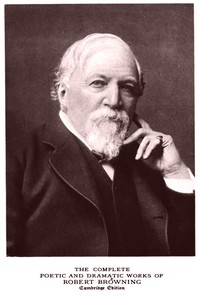
In this edition have been added, ‘A Death in the Desert’, with argument, notes, and commentary, a fac-simile of a letter from the poet, and a portrait copied from a photograph (the last taken of him) which he gave me when visiting him in Venice, a month before his death.
It may be of interest, and of some value, to many students of Browning’s poetry, to know a reply he made, in regard to the expression in ‘My Last Duchess’, “I gave commands; then all smiles stopped together.”
We were walking up and down the great hall of the Palazzo Rezzonico, when, in the course of what I was telling him about the study of his works in the United States, I alluded to the divided opinion as to the meaning of the above expression in ‘My Last Duchess’, some understanding that the commands were to put the Duchess to death, and others, as I have explained the expression on p. 87 of this volume (last paragraph). {For etext use, section III (Browning’s Obscurity) of the Introduction, sixth paragraph before the end of the section.} He made no reply, for a moment, and then said, meditatively, “Yes, I meant that the commands were that she should be put to death.” And then, after a pause, he added, with a characteristic dash of expression, and as if the thought had just started in his mind, “Or he might have had her shut up in a convent.” This was to me very significant. When he wrote the expression, “I gave commands”, etc., he may not have thought definitely what the commands were, more than that they put a stop to the smiles of the sweet Duchess, which provoked the contemptible jealousy of the Duke. This was all his art purpose required, and his mind did not go beyond it. I thought how many vain discussions take place in Browning Clubs, about little points which are outside of the range of the artistic motive of a composition, and how many minds are occupied with anything and everything under the sun, except the one thing needful (the artistic or spiritual motive), the result being “as if one should be ignorant of nothing concerning the scent of violets, except the scent itself.”
H.C.
CONTENTS.
PREFACE.
INTRODUCTION.
I. The Spiritual Ebb and Flow exhibited in English Poetry from Chaucer to Tennyson and Browning. {This section contains Browning’s ‘Popularity’ and many excerpts.}
II. The Idea of Personality and of Art as an intermediate agency of Personality, as embodied in Browning’s Poetry.
III. Mr. Browning’s “Obscurity”. {This section contains Browning’s ‘My Last Duchess’}
IV. Browning’s Verse.
V. Arguments of the Poems.
Wanting is--What? My Star. The Flight of the Duchess. The Last Ride Together. By the Fireside. Prospice. Amphibian. James Lee’s Wife. A Tale. Confessions. Respectability. Home-Thoughts from Abroad. Home-Thoughts from the Sea. Old Pictures in Florence. Pictor Ignotus. Andrea del Sarto. Fra Lippo Lippi. A Face. The Bishop orders his Tomb. A Toccata of Galuppi’s. Abt Vogler. ‘Touch him ne’er so lightly’, etc. Memorabilia. How it strikes a Contemporary. “Transcendentalism”. Apparent Failure. Rabbi Ben Ezra. A Grammarian’s Funeral. An Epistle containing the Strange Medical Experience of Karshish, the Arab Physician. A Martyr’s Epitaph. Soliloquy of the Spanish Cloister. Holy-Cross Day. Saul. A Death in the Desert.
POEMS.
Wanting is--What? My Star. The Flight of the Duchess. The Last Ride Together. By the Fireside. Prospice. Amphibian. James Lee’s Wife. A Tale. Confessions. Respectability. Home Thoughts, from Abroad. Home Thoughts, from the Sea. Old Pictures in Florence. Pictor Ignotus. Andrea del Sarto. Fra Lippo Lippi. A Face. The Bishop orders his Tomb. A Toccata of Galuppi’s. Abt Vogler. “Touch him ne’er so lightly.” Memorabilia. How it strikes a Contemporary. “Transcendentalism”: Apparent Failure. Rabbi Ben Ezra. A Grammarian’s Funeral. An Epistle containing the Strange Medical Experience of Karshish, the Arab Physician. A Martyr’s Epitaph. Soliloquy of the Spanish Cloister. Holy-Cross Day. Saul. A Death in the Desert.