Public-domain ebook
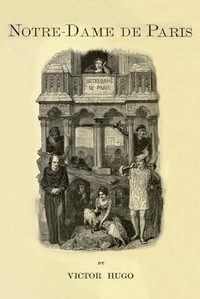
Notre-Dame de Paris
by Victor Hugo
Language: en9,788 downloads on Project Gutenberg
Subjects
In: Harvard Classics·Movie Books·Banned Books from Anne Haight's list
Public-domain ebook sourced from Project Gutenberg #2610.

Public-domain ebook
by Victor Hugo
Language: en9,788 downloads on Project Gutenberg
Subjects
In: Harvard Classics·Movie Books·Banned Books from Anne Haight's list
Public-domain ebook sourced from Project Gutenberg #2610.
Victor Hugo’s Notre‑Dame de Paris is a sprawling historical novel that intertwines the fate of a medieval cathedral with the lives of its inhabitants. The book opens with a 19th‑century narrator discovering a mysterious Greek inscription, ἈΝÁΓΚΗ, etched into a tower wall, a word that vanishes under whitewash and becomes the seed for a meditation on loss, memory, and the inevitable decay of great structures. From that moment Hugo launches into a vivid tableau of 1482 Paris, describing the bustling Grand Hall of the Palais de Justice on the day of the Epiphany and the Feast of Fools, and setting the stage for a cast that includes clergy, courtiers, and the famously hunchbacked bell‑ringer Quasimodo. The narrative weaves together historical detail, Gothic atmosphere, and the lives of people with disabilities, all anchored in the cathedral’s stone and the city’s turbulent past.
The novel’s voice is unmistakably Romantic, marked by lush, baroque description and a philosophical, often digressive narrator who invites the reader to contemplate the passage of time. Hugo’s prose, rich with rhetorical flourishes and intricate sentence structures, reflects the early‑19th‑century French literary style. Readers who relish immersive historical settings, complex character studies, especially of those on society’s margins, and a lyrical, almost theatrical storytelling will find this work rewarding. It appeals to lovers of French history, Gothic architecture, and anyone drawn to a novel that balances sweeping social commentary with intimate human drama.
The opening · free to read
ἈΝÁΓΚΗ.
These Greek capitals, black with age, and quite deeply graven in the stone, with I know not what signs peculiar to Gothic caligraphy imprinted upon their forms and upon their attitudes, as though with the purpose of revealing that it had been a hand of the Middle Ages which had inscribed them there, and especially the fatal and melancholy meaning contained in them, struck the author deeply.
He questioned himself; he sought to divine who could have been that soul in torment which had not been willing to quit this world without leaving this stigma of crime or unhappiness upon the brow of the ancient church.
Afterwards, the wall was whitewashed or scraped down, I know not which, and the inscription disappeared. For it is thus that people have been in the habit of proceeding with the marvellous churches of the Middle Ages for the last two hundred years. Mutilations come to them from every quarter, from within as well as from without. The priest whitewashes them, the archdeacon scrapes them down; then the populace arrives and demolishes them.
Thus, with the exception of the fragile memory which the author of this book here consecrates to it, there remains to-day nothing whatever of the mysterious word engraved within the gloomy tower of Notre-Dame,—nothing of the destiny which it so sadly summed up. The man who wrote that word upon the wall disappeared from the midst of the generations of man many centuries ago; the word, in its turn, has been effaced from the wall of the church; the church will, perhaps, itself soon disappear from the face of the earth.
It is upon this word that this book is founded.
March, 1831.
The book keeps going
Reading is free forever. Sign up and watch scenes appear while you read.


Scenes Storieta drew for other classics.

New illustrated classics
Once or twice a month: the latest books to get full character casts, scene art, and free comic editions. No account needed.