
Public-domain ebook
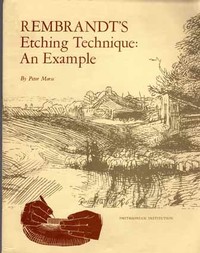
Rembrandt's Etching Technique: An Example
by Peter Morse
Language: en721 downloads on Project Gutenberg
Subjects
In: Art
Public-domain ebook sourced from Project Gutenberg #26496.
Public-domain ebook
by Peter Morse
Language: en721 downloads on Project Gutenberg
Subjects
In: Art
Public-domain ebook sourced from Project Gutenberg #26496.
The opening · free to read
A Rembrandt print in the collection of the Smithsonian Institution has been made the subject of a study of the artist's etching technique. The author is associate curator, division of graphic arts, in the Smithsonian Institution's Museum of History and Technology.
All footnotes appear at the end of this paper.
Rembrandt's print, Landscape with a hay barn and a flock of sheep,[1] is a singularly apt example of the variety of etching treatment used by the artist in his mature period.[2] The print, in black ink, 83 x 174 mm. in size (approximately 3-1/2 x 7 inches), is signed and dated 1650.[3] It shows a peaceful Dutch landscape along the Onderdijk Road on the south side of the Saint Anthony's Dike, only a short walk from Rembrandt's home in Amsterdam. The picture is, as usual, the mirror reversal of the actual scene.[4]
The observer's attention, from his raised position, is first drawn to the center of the print, attracted by the bright highlights on the trees and barn, then is snapped abruptly to the left side by the figure of the woman outlined against the sky. Now the eye moves slowly across the bottom, noticing the flock of sheep and the shepherd, and is led further by the soft dark line of the creek bank, to pick up the distant town and then the cows on the right. Only after completely circling the composition does one notice the horse, rolling in the grass and joyfully kicking its feet in the air.
Such artistic command seldom comes spontaneously. In Rembrandt's case, it is clearly the result of careful preparation, many years of learning and experience, and hard work in the creation of each picture. Such a process has produced in this print--one of nine landscapes which mark a turning point in 1650--a work of stylistic synthesis, which integrates Rembrandt's previous knowledge and leads on to his later masterpieces.
Mirror reversal of Landscape with a hay barn and a flock of sheep.]
In 1650 Rembrandt was evidently in a tranquil state of mind. He was 44 years old. Young Hendrickje Stoffels, who had entered his household in 1645 as a maid, was well settled as housekeeper and mistress. Geertghe Dircx--who had been the nurse of Rembrandt's son, Titus, since the death of his wife, Saskia, in 1642--had just been taken to an institution after a nasty breach of promise suit.[5] Rembrandt's finances were in good shape; his insolvency was not to come until 1656, after the international economic crisis of 1653.[6] The artist certainly had the fullest confidence and experience in his working methods, having already done close to 250 prints.[7] This state of well-being is reflected in the fact that of the 27 prints Rembrandt did in the three years, 1650-1652, no fewer than 14 are landscapes of a serene character.[8] This is an unusually large proportion of a single subject and surely reflects the artist's state of mind, which helped him to produce this masterpiece of serenity, humor, and technical virtuosity.
His etching technique can be clearly studied in this print. In summary, all the evidence shows that Rembrandt here laid a foundation of lines on his plate with a single etching. He then mantled the sketch with rich drypoint lines, to give a sensitive chiaroscuro to the finished work. The integration of etching and drypoint is striking. There are few areas of this print (except the sky) that do not contain both kinds of line.
Rembrandt evidently had an excellent idea of his design before he ever touched the needle to the plate. Though he is often admired for his spontaneity, particularly in his landscapes,[9] this is a misconception. Benesch lists no fewer than 78 landscape drawings by Rembrandt in the years 1648-1650,[10] and there were perhaps many more, now lost or unidentified. For this etching alone, there are at least five likely preparatory drawings, each giving certain essential features of the final print. The most interesting is the Landscape with a Rolling Horse.[11] Here we see that the horse, apparently the happiest of impulsive inspirations, is instead a carefully considered part of the final design, copied from the drawing previously done on the spot. As the horse in the drawing is the mirror image of that in the print, we can feel certain that the drawing came first and not the etching. Two other drawings[12] (figures 4 and 5) delineate the clump of trees, in form and placement very similar to the print. A fourth[13] (figure 6) is a sketch of a hay barn of the type shown in the print, evidently quite common in the Dutch countryside, and a fifth[14] (figure 7) foreshadows the scheme of composition used in the print, principally the relationship of the road and the dark central mass. All these drawings are the mirror reversal of the print.
Landscape with a rolling horse. Drawing by Rembrandt. After Benesch, vol. 6, fig. 1444. (Smithsonian photo 59391, with the permission of Phaidon Press, Ltd., and the Groningen Museum.)]
A clump of trees. Drawing by Rembrandt. After Benesch, vol. 4, fig. 1001. (Smithsonian photo 59392, with the permission of Phaidon Press, Ltd.)]
Farm building among trees. Drawing by Rembrandt. (Photo courtesy of the Albertina Museum, Vienna.)]
Farmstead with a hay barn. Drawing by Rembrandt. After Benesch, vol. 6, fig. 1458. (Smithsonian photo 59393, with the permission of Phaidon Press, Ltd., and the Royal Museum of Fine Arts, Copenhagen.)]
Farm buildings beside a road with distant farmstead. Drawing by Rembrandt. (Photo courtesy of the Ashmolean Museum, Oxford.)]
It is very much a modern taste to admire spontaneity more than craft. We must understand that Rembrandt's work was anything but spontaneous in execution. The existence of so many drawings prior to this print certainly suggests that Rembrandt collected his ideas from many sources, on the spot, but did his finished work in the quiet of his studio, with his notes ready at hand. He used the sketches as the raw material for a work of art. Rembrandt said that the only rule that should bind the artist is nature,[15] but he was certainly not distracted by nature. The individual genius here lies in assembling many observations from nature into a work which goes beyond nature and yet appears fresh and natural.
The metal plates he commonly used were of thin, cold-hammered copper, as shown by extant examples.[16] The hammering had the effect of making the metal harder than today's rolled copper sheets. This enabled more prints to be taken from the plate than is possible for a present-day printmaker. Today, we tend to consider drypoint a very fugitive medium, because the burr perishes so quickly under the pressure of the printing press. Rembrandt undoubtedly had fewer inhibitions about drypoint, for he could expect his harder copper to hold up longer, perhaps for as many as fifty excellent prints from the same plate. Hammered copper, unlike the modern rolled variety, is also completely free of grain in the metal. This enables a drypoint needle to move freely in any direction without encountering the resistance of a grain. Here again, Rembrandt had more incentive to use drypoint than a modern artist.
Rembrandt's etching ground has been the subject of considerable discussion. A book published in 1660, nine years before the artist's death, contains a recipe for "The Ground of Rinebrant of Rine."[17] This ground, similar to that described by Bosse as a "soft" ground,[18] consists of two parts wax, one part mastic, and one part asphaltum. There are countless formulae for such grounds, but virtually all are permutations of the same three ingredients, with only slight differences in the proportions.[19] The ground given as Rembrandt's is a thoroughly conventional one.
A knotty problem, however, is introduced by the last line of this 1660 description: "... lay your black ground very thin, and the white ground upon it. This is the only way of Rinebrant...."[20] No elaboration is given. This one line presents a number of problems, not all of which are soluble. To take it at face value is to accept the contemporary evidence that Rembrandt not only used a white ground but used it exclusively. This assertion cannot be taken uncritically.
It will readily be seen that a white ground might be of considerable assistance to an artist. His needle penetrates the white to the copper, giving the familiar effect of a reddish ink line on white paper. A normal ground, without treatment, is virtually transparent, making the etcher's lines rather difficult to see.[21] The most usual procedure, both in the 17th century and today, is to smoke the ground and incorporate the soot with the ground by heating the plate slightly. This gives a black ground, against which the lines appear light, the negative of the ultimate print. The black ground is favored, both out of long-established tradition and because it is very easy to apply. Furthermore, artists today explain that they also enjoy the feeling of working slightly blind, that one of their greatest rewards is the sense of surprise in peeling the first proof print off the plate. For whatever reason, the black ground has been preferred by the great majority of artists, both past and present.
The description of Rembrandt's ground in 1660 takes knowledge of the white ground for granted. Its technique certainly appears to have been generally well known among artists in the middle of the 17th century. Rubens, in a letter as early as 1622, mentions having received a recipe for a white ground, although he could not remember it.[22] The first technical explanation of the process appeared in Bosse's pioneer treatise in 1645.[23] There is no reason why Rembrandt should not have known of the white-ground technique and every reason to suppose that he did.
There is one piece of strong evidence that he did use a white ground about 1631. One of Rembrandt's drawings exists which, unlike most of his sketches is an exact prototype (in reverse) of a specific etching, Diana at the Bath.[24] The back of this drawing is covered with black chalk, and its lines show the indentation of tracing. The only reasonable explanation of this evidence is that Rembrandt placed his prepared drawing on top of a white-grounded plate and traced the lines, depositing the black chalk lines on the ground, where he could then trace them with his etching needle. Another similarly indented drawing--for the portrait of Cornelis Claesz Anslo--has been held to show the same procedure as late as 1641. This drawing, however, is backed, not with black chalk as previously cited, but with ocher tempera.[25] Although surely used for tracing, this gives perhaps even more evidence of his use of a black ground rather than white, although ocher lines would show on either. These conclusions are not meant to imply in any way that Rembrandt used the tracing of a drawing for his Landscape with a hay barn.... There is every probability that he did not do so. The implication is rather that only where a traced drawing with black backing exists do we have circumstantial evidence for the use, and possibly a more general use, of white ground. Without the published recipe no question would be likely to arise that Rembrandt used anything but the standard black ground. With it, we must search for corroboration.
The book keeps going
Reading is free forever. Sign up and watch scenes appear while you read.



Scenes Storieta drew for other classics.
New illustrated classics
Once or twice a month: the latest books to get full character casts, scene art, and free comic editions. No account needed.