Public-domain ebook
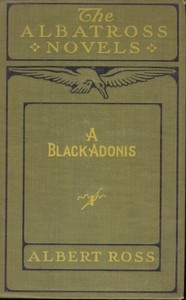
A Black Adonis
Language: en5,241 downloads on Project Gutenberg
Subjects
In: Novels
Public-domain ebook sourced from Project Gutenberg #26599.
Public-domain ebook
Language: en5,241 downloads on Project Gutenberg
Subjects
In: Novels
Public-domain ebook sourced from Project Gutenberg #26599.
A Black Adonis is a turn‑of‑the‑century work of African‑American fiction that opens with a reflective, almost philosophical meditation on marriage and gender roles, voiced through the character Blanche and her lover Fantelli. Their conversation about the morality of contracts and the desire for a partnership that respects a woman’s rights sets a tone of social commentary before the narrative shifts to the bustling streets of a city publishing house. The first chapter introduces the young, dark‑complexioned writer Shirley Roseleaf, whose anxieties over a manuscript’s fate and his fiery encounter with indifferent publishers frame the novel’s central conflict: the struggle of a Black author to have his voice heard in a world that often dismisses it.
The prose is unmistakably Victorian, marked by elaborate sentences, formal diction, and a stage‑like dialogue that mirrors the theatrical sensibilities of the 1890s. Its blend of domestic discourse and the gritty realities of the literary marketplace offers a window into the aspirations and frustrations of Black creatives of the period. Readers who enjoy historically situated narratives that combine social critique with a vivid portrait of an aspiring writer’s world will find this novel both engaging and illuminating.
The opening · free to read
The young man referred to stood just within his chamber door, waiting with some anxiety for the letter to be brought to him. He was about twenty years of age, of medium height, with rather dark complexion, curling hair and expressive eyes, and with a natural delicacy of manner that made him seem almost feminine at first view.
He had the greatest possible interest in the letter that the postman had just brought, but he was far too polite to disturb the landlady or her servant, who were not yet through with it.
"You can see that it is from a publishing house," commented Mrs. Ranning, inspecting the envelope with care. "It is from Cutt & Slashem, who bring out more novels than any other firm in the city. I told you he was some kind of a writer. Perhaps they are going to publish a book for him! If they do he will leave us for finer quarters. Novelists make a mint of money, I have heard. We must do our best to keep him as long as we can. Be very polite to him, Nellie. He appears to be an excellent young man."
Shirley Roseleaf's anxiety to get possession of his letter was not lessened by this conversation. It seemed as if his entire future hung on the contents of that envelope tarrying so long in Nellie's hands. The great publishers, Cutt & Slashem, had had a manuscript of his in their hands for nearly a fortnight. When they had definitely accepted it, his path would be perfectly clear. If they rejected it--but he had not got so far as that.
The manuscript was a romance--a romance of love! Its author had spent a great deal of time upon it. He had rewritten it with care, and finally made a neat copy, of which he was very proud. Then he had thought a long time over the question of a publishing firm. Cutt & Slashem stood at the top of their profession, and they finally received the preference. With the MSS. Roseleaf sent a pretty note, in which he included a delicate compliment on their success. The MSS. and the note were arranged tastefully in a neat white package and tied with pink twine.
After all of those precautions it is no wonder that the novelist felt surprise when days passed and no reply was sent to him. But never at any time was he discouraged. Had they intended to reject the novel, he reasoned, they could as easily have done so in three days as ten.
He pictured the members of the firm hugging themselves over their good fortune, passing the manuscript from one to the other, all eager for a taste of such a marvelous work. He did not think it egotism to believe they did not get stories like that every day.
His thoughts flew rapidly as Nellie slowly climbed the stairs. Now he would be famous, he would be courted, he would be envied! He would also be very, very rich, though that was not of so much account.
As Nellie handed him the letter he responded to her pleasant smile with one of his own, and even pressed a twenty-five cent piece into her hand. Then he closed his door behind him, bolting it in his eagerness to be alone. The morning was foggy, and he sank into a chair by the window, the only part of the room where he could see to read distinctly.
There was an attraction about the envelope. It was light buff in color, bearing the address of Cutt & Slashem in large letter on one side of the front face, besides the names of several of the most famous authors whose publishers the firm had the happiness to be.
"Shirley Roseleaf!" It would not look so badly in print.
So lost was he in the pleasant pictures which these thoughts conjured up that it was some minutes before he tore open the envelope. Then his astounded eyes rested upon these lines:
"Messrs. Cutt & Slashem regret to be obliged to decline with thanks the MSS. of M. Shirley Roseleaf, and request to be informed what disposition he desires made of the same."
Roseleaf read this dizzily. For some moments he could not understand what that sentence meant. "Obliged to decline" was plain enough; but his confused mind found some grains of comfort in the request of the firm to know what he wished done with his manuscript. They must, he reasoned, consider it of value, or they would not respond in that courteous manner. Still, he could not comprehend how they had had the asininity to "decline" it at all.
Were they unwilling to add another star to their galaxy?
Could they actually have read the tale?
A firm of their reputation, too!
When Roseleaf emerged from his temporary stupor it was into a state of great indignation. Why, the men were fools! He wished heartily he had never gone to them. They would yet see the day when, with tears in their eyes, they would regret their lack of judgment. His first act should be to go to their office and express his opinion of their stupidity, and then he would take his MSS. to some rival house. And never, never in the world--after he had become famous, and when every publisher on both sides of the Atlantic were besieging him--never, he said, should these ignorant fellows get a scrap of his writing, not even if they offered its weight in gold!
He was too excited for delay, and donning his hat, he took his way with all speed to Cutt & Slashem's office. At that instant he had more faith in his novel than ever. As he walked rapidly along he compared it with some of the stories issued by the firm that had rejected it, to the great disadvantage of the latter.
"I wish to see Mr. Cutt or Mr. Slashem," he said, imperiously, as he entered the counting room.
"Both are in," said the office boy, imperturbably. "Which will you have?"
"I will see them together."
Had they been tigers, fresh from an Indian jungle, it would have made no difference to him.
The boy asked for his card, vanished with it, returned and bade him follow. Up a flight of stairs they went, then to the left, then to the right, then across a little hall. A door with the name of the house and the additional word "Private" loomed before them.
"Come in!" was heard in response to the knock of the office boy.
Roseleaf entered, something slower than a cannon ball, and yet considerably faster than a snail. The two principal members of the firm were sitting together, with lighted cigars in their mouths, examining a lot of paper samples that lay upon a table. They did no more at first than glance up and nod, not having finished the business upon which they were engaged.
"Is it any better than the last?" asked Mr. Slashem, referring to the sample his partner was examining.
"It's just as good, at least," was the answer. "And an eighth of a cent a pound less. I think we had better order five hundred reams."
"Five hundred reams," repeated the other, slowly, making a memorandum in a little book that he carried. "And the other lot we'll wait about, eh? Paper is not very steady. It's gone off a sixteenth since Thursday."
This conversation only served to infuriate still more the visitor who stood waiting to pour out his wrath. Were these men wasting time over fractions of a cent in the price of stock, just after they had rejected one of the greatest romances of modern times!
With the precision of a duplex machine both partners finally looked up from the table at the young man.
"Mr. Shirley Roseleaf?" said Mr. Slashem, interrogatively, glancing at the card that the office boy had brought.
"Yes, sir!" was the sharp and disdainful reply.
"We need nothing in your line," interrupted Mr. Cutt. "I suppose Mr. Trimm has our other order well under way?"
The look of indignant protest that appeared in Roseleaf's face caused Mr. Slashem to speak.
"This is not Mr. Roseberg," he explained. "My partner took you for an agent of our bookbinder," he added.
The novelist thought his skin would burst.
"I am quite complimented," he said, in an icy tone. "Let me introduce myself. I am the author of 'Evelyn's Faith.'"
The partners consulted each other.
"The similarity of names confused me," said Mr. Cutt. "Is your book one that we have published?"
The book keeps going
Reading is free forever. Sign up and watch scenes appear while you read.



Scenes Storieta drew for other classics.
New illustrated classics
Once or twice a month: the latest books to get full character casts, scene art, and free comic editions. No account needed.