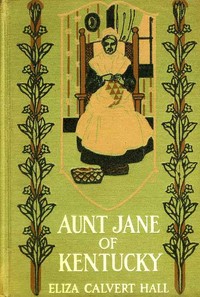
Public-domain ebook
Aunt Jane of Kentucky
Language: en4,258 downloads on Project Gutenberg
Subjects
In: Novels·American Literature
Public-domain ebook sourced from Project Gutenberg #26728.
Public-domain ebook
Language: en4,258 downloads on Project Gutenberg
Subjects
In: Novels·American Literature
Public-domain ebook sourced from Project Gutenberg #26728.
The novel is a domestic tale set in rural Kentucky, narrated through the eyes of a young visitor who finds herself in Aunt Jane’s modest, flower‑scented parlor. From the opening, the story frames its world with a contrast between a “colorless, dreary” existence and the vivid, almost theatrical emotions that stir within an old‑fashioned country home. The opening scene introduces Aunt Jane, a widowed, elderly spinster, her simple Shaker furniture, her purple calico dress, and her habit of knitting quilts while recounting memories of church meetings, family loss, and the small moral dilemmas of a tight‑knit community. The dialogue is peppered with regional dialect and the everyday concerns of a women’s society, hinting at themes of faith, duty, and the lingering ties of past generations.
Written in a leisurely, nineteenth‑century prose style, the voice blends gentle humor with earnest moral reflection, echoing the sentimental domestic fiction of its era. Readers who enjoy richly described rural settings, intergenerational family dynamics, and the quiet strength of older women will find the novel’s measured pacing and dialect‑colored dialogue appealing. It offers a window into a bygone Kentucky life, making it a satisfying choice for those who appreciate period pieces that foreground character over plot.
The opening · free to read
"Come right in and set down. I was jest wishin' I had somebody to talk to. Take that chair right by the door so's you can get the breeze."
And Aunt Jane beamed at me over her silver-rimmed spectacles and hitched her own chair a little to one side, in order to give me the full benefit of the wind that was blowing softly through the white-curtained window, and carrying into the room the heavenliest odors from a field of clover that lay in full bloom just across the road. For it was June in Kentucky, and clover and blue-grass were running sweet riot over the face of the earth.
Aunt Jane and her room together always carried me back to a dead and gone generation. There was a rag carpet on the floor, of the "hit-or-miss" pattern; the chairs were ancient Shaker rockers, some with homely "shuck" bottoms, and each had a tidy of snowy thread or crochet cotton fastened primly over the back. The high bed and bureau and a shining mahogany table suggested an era of "plain living" far, far remote from the day of Turkish rugs and Japanese bric-a-brac, and Aunt Jane was in perfect correspondence with her environment. She wore a purple calico dress, rather short and scant; a gingham apron, with a capacious pocket, in which she always carried knitting or some other "handy work"; a white handkerchief was laid primly around the wrinkled throat and fastened with a pin containing a lock of gray hair; her cap was of black lace and lutestring ribbon, not one of the butterfly affairs that perch on the top of the puffs and frizzes of the modern old lady, but a substantial structure that covered her whole head and was tied securely under her chin. She talked in a sweet old treble with a little lisp, caused by the absence of teeth, and her laugh was as clear and joyous as a young girl's.
"Yes, I'm a-piecin' quilts again," she said, snipping away at the bits of calico in her lap. "I did say I was done with that sort o' work; but this mornin' I was rummagin' around up in the garret, and I come across this bundle of pieces, and thinks I, 'I reckon it's intended for me to piece one more quilt before I die;' I must 'a' put 'em there thirty years ago and clean forgot 'em, and I've been settin' here all the evenin' cuttin' 'em and thinkin' about old times.
"Jest feel o' that," she continued, tossing some scraps into my lap. "There ain't any such caliker nowadays. This ain't your five-cent stuff that fades in the first washin' and wears out in the second. A caliker dress was somethin' worth buyin' and worth makin' up in them days. That blue-flowered piece was a dress I got the spring before Abram died. When I put on mournin' it was as good as new, and I give it to sister Mary. That one with the green ground and white figger was my niece Rebecca's. She wore it for the first time to the County Fair the year I took the premium on my salt-risin' bread and sponge cake. This black-an'-white piece Sally Ann Flint give me. I ricollect 'twas in blackberry time, and I'd been out in the big pasture pickin' some for supper, and I stopped in at Sally Ann's for a drink o' water on my way back. She was cuttin' out this dress."
Aunt Jane broke off with a little soprano laugh.
"Did I ever tell you about Sally Ann's experience?" she said, as she laid two three-cornered pieces together and began to sew with her slender, nervous old fingers.
To find Aunt Jane alone and in a reminiscent mood! This was delightful.
"Do tell me," I said.
Aunt Jane was silent for a few moments. She always made this pause before beginning a story, and there was something impressive about it. I used to think she was making an invocation to the goddess of Memory.
"'Twas forty years ago," she began musingly, "and the way of it was this. Our church was considerably out o' fix. It needed a new roof. Some o' the winder lights was out, and the floor was as bare as your hand, and always had been. The men folks managed to git the roof shingled and the winders fixed, and us women in the Mite Society concluded we'd git a cyarpet. We'd been savin' up our money for some time, and we had about twelve dollars. I ricollect what a argument we had, for some of us wanted the cyarpet, and some wanted to give it to furrin missions, as we'd set out to do at first. Sally Ann was the one that settled it. She says at last--Sally Ann was in favor of the cyarpet--she says, 'Well, if any of the heathen fails to hear the gospel on account of our gittin' this cyarpet, they'll be saved anyhow, so Parson Page says. And if we send the money and they do hear the gospel, like as not they won't repent, and then they're certain to be damned. And it seems to me as long as we ain't sure what they'll do, we might as well keep the money and git the cyarpet. I never did see much sense anyhow,' says she, 'in givin' people a chance to damn theirselves.'
"Well, we decided to take Sally Ann's advice, and we was talkin' about app'intin' a committee to go to town the follerin' Monday and pick out the cyarpet, when all at once 'Lizabeth Taylor--she was our treasurer--she spoke up, and says she, 'There ain't any use app'intin' that committee. The money's gone,' she says, sort o' short and quick. 'I kept it in my top bureau drawer, and when I went for it yesterday, it was gone. I'll pay it back if I'm ever able, but I ain't able now.' And with that she got up and walked out o' the room, before any one could say a word, and we seen her goin' down the road lookin' straight before her and walkin' right fast.
"And we--we set there and stared at each other in a sort o' dazed way. I could see that everybody was thinkin' the same thing, but nobody said a word, till our minister's wife--she was as good a woman as ever lived--she says, '_Judge not_.'
"Them two words was jest like a sermon to us. Then Sally Ann spoke up and says: 'For the Lord's sake, don't let the men folks know anything about this. They're always sayin' that women ain't fit to handle money, and I for one don't want to give 'em any more ground to stand on than they've already got.'
"So we agreed to say nothin' about it, and all of us kept our promise except Milly Amos. She had mighty little sense to begin with, and havin' been married only about two months, she'd about lost that little. So next mornin' I happened to meet Sam Amos, and he says to me, 'Aunt Jane, how much money have you women got to'rds the new cyarpet for the church?' I looked him square in the face, and I says, 'Are you a member of the Ladies' Mite Society of Goshen church, Sam Amos? For if you are, you already know how much money we've got, and if you ain't, you've got no business knowin'. And, furthermore,' says I, 'there's some women that can't keep a secret and a promise, and some that can, and I can.' And that settled him.
"Well, 'Lizabeth never showed her face outside her door for more'n a month afterwards, and a more pitiful-lookin' creatur' you never saw than she was when she come out to prayer-meetin' the night Sally Ann give her experience. She set 'way back in the church, and she was as pale and peaked as if she had been through a siege of typhoid. I ricollect it all as if it had been yesterday. We sung 'Sweet Hour of Prayer,' and Parson Page prayed, and then called on the brethren to say anything they might feel called on to say concernin' their experience in the past week. Old Uncle Jim Matthews begun to clear his throat, and I knew, as well as I knew my name, he was fixin' to git up and tell how precious the Lord had been to his soul, jest like he'd been doin' every Wednesday night for twenty years. But before he got started, here come 'Lizabeth walkin' down the side aisle and stopped right in front o' the pulpit.
"'I've somethin' to say,' she says. 'It's been on my mind till I can't stand it any longer. I've got to tell it, or I'll go crazy. It was me that took that cyarpet money. I only meant to borrow it. I thought sure I'd be able to pay it back before it was wanted. But things went wrong, and I ain't known a peaceful minute since, and never shall again, I reckon. I took it to pay my way up to Louisville, the time I got the news that Mary was dyin'.'
"Mary was her daughter by her first husband, you see. 'I begged Jacob to give me the money to go on,' says she, 'and he wouldn't do it. I tried to give up and stay, but I jest couldn't. Mary was all I had in the world; and maybe you that has children can put yourself in my place, and know what it would be to hear your only child callin' to you from her death-bed, and you not able to go to her. I asked Jacob three times for the money,' she says, 'and when I found he wouldn't give it to me, I said to myself, "I'm goin' anyhow." I got down on my knees,' says she, 'and asked the Lord to show me a way, and I felt sure he would. As soon as Jacob had eat his breakfast and gone out on the farm, I dressed myself, and as I opened the top bureau drawer to get out my best collar, I saw the missionary money. It come right into my head,' says she, 'that maybe this was the answer to my prayer; maybe I could borrow this money, and pay it back some way or other before it was called for. I tried to put it out o' my head, but the thought kept comin' back; and when I went down into the sittin'-room to get Jacob's cyarpetbag to carry a few things in, I happened to look up at the mantelpiece and saw the brass candlesticks with prisms all 'round 'em that used to belong to my mother; and all at once I seemed to see jest what the Lord intended for me to do.
"'You know,' she says, 'I had a boarder summer before last--that lady from Louisville--and she wanted them candlesticks the worst kind, and offered me fifteen dollars for 'em. I wouldn't part with 'em then, but she said if ever I wanted to sell 'em, to let her know, and she left her name and address on a cyard. I went to the big Bible and got out the cyard, and I packed the candlesticks in the cyarpetbag, and put on my bonnet. When I opened the door I looked up the road, and the first thing I saw was Dave Crawford comin' along in his new buggy. I went out to the gate, and he drew up and asked me if I was goin' to town, and said he'd take me. It looked like the Lord was leadin' me all the time,' says she, 'but the way things turned out it must 'a' been Satan. I got to Mary just two hours before she died, and she looked up in my face and says, "Mother, I knew God wouldn't let me die till I'd seen you once more."'"
Here Aunt Jane took off her glasses and wiped her eyes.
"I can't tell this without cryin' to save my life," said she; "but 'Lizabeth never shed a tear. She looked like she'd got past cryin', and she talked straight on as if she'd made up her mind to say jest so much, and she'd die if she didn't git to say it."
"'As soon as the funeral was over,' says she, 'I set out to find the lady that wanted the candlesticks. She wasn't at home, but her niece was there, and said she'd heard her aunt speak of the candlesticks often; and she'd be home in a few days and would send me the money right off. I come home thinkin' it was all right, and I kept expectin' the money every day, but it never come till day before yesterday. I wrote three times about it, but I never got a word from her till Monday. She had just got home, she said, and hoped I hadn't been inconvenienced by the delay. She wrote a nice, polite letter and sent me a check for fifteen dollars, and here it is. I wanted to confess it all that day at the Mite Society, but somehow I couldn't till I had the money right in my hand to pay back. If the lady had only come back when her niece said she was comin', it would all have turned out right, but I reckon it's a judgment on me for meddling with the Lord's money. God only knows what I've suffered,' says she, 'but if I had to do it over again, I believe I'd do it. Mary was all the child I had in the world, and I had to see her once more before she died. I've been a member of this church for twenty years,' says she, 'but I reckon you'll have to turn me out now.'
The book keeps going
Reading is free forever. Sign up and watch scenes appear while you read.



Scenes Storieta drew for other classics.
New illustrated classics
Once or twice a month: the latest books to get full character casts, scene art, and free comic editions. No account needed.