Public-domain ebook
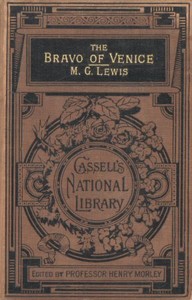
The Bravo of Venice: A Romance
Language: en498 downloads on Project Gutenberg
Subjects
Public-domain ebook sourced from Project Gutenberg #2706.
Public-domain ebook
Language: en498 downloads on Project Gutenberg
Subjects
Public-domain ebook sourced from Project Gutenberg #2706.
The opening · free to read
IT was evening. Multitudes of light clouds, partially illumined by the moonbeams, overspread the horizon, and through them floated the full moon in tranquil majesty, while her splendour was reflected by every wave of the Adriatic Sea. All was hushed around; gently was the water rippled by the night wind; gently did the night wind sigh through the Colonnades of Venice.
It was midnight; and still sat a stranger, solitary and sad, on the border of the great canal. Now with a glance he measured the battlements and proud towers of the city; and now he fixed his melancholy eyes upon the waters with a vacant stare. At length he spoke—
“Wretch that I am, whither shall I go? Here sit I in Venice, and what would it avail to wander further? What will become of me? All now slumber, save myself! the Doge rests on his couch of down; the beggar’s head presses his straw pillow; but for me there is no bed except the cold, damp earth! There is no gondolier so wretched but he knows where to find work by day and shelter by night—while _I_—while _I_—Oh! dreadful is the destiny of which I am made the sport!”
He began to examine for the twentieth time the pockets of his tattered garments.
“No! not one paolo, by heavens!—and I hunger almost to death.”
He unsheathed his sword; he waved it in the moonshine, and sighed, as he marked the glittering of the steel.
“No, no, my old true companion, thou and I must never part. Mine thou shalt remain, though I starve for it. Oh, was not that a golden time when Valeria gave thee to me, and when she threw the belt over my shoulder, I kissed thee and Valeria? She has deserted us for another world, but thou and I will never part in this.”
He wiped away a drop which hung upon his eyelid.
“Pshaw! ’twas not a tear; the night wind is sharp and bitter, and makes the eyes water; but as for _tears_—Absurd! my weeping days are over.”
And as he spoke, the unfortunate (for such by his discourse and situation he appeared to be) dashed his forehead against the earth, and his lips were already unclosed to curse the hour which gave him being, when he seemed suddenly to recollect himself. He rested his head on his elbow, and sang mournfully the burthen of a song which had often delighted his childhood in the castle of his ancestors.
“Right,” he said to himself; “were I to sink under the weight of my destiny, I should be myself no longer.”
At that moment he heard a rustling at no great distance. He looked around, and in an adjacent street, which the moon faintly enlightened, he perceived a tall figure, wrapped in a cloak, pacing slowly backwards and forwards.
“’Tis the hand of God which hath guided him hither—yes—I’ll—I’ll _beg_—better to play the beggar in Venice than the villain in Naples; for the beggar’s heart may beat nobly, though covered with rags.”
He then sprang from the ground, and hastened towards the adjoining street. Just as he entered it at one end, he perceived another person advancing through the other, of whose approach the first was no sooner aware than he hastily retired into the shadow of a piazza, anxious to conceal himself.
“What can this mean?” thought our mendicant. “Is yon eavesdropper one of death’s unlicensed ministers? Has he received the retaining fee of some impatient heir, who pants to possess the wealth of the unlucky knave who comes strolling along yonder, so careless and unconscious? Be not so confident, honest friend! I’m at your elbow.”
He retired further into the shade, and silently and slowly drew near the lurker, who stirred not from his place. The stranger had already passed them by, when the concealed villain sprang suddenly upon him, raised his right hand in which a poniard was gleaming, and before he could give the blow, was felled to the earth by the arm of the mendicant.
The stranger turned hastily towards them; the bravo started up and fled; the beggar smiled.
“How now?” cried the stranger; “what does all this mean?”
“Oh, ’tis a mere jest, signor, which has only preserved your life.”
“What? my life? How so?”
“The honest gentleman who has just taken to his heels stole behind you with true cat-like caution, and had already raised his dagger, when I saw him. You owe your life to me, and the service is richly worth one little piece of money! Give me some alms, signor, for on my soul I am hungry, thirsty, cold.”
“Hence, scurvy companion! I know you and your tricks too well. This is all a concerted scheme between you, a design upon my purse, an attempt to procure both money and thanks, and under the lame pretence of having saved me from an assassin. Go, fellow, go! practise these dainty devices on the Doge’s credulity if you will; but with Buonarotti you stand no chance, believe me.”
The wretched starving beggar stood like one petrified, and gazed on the taunting stranger.
“No, as I have a soul to save, signor, ’tis no lie I tell you!—’tis the plain truth; have compassion, or I die this night of hunger.”
“Begone this instant, I say, or by Heaven—”
The unfeeling man here drew out a concealed pistol, and pointed it at his preserver.
“Merciful Heaven! and is it thus that services are acknowledged in Venice?”
“The watch is at no great distance, I need only raise my voice and—”
“Hell and confusion! do you take me for a robber, then?”
“Make no noise, I tell you. Be quiet—you had better.”
“Hark you, signor. Buonarotti is your name, I think? I will write it down as belonging to the second scoundrel with whom I have met in Venice.”
He paused for a moment, then continuing in a dreadful voice, “And when,” said he, “thou, Buonarotti, shalt hereafter hear the name of _Abellino_—_tremble_!”
Abellino turned away, and left the hard-hearted Venetian.
CHAPTER II. THE BANDITTI.
AND now rushed the unfortunate wildly through the streets of Venice. He railed at fortune; he laughed and cursed by turns; yet sometimes he suddenly stood still, seemed as pondering on some great and wondrous enterprise, and then again rushed onwards, as if hastening to its execution.
Propped against a column of the Signoria, he counted over the whole sum of his misfortunes. His wandering eyeballs appeared to seek comfort, but they found it not.
“Fate,” he at length exclaimed in a paroxysm of despair, “Fate has condemned me to be either the wildest of adventurers, or one at the relation of whose crimes the world must shudder. To astonish is my destiny. Rosalvo can know no medium; Rosalvo can never act like common men. Is it not the hand of fate which has led me hither? Who could ever have dreamt that the son of the richest lord in Naples should have depended for a beggar’s alms on Venetian charity? I—I, who feel myself possessed of strength of body and energy of soul fit for executing the most daring deeds, behold me creeping in rags through the streets of this inhospitable city, and torturing my wits in vain to discover some means by which I may rescue life from the jaws of famine! Those men whom my munificence nourished, who at my table bathed their worthless souls in the choicest wines of Cyprus, and glutted themselves with every delicacy which the globe’s four quarters could supply, these very men now deny to my necessity even a miserable crust of mouldy bread. Oh, that is dreadful, cruel—cruel of men—cruel of Heaven!”
He paused, folded his arms, and sighed.
“Yet will I bear it—I will submit to my destiny. I will traverse every path and go through every degree of human wretchedness; and whate’er may be my fate, I will still be myself; and whate’er may be my fate, I will still act greatly! Away, then, with the Count Rosalvo, whom all Naples idolised; now—now, I am the beggar Abellino. A beggar—that name stands last in the scale of worldly rank, but first in the list of the famishing, the outcast, and the unworthy.”
Something rustled near him. Abellino gazed around. He was aware of the bravo, whom he struck to the ground that night, and whom two companions of a similar stamp had now joined. As they advanced, they cast inquiring glances around them. They were in search of some one.
The book keeps going
Reading is free forever. Sign up and watch scenes appear while you read.



Scenes Storieta drew for other classics.
New illustrated classics
Once or twice a month: the latest books to get full character casts, scene art, and free comic editions. No account needed.