Public-domain ebook
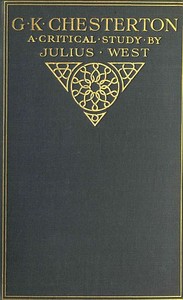
G. K. Chesterton, A Critical Study
by Julius West
Language: en4,886 downloads on Project Gutenberg
Subjects
In: Biographies·British Literature
Public-domain ebook sourced from Project Gutenberg #27080.
Public-domain ebook
by Julius West
Language: en4,886 downloads on Project Gutenberg
Subjects
In: Biographies·British Literature
Public-domain ebook sourced from Project Gutenberg #27080.
Julius West’s A Critical Study offers a scholarly appraisal of G. K. Chesterton, framing the work as a literary‑critical essay rather than a biography. The opening pages lay out the book’s structure, an introductory essay followed by eight themed chapters that examine Chesterton as romancer, maker of magic, critic, humorist, poet, debater, politician, and “decadent of sorts,” before concluding with a bibliography. West begins by acknowledging the permissions needed to quote Chesterton’s own writings, then launches into a reflective, almost self‑aware commentary on the practice of writing about other writers. He situates Chesterton within the turbulent transition from Victorian to fin-de‑siècle culture, using vivid metaphors to describe the era’s “boredom” and “mechanical brilliancy,” and sets up a series of arguments about Chesterton’s style, humor, and the paradoxes of his public reception.
The tone is erudite and conversational, marked by West’s characteristic wit and a penchant for digressive, richly allusive sentences typical of early‑20th‑century criticism. Readers who enjoy dense, historically grounded analysis, particularly those interested in literary history, the fin‑de‑siècle period, or the intellectual currents that shaped Chesterton’s work, will find this study rewarding. Its blend of scholarly rigor and lively prose makes it especially appealing to students of Victorian and Edwardian literature, as well as to general readers who appreciate a nuanced, argumentative portrait of a writer whose influence still sparks debate.
The opening · free to read
THE habit, to which we are so much addicted, of writing books about other people who have written books, will probably be a source of intense discomfort to its practitioners in the twenty-first century. Like the rest of their kind, they will pin their ambition to the possibility of indulging in epigram at the expense of their contemporaries. In order to lead up to the achievement of this desire they will have to work in the nineteenth century and the twentieth. Between the two they will find an obstacle of some terror. The eighteen nineties will lie in their path, blocking the way like an unhealthy moat, which some myopes might almost mistake for an aquarium. All manner of queer fish may be discerned in these unclear waters.
To drop the metaphor, our historians will find themselves confronted by a startling change. The great Victorians write no longer, but are succeeded by eccentrics. There is Kipling, undoubtedly the most gifted of them all, but not everybody's darling for all that. There is that prolific trio of best-sellers, Mrs. Humphry Ward, Miss Marie Corelli, and Mr. Hall Caine. There is Oscar Wilde, who has a vast reputation on the Continent, but never succeeded in convincing the British that he was much more than a compromise between a joke and a smell. There is the whole Yellow Book team, who never succeeded in convincing anybody. The economic basis of authorship had been shaken by the abolition of the three-volume novel. The intellectual basis had been lulled to sleep by that hotchpotch of convention and largeness that we call the Victorian Era. Literature began to be an effort to express the inexpressible, resulting in outraged grammar and many dots. . . .
English literature at the end of the last century stood in sore need of some of the elementary virtues. If obviousness and simplicity are liable to be overdone, they are not so deadly in their after-effects as the bizarre and the extravagant. The literary movement of the eighteen nineties was like a strong stimulant given to a patient dying of old age. Its results were energetic, but the energy was convulsive. We should laugh if we saw a man apparently dancing in mid-air--until we noticed the rope about his neck. It is impossible to account for the success of the Yellow Book school and its congeners save on the assumption that the rope was, generally speaking, invisible.
In this Year of Grace, 1915, we are still too close to the eighteen nineties, still too liable to be influenced by their ways, to be able to speak for posterity and to pronounce the final judgment upon those evil years. It is possible that the critics of the twenty-first century, as they turn over the musty pages of the Yellow Book, will ejaculate with feeling: "Good God, what a dull time these people must have had!" On the whole it is probable that this will be their verdict. They will detect the dullness behind the mechanical brilliancy of Oscar Wilde, and recognize the strange hues of the whole AEsthetic Movement as the garments of men who could not, or would not see. There is really no rational alternative before our critics of the next century; if the men of the eighteen nineties, and the queer things they gave us, were not the products of an intense boredom, if, in strict point of fact, Wilde, Beardsley, Davidson, Hankin, Dowson, and Lionel Johnson were men who rollicked in the warm sunshine of the late Victorian period, then the suicide, drunkenness and vice with which they were afflicted is surely the strangest phenomenon in the history of human nature. To many people, those years actually were dull.
The years from 1885 to 1898 were like the hours of afternoon in a rich house with large rooms; the hours before teatime. They believed in nothing except good manners; and the essence of good manners is to conceal a yawn. A yawn may be defined as a silent yell.
So says Chesterton, yawning prodigiously.
One may even go farther, and declare that in those dark days a yawn was the true sign of intelligence. It is no mere coincidence that the two cleverest literary debutants of that last decade, Mr. Max Beerbohm and the subject of this essay, both stepped on the stage making a pretty exhibition of boredom. When the first of these published, in 1896, being then twenty-four years old, his Works of Max Beerbohm he murmured in the preface, "I shall write no more. Already I begin to feel myself a trifle outmoded. . . . Younger men, with months of activity before them . . . have pressed forward. . . . Cedo junioribus."
So too, when Chesterton produced his first book, four years later, he called it Greybeards at Play: Literature and Art for Old Gentlemen, and the dedication contained this verse:
Now we are old and wise and grey, And shaky at the knees; Now is the true time to delight In picture books like these.
The joke would have been pointless in any other age. In 1900, directed against the crapulous exoticism of contemporary literature, it was an antidote, childhood was being used as a medicine against an assumed attack of second childhood. The attack began with nonsense rhymes and pictures. It was a complete success from the very first. There is this important difference between the writer of nonsense verses and their illustrator; the former must let himself go as much as he can, the latter must hold himself in. In Greybeards at Play, Chesterton took the bit between his teeth, and bolted faster than Edward Lear had ever done. The antitheses of such verses as the following are irresistible:
For me, as Mr. Wordsworth says, The duties shine like stars; I formed my uncle's character, Decreasing his cigars.
The Shopmen, when their souls were still, Declined to open shops-- And cooks recorded frames of mind, In sad and subtle chops.
The drawings which accompanied these gems, it may be added, were such as the verses deserved. They exhibit a joyous inconsistency, the disproportion which is the essence of parody combined with the accuracy which is the sine qua non of satire.
About a month after Chesterton had produced his statement of his extreme senility (the actual words of the affidavit are
I am, I think I have remarked, [he had not], Terrifically old.)
he published another little book, The Wild Knight and Other Poems, as evidence of his youth. For some years past he had occasionally written more or less topical verses which appeared in The Outlook and the defunct Speaker. Greybeards at Play was, after all, merely an elaborate sneer at the boredom of a decade; the second book was a more definite attack upon some points of its creeds and an assertion of the principles which mattered most.
There is one sin: to call a green leaf grey, Whereat the sun in heaven shuddereth. There is one blasphemy: for death to pray, For God alone knoweth the praise of death.
The book keeps going
Reading is free forever. Sign up and watch scenes appear while you read.



Scenes Storieta drew for other classics.
New illustrated classics
Once or twice a month: the latest books to get full character casts, scene art, and free comic editions. No account needed.