Public-domain ebook
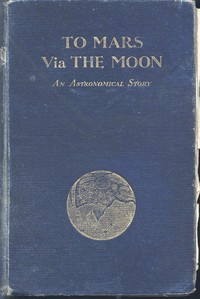
To Mars via the Moon: An Astronomical Story
by Mark Wicks
Language: en6,764 downloads on Project Gutenberg
Subjects
In: Science-Fiction & Fantasy·Novels
Public-domain ebook sourced from Project Gutenberg #27633.
Public-domain ebook
by Mark Wicks
Language: en6,764 downloads on Project Gutenberg
Subjects
In: Science-Fiction & Fantasy·Novels
Public-domain ebook sourced from Project Gutenberg #27633.
Mark Wicks’s “To Mars via the Moon” is a speculative scientific narrative that blends factual astronomy with imaginative storytelling. The author opens with a clear statement that the astronomical data are drawn from contemporary scientific knowledge, while the tale of a voyage to Mars remains a product of logical inference rather than pure fantasy. The introductory passage outlines the author’s reliance on Professor Lowell’s theories, the inclusion of maps, plates, and charts, and a dedication to the promotion of astronomy. From the very first chapter, the reader meets two seasoned travelers, Wilfrid Poynders and his long‑time companion John Yiewsley Claxton, as they prepare to embark on a clandestine launch from a shed near Croydon under a vividly described twilight sky. Their careful preparations, the presence of a seasoned Scottish engineer, and the promise of an “air‑ship” set the stage for a methodical, fact‑based adventure through space.
The work reflects the early‑20th‑century style of popular scientific romance, written in a formal yet conversational voice that intersperses technical exposition with lyrical description. Its prose is dense with period terminology, detailed planetary data, and earnest footnotes, giving the story the feel of a lecture‑like travelogue rather than a fast‑paced pulp adventure. Readers who enjoy classic speculative fiction that treats space travel as a plausible extension of contemporary science, particularly those fascinated by the Lowellian view of Martian canals and the meticulous cartographic illustrations, will find this book rewarding. It appeals to lovers of historic astronomy, Victorian‑era adventure, and anyone interested in seeing how early writers imagined interplanetary voyages before the age of rockets.
The opening · free to read
The reader will, of course, understand that whilst the astronomical information is, in all cases, scientific fact according to our present knowledge, the story itself--as well as the attempt to describe the physical and social conditions on Mars--is purely imaginative. It is not, however, merely random imagining. In a narrative such as this some matters--as, for instance, the "air-ship," and the possibility of a voyage through space--must be taken for granted; but the other ideas are mainly logical deductions from known facts and scientific data, or legitimate inferences.
Many years' careful study of the various theories which have been evolved has convinced me that the weight of evidence is in favour of Professor Lowell's conceptions, as being not only the most reasonable but the most scientific; and that they fit the observed facts with a completeness attaching to no other theory. These conceptions I have endeavoured to present fully and clearly; together with my own views as an entirely independent writer.
In dealing with the conditions on a distant and inaccessible world the farthest flight of imagination might fall short of the reality, but I have preferred to treat these matters somewhat restrainedly. Whilst no one can say positively that the intelligent inhabitants of Mars do not possess bodies resembling our own, it is very probable that they differ from us entirely; and may possess forms which would appear to us strange and weird. I have, however, thought it desirable to endow the Martians with bodies resembling ours, but glorified in form and features. The powers ascribed to the Martians are really only extensions of powers which some amongst us claim to possess, and they fall short of what more than one modern scientific writer has predicated as being within the possibilities of science at a not very distant future.
During the past few years I have been greatly indebted to Professor Lowell for his kindness and ready courtesy in furnishing me with information on obscure matters connected with Mars; and my thanks are also due to the Rev. Theodore E.R. Phillips, of Ashstead, who was good enough to read the manuscript of this book, and whose great observational experience enabled him to make valuable suggestions in regard to the scientific matters dealt with therein.
Truly "a labour of love," this little book--which Professor Lowell has most kindly permitted me to dedicate to him--is now submitted to the public, in the sincere hope that its perusal may serve not only to while away a leisure hour, but tend to nurture a love of the sublime science of astronomy, and at the same time provide some food for thought.
A few maps, plates, and charts have been added to give completeness to the work, and it is hoped that they will aid the reader in understanding the several matters dealt with.
M.W. 1910.
The book keeps going
Reading is free forever. Sign up and watch scenes appear while you read.



Scenes Storieta drew for other classics.
New illustrated classics
Once or twice a month: the latest books to get full character casts, scene art, and free comic editions. No account needed.