Public-domain ebook
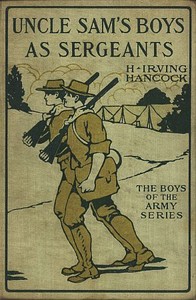
Uncle Sam's Boys as Sergeants; or, Handling Their First Real Commands
Language: en4,418 downloads on Project Gutenberg
Subjects
Public-domain ebook sourced from Project Gutenberg #27679.
Public-domain ebook
Language: en4,418 downloads on Project Gutenberg
Subjects
Public-domain ebook sourced from Project Gutenberg #27679.
The work is a juvenile military adventure that follows two young corporals, Hal Overton and Noll Terry, as they move from a routine quarter‑master request for signal flags into their first real command duties. The opening scene places the boys in a bustling post at Fort Clowdry, where they navigate proper channels for equipment, receive a brief lesson in wig‑wag signaling from Sergeant Hupner, and exchange banter about telegraphy and guard duty. The narrative assumes familiarity with earlier volumes that chronicled their enlistment, training, and earlier exploits, and it quickly shifts to the present moment of learning to signal and the camaraderie that defines their service.
Written in the brisk, dialogue‑heavy style of early twentieth‑century boys’ series, the prose blends military jargon with the earnest chatter of youthful soldiers. The tone is earnest yet lively, reflecting the period’s emphasis on patriotism and personal honor. Readers who enjoy detailed depictions of army life, period slang, and a steady progression from drills to responsibility will find this volume rewarding, especially those who have followed the earlier “Uncle Sam’s Boys” stories or appreciate classic adventure tales set against a realistic military backdrop.
The opening · free to read
"So I understand, sir. Corporal Terry and I are delighted at the idea of having the sergeant instruct us."
"But what do you want to do, especially, with flag signaling?" inquired the quartermaster.
"It is simply, sir, that we want to make ourselves better soldiers."
"It is rarely that we find better soldiers than Terry and yourself," replied the quartermaster, with a friendly smile. "But you are quite right, none the less. A soldier can never know too much of military duties. I see no objection whatever to your having the flags, but as they are not a matter of ordinary issue, I think it better for me to seek Major Silsbee's authority for issuing them."
"Would it have been better if I had gone to the battalion commander in the first place, sir?"
"No; whenever you wish anything in the Army it is usually better to go direct to the officer who has that thing in charge in his department, save when it is something that you are expected to draw through your company officers."
"It was Captain Cortland who sent me to you, sir, but he said he had no authority to draw a requisition for signal flags."
"You have taken the right course, Corporal. If Major Silsbee is in his office it will take but a moment more."
While the young corporal remained at attention Lieutenant Pope turned to his telephone and called for the battalion commander.
"It's all right, Corporal," nodded the lieutenant, hanging up the receiver. Then he wrote on a slip of official paper. "Here is an order on which the quartermaster sergeant will issue you two signal flags. You are, of course, responsible for the flags, or for the value."
"Yes, sir. Thank you, sir."
Five minutes later Corporal Hal Overton stepped briskly from the building in which the quartermaster's stores were kept. Under his left arm he carried two signal flags, rolled and attached to short staffs.
"Noll hasn't shown up yet. I hope he won't be long," murmured Hal, gazing across the parade grounds in the direction of the barracks of enlisted men. "Bunkie and I have a lot to do to-day."
Readers of the preceding volumes in this series will need no introduction to Corporals Hal Overton and Noll Terry, of the Thirty-fourth United States Infantry.
The headquarters battalion to which these two earnest young soldiers were attached was still stationed at Fort Clowdry. Readers of "UNCLE SAM'S BOYS IN THE RANKS" are familiar with the circumstances under which Overton and Terry first enlisted at a recruiting office in New York City. These same readers also know how the two young soldiers put in several weeks of steady drilling at a recruit rendezvous near New York, where they learned the first steps in the soldier's strenuous calling. Our readers are also familiar with all the many things that happened during that period of recruit instruction, and how Hal and Noll, while traveling through the Rockies on their way to join their regiment, aided in resisting an attempt by robbers to hold up the United States mail train. Our readers are well aware of all the exciting episodes of that first garrison life, including the life and death fight that Hal Overton had with thieves while he was on sentry duty in officers' row, and of the efforts of one worthless character in the battalion to discredit and disgrace the service of both splendid but new young soldiers.
In the second volume, "UNCLE SAM'S BOYS ON FIELD DUTY," our readers were admitted to equally exciting scenes of a wholly different nature. This volume dealt largely with the troops while away in rough country, under practical instruction in the actual duties of soldiers in the field in war time. Just how soldiers learn the grim business of war was most fully set forth in this volume. Among other hosts of entertaining incidents our readers will recall how Hal, on scouting duty, robbed the "enemy's" outpost of rifles, canteens and secured even the corporal's shoes. Some of Hal's and Noll's other brilliant scouting successes are therein told, and it is described how Hal and Noll finally gained the information that resulted in their own side gaining the victory in the mimic campaign. That volume also told how Lieutenant Prescott, aided by Soldiers Hal and Noll, succeeded at very nearly the cost of their lives in arresting a notorious and desperate criminal for the civil authorities, and how all this was done in the most soldier-like manner. It was such deeds as the scouting and the clever arrest that resulted in the appointment of the two chums as corporals. Then there was the affair, while the regulars were on duty in summer encampment with the Colorado National Guard, in which Hal and Noll, acting under impulses of the highest chivalry, got themselves into trouble that came very near to driving them out of the service.
Since the last rousing scenes in and near Denver, something more than a year had passed. It was now the beginning of the fall of the year following when Corporal Hal Overton, with the signal flags under his arm, waited near the parade ground for that other fine young soldier, Corporal Noll Terry.
A year of busy life it had been, though in the main uneventful. Our two young corporals had spent most of their time since in perfecting themselves in the soldier's grim game. They were now looked upon as two of the very finest and staunchest young soldiers in the service.
"Oh, there comes Noll at last," muttered Corporal Overton some minutes later. "And it's high time, too, if he has any regard for the sacredness of a soldier's punctuality. But he's leaving the telegraph office. I wonder if the dear old fellow has been getting any bad news from the home town?"
Corporal Terry, as he came briskly along the smooth, hard walk of a well-kept military post, looked every inch as fine a soldier as his chum. By this time Noll was just as thoroughly in love with all that pertained to the soldier's spirited life as was Overton.
"Think I was never coming?" hailed Noll gayly.
"I began to wonder if you weren't losing sight of the sacredness that is supposed to be attached to a soldier's appointment," said Hal dryly.
"I am afraid I have been so carried away with a new chance that I've treated you just a bit shabbily," Corporal Noll admitted.
"Think no more of it," begged Hal. "I got the flags."
"So my eyes tell me."
"And what have you been up to, Noll?"
"Oh, the greatest chance!" glowed Terry. "You know how hard I have been plugging away at telegraphy in spare time during the last few months?"
"Of course."
"Well, Lieutenant Ray is through with his tour of duty as officer in charge of our telegraph station, and Lieutenant Prescott has succeeded him for the next tour."
"Yes."
"I've been over to the telegraph office to interview Lieutenant Prescott, whom I saw going in there. Prescott is a grand young officer, isn't he?"
"Every man in the battalion knows that," Hal agreed heartily, for, indeed, there were no two more popular young officers in the service than Lieutenants Prescott and Holmes, of B and C Companies, respectively.
Readers of our "HIGH SCHOOL BOYS' SERIES" and of the "WEST POINT SERIES" know all about Dick Prescott and Greg Holmes, once leaders among High School athletes and afterwards among the brightest and finest of West Point cadets. Prescott and Holmes were now fully launched in their careers as Army officers.
"Lieutenant Prescott has given me a really bully chance," Noll went on happily.
"Did you ask him for it?" suspected Corporal Hal shrewdly.
"Well, I--er--er--hinted some, I guess," responded Noll, with a quiet grin. "But if you want things in this world aren't you a heap more likely to get them by asking than by keeping quiet?"
"Surely. But go on and tell me what it is that you got."
"I haven't exactly got it yet," Noll continued. "But Lieutenant Prescott is going to recommend me for it, and ask Captain Cortland's permission."
"I guess you'll get it, then," nodded Hal Overton. "Mr. Prescott's superior officers think so highly of him that he usually doesn't have to beg very hard to get what he wants. And--what is it?"
"Why, old fellow, I'm to be relieved from most other duties and placed in charge of the telegraph office. You know, there are two soldiers stationed there as day operators, and one as night operator. And I'm to be there in charge night and day."
The book keeps going
Reading is free forever. Sign up and watch scenes appear while you read.



Scenes Storieta drew for other classics.
New illustrated classics
Once or twice a month: the latest books to get full character casts, scene art, and free comic editions. No account needed.