Public-domain ebook
A Portrait of Old George Town
Language: en6,226 downloads on Project Gutenberg
Subjects
Public-domain ebook sourced from Project Gutenberg #27716.
Public-domain ebook
Language: en6,226 downloads on Project Gutenberg
Subjects
Public-domain ebook sourced from Project Gutenberg #27716.
This work is a historical portrait of Georgetown, Washington, D.C., written by Grace Glasgow Dunlop Ecker and published in the late nineteenth century. It opens with a lament for the loss of the town’s original architecture, contrasting the “dignified houses of yore” with the “rows of cheap dwellings” that sprang up in the 1970s and 1980s. The author then promises to trace the community from its earliest settlers through the “gay nineties,” detailing the people’s occupations, beliefs, and social customs, especially the influence of Scottish Presbyterianism. The narrative quickly moves from this overview to a detailed chronicle of the town’s origins, citing early explorers such as John Smith and Henry Fleete, the native Algonquin peoples, and the land grants that created the Beall and Gordon estates. The introductory pages also list the extensive illustrations and primary sources that underpin the study, indicating a richly documented account of Georgetown’s evolution.
The voice is that of a diligent antiquarian, blending earnest admiration with a measured, scholarly tone. The prose reflects the Victorian era’s fondness for exhaustive detail, formal diction, and occasional moral commentary, as seen in the quoted oath of a flour inspector and the reverent description of early settlers. Readers who enjoy meticulous local histories, architectural heritage, and the social fabric of early American towns will find it rewarding. It will especially appeal to those interested in the interplay of religion, immigration, and urban development in the formative years of the nation’s capital.
The opening · free to read
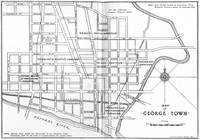
A portrait, partly of its physical features, its streets, its houses and gardens, some of which still exist in their pristine glory but, alas, many of which have gone the way of so-called progress. In place of the dignified houses of yore, of real architectural beauty, stand rows of cheap dwellings or stores, erected mostly in the seventies and eighties when architecture was at its worst. In 1895 it was that the old names of the streets were taken away and from then on we've been just an adjunct of Washington.
Not only of its physical side do I wish to tell, but I want to paint a picture of the kind of people who lived here, from the beginning up through the gay nineties--nearly one hundred and fifty years. Of the kind of things they did, their work, their play, their thoughts and their beliefs, for the character of the town, like human beings, was formed largely by their beliefs, and these old Scotsmen--for they were greatly in the majority--laid a great deal of stress on their Presbyterian form of Christianity. Witness the oath that had to be taken by the Flour Inspector on February 24, 1772: "I, Thomas Brannan, do declare that I do believe that there is not any trnsubstantiation in the Sacrament of the Lord's Supper or in the elements of bread and wine, at or after the consecration thereof by any person whatsoever."
And yet, with this strong prejudice, they cooperated and lived on friendly terms with the Roman Catholics who, very soon after the taking of this particular oath, founded their college and established their convent for teaching young girls.
Dr. Balch counselled well when he besought his people: "Let us resolve to be social rather than fashionable, and generous instead of extravagant."
All down through the years and to this day I think that has been the hall-mark of the real Georgetonian. A great deal of fashion has come to Georgetown, as in the early days of the bringing of the government when Washington City was a waste and almost entirely one big mud puddle, and the foreign ministers and many high in our government sought the comfort and dignity of this town, which was then far from young.
Again in later years there has been an exodus across Rock Creek of men and women high in the government; in the diplomatic corps; in industry; in literature and the arts; lured hither by the quiet dignity of the old-time atmosphere.
There are today living in Georgetown descendants of nearly every one of the original makers of the town, and all through these years the old friendships still persist and flourish.
It is impossible for me to express my thanks to all the people who have helped me and made it possible to write this book. I want to mention Mrs. Gilbert Grosvenor; Miss Williams of the Peabody Room of the Georgetown Branch of the Public Library; Miss McPherson and Mr. John Beverley Riggs of the Manuscript Division of the Library of Congress; Mr. Meredith Colket and Mr. O. W. Holmes of the National Archives; Dr. H. Paul Caemmerer, Secretary of the Commission of Fine Arts; Miss Pennybaker, of the Real Estate and Columbia Title Insurance Company; the Mount Vernon Ladies' Association and Mr. C. C. Wall, Superintendent of Mount Vernon. Also the various people who did the typing and helped secure the photographs.
And last but not least the friends of the old regime who have given to me freely of the history and traditions of their ancestors. They are too many to name, but to each one I owe a real debt of gratitude. Especially to one, my life-long friend, am I indebted. Without her unceasing interest and encouragement this Portrait might never have been done.
GRACE GLASGOW DUNLOP ECKER.
The book keeps going
Reading is free forever. Sign up and watch scenes appear while you read.



Scenes Storieta drew for other classics.
New illustrated classics
Once or twice a month: the latest books to get full character casts, scene art, and free comic editions. No account needed.