Public-domain ebook
The Strange Adventures of Mr. Middleton
Language: en5,843 downloads on Project Gutenberg
Subjects
Public-domain ebook sourced from Project Gutenberg #27917.
Public-domain ebook
Language: en5,843 downloads on Project Gutenberg
Subjects
Public-domain ebook sourced from Project Gutenberg #27917.
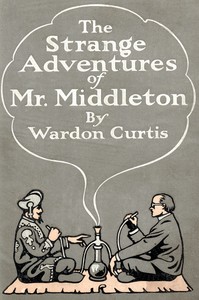
The work is a comic series of loosely linked episodes that follow the well‑meaning but haplessly adventurous Edward Middleton as he becomes entangled with the flamboyant Emir Achmed Ben Daoud and a parade of colorful characters. It opens on a rainy Chicago night, where a young Middleton, freshly out of his twenty‑third year and worried about a borrowed suit, darts into a dark shop that soon reveals itself as an exotic bazaar. Inside, a towering black‑amored attendant and a handsome, pipe‑smoking Arab prince greet him with a booming “Salaam aleikoom,” and an absurdly elaborate exchange of gifts and garb ensues. The scene sets the tone for a succession of “adventures” each triggered by a successive gift from the Emir, promising a blend of far‑codded travel, absurd mishaps, and satirical commentary on social pretensions.
The narrative voice is exuberantly baroque, echoing the turn‑of‑the‑century American humorists who loved to parody both high society and Orientalist tropes. Its sentences tumble with elaborate description, witty dialogue, and occasional mock‑solemnity, reflecting a late‑Victorian taste for serialized amusement. Readers who enjoy playful, slightly exaggerated sketches of urban life mixed with exotic set‑pieces, especially those fond of witty social satire and episodic humor, will find this quirky, fast‑moving romp an entertaining diversion.
The opening · free to read
"I do not understand the German language."
A low, musical laugh greeted this remark and the laugh resolving itself into a low, musical voice that bade him enter, Mr. Middleton found himself in a small boudoir of oriental magnificence, facing a young man in the costume of the Moslem nations, who sat cross-legged upon a divan smoking a narghileh. He was of perhaps twenty-six, somewhat slight, but elegant of person. His face, extremely handsome, betokened that he was a man of intelligence and sensibility. Two brilliant, sparkling eyes illumined his countenance and the curl of his carmine lips was that of one who while kind--without condescension and the odiousness of patronage--to all whom the mischance of fate had made his inferiors in fortune, would not bend the fawning knee to any whom the world calls great. Behind him stood a giant blackamore, he of the voice that had saluted Mr. Middleton. The blackamore was dressed in crimson silk sparkling with an array of gold lace, but his immense turban was snowy white. Against his shoulder reposed a great glittering scimetar and a dozen silver-mounted pistols and poniards were thrust in his sash.
Presently the young man removed the golden mouth-piece of the narghileh from his lips and regarding Mr. Middleton fixedly, remarked:
"There is but one God and Mohammed is his Prophet."
Now this was not the doctrine Mr. Middleton had been taught in the Methodist Sunday School in Janesville, Wisconsin, but disliking to dispute with one so engaging as the handsome Moslem, and having read in a book of etiquette that it was very ill mannered to indulge in theological controversy and, moreover, being conscious of the presence of the blackamore with the glittering scimetar, he began to make his excuses for an immediate departure. But the Moslem would not hear to this.
"Mesrour will bear your garments to Mr. Cohen. From your visage, I judge you to be a person I wish to know. I take you to be endowed with probity, discretion, and valor, and not without wit, good taste, and good manners. Mesrour, relieve the gentleman of his burden."
Whereupon Mr. Middleton was compelled to state that it was the garment on his back that was to go to Mr. Cohen, though he feared this confession would cause him to fall in the estimation of the Moslem. But the stranger relaxed none of his deference at this intimation that Mr. Middleton was not a person of consequence.
"Mesrour, take two sequins from the ebony chest. The price the extortionate tailor charges, is some thirty piastres. Bring back the change and a receipt."
"Salaam, effendim!" and Mesrour bowed until the crown of his head was presented toward his master, together with the palms of his hands, and in this posture backed from the room, leaving Mr. Middleton speculating upon the wonder and alarm little Mr. Cohen would experience at beholding the gigantic Nubian in all his outlandish panoply. While changing the dress suit for his street wear, from a back room came the sound of the blackamore moving about, chanting that weird refrain, tumpty, tumpty, tum--tum; tumpty, tumpty, tum--tum; which from Mesopotamia to the Pillars of Hercules, from the time of Ishmael to the present, has been the song of the sons of the desert. What was his surprise when the blackamore emerged. Gone were his turban, his flowing trousers, his scimetar, pistols, and poniards. He had on a long yellow mackintosh, which did not, however, conceal a pair of black and white checked pantaloons, a red tie, and green vest, from each upper pocket of which projected an ivory-handled razor.
"Don't forget the change, Mesrour."
"No indeed, boss," replied the blackamore, whistling "Mah Tiger Lily," as he departed.
The Moslem provided Mr. Middleton with one of those pipes which in various parts of the Orient are known as narghilehs, hubble-bubbles, or hookabadours, and seeing his guest entirely at his ease, without ado began as follows:
"My name is Achmed Ben Daoud, and I am hereditary emir of the tribe of Al-Yam, which ranges on the border of that fortunate part of the Arabian peninsular known as Arabia the Happy. My youngest brother, Ismail, desirous of seeing the world, went to the court of Oman, where struck by his inimitable skill in narration, the imam installed him as royal story-teller. But having in the space of a year exhausted his stock of stories, the imam, who is blessed with an excellent memory, discovering that he was telling the same stories over again, shut him up in a tower constructed of vermilion stone quarried on the upper waters of the great river Euphrates. There my poor brother is to stay until he can invent a new stock of stories, but being utterly devoid of invention, only death or relenting upon the part of the imam could release him. Hearing of his plight, I went to the imam with the proposition that I seek out some other story-teller and that upon bringing him to Muscat, my brother be released. But the imam exclaimed that he was tired of tales of genii and magicians, of enchantments and spells, devils, dragons, and rocs.
"'These things are too common, too everyday. Go to the country of the Franks and bring me a story-teller who shall tell me tales of far nations, and I will release Ismail, and load him with treasure.'
"'My Lord,' said I, 'peradventure no Frank story-teller will come. To guard against such eventuality, I will myself go to the lands of the Franks, there to learn of adventures worthy the ear of your highness. This I will do that my brother may be released from the vermilion tower.'
"'Do this, and I will give him the vermilion tower and make him grand vizier of the dominions of Oman.'
"As hereditary emir of the tribe of Al-Yam, I am prince of a considerable population. My revenues are sufficient to support life becomingly. But desiring to escape attention, and moreover, feeling that I could better get in touch with all classes of the population, I have established here in Chicago a small bazaar for the sale of frankincense and myrrh, the balsam of Hadramaut and attar of roses from the vales of Nejd, coffee of Mocha--which is in Arabia the Happy--dates from Hedjaz, together with ornaments made from wood grown in Mecca and Medina. Such is my stock in trade. By day, Mesrour and I dress like Feringhis. But at night, it pleases us to cast aside the stiff garb of the infidel for the flowing garments of my native land. Mesrour then delights to make the obeisances my rank deserves, but which in the presence of the giaours would excite mocking laughter. I have prospered. I have made acquaintances and have learned of many adventures. But I have made no friends. I have been much prepossessed by your bearing and feel that I would like to have you for a friend. I am also desirous of observing the effect of the tales of adventure I have been collecting. I need to acquire skill in the art of narration, and accordingly, I must have someone to tell them to, a person whose complaisance will cause him to overlook the faults of a novice. I am exceedingly anxious to have the distinguished honor of your company and if you have any evenings when you are at leisure, I should be only too glad to have you spend them here."
"I can come this day week," said Mr. Middleton.
"So be it. On that occasion I will tell you the tale of The Adventure of the Virtuous Spinster. I have not asked you your calling in life, for I am utterly without curiosity----"
"I am a clerk in a law office," said Mr. Middleton, quickly, "where I perform certain tasks and at the same time study law, and it is my hope to be soon admitted to the bar."
Prince Achmed regarded him earnestly for a moment, and then withdrew to return with a sandalwood case in his hands. This he opened to disclose a leathern-bound volume. Upon the cover was stamped a great gilt monogram of letters in some strange language. The edges were stained a brilliant and peculiarly vivid green. The pages were of fine pearl-colored vellum, covered with strange characters in black. Each chapter began with a great red initial surrounded by an illuminated design of many colored arabesques. It was indeed a volume to cause a book-lover to cry out with joy.
"Here is all the law man needs, the sacred Koran. Here is the beginning and end of law, the source of regulations that ensure righteous conduct, the precepts of Mohammed, prophet of Allah. If other laws agree with those of the Koran, they are needless. If they disagree, they are evil. Study this guide of life, my friend, and there will be no need to worry your brain with tomes of the presumptuous wights who from their own imaginings dare attempt to dictate laws and impiously substitute them for the laws revealed to Mohammed from on high. Accept this gift and study it."
With the sandalwood case containing the precious volume of the law under his arm, Mr. Middleton departed. After the lapse of three days, finding no immediate prospect of learning the Arabic language, and fearful of offending Prince Achmed if he returned the book, and having no possible use for it, he took it to a bibliophile, who exclaiming that it was the handiwork of a Mohammedan monastery of Damascus and bore on the cover the monogram of the fifth Fatimite caliph, and was therefore a thousand years old, he told Mr. Middleton that though it was worth much more, he could offer him but five hundred dollars, which sum the astonished friend of Achmed received in a daze, and departed to invest in a well located lot in a new suburb. Having no use for the sandalwood case after the Koran had been disposed of, he presented it to a young lady of Englewood as a receptacle for handkerchiefs.
Mr. Middleton said nothing of these transactions when on the appointed evening he once more sat in the presence of the urbane prince of the tribe of Al-Yam. Having handed him a bowl of delicately flavored sherbet, Achmed began to narrate The Adventure of the Virtuous Spinster.
The Adventure of the Virtuous Spinster.
Miss Almira Johnson was a virtuous spinster, aged thirty-nine, who lived in a highly respectable boarding-house on the north side. Her days she spent in keeping the books of a large leather firm, in an office which she shared with two male clerks who were married, and a red-headed boy of sixteen, who was small for his age.
On the evening when my tale begins, Miss Almira, tastefully attired for her night's rest in a white nightgown trimmed with blue lace, was peeping under the bed for the ever-possible man, the nightly rite preliminary to her prayers. She fell back gasping in a vain attempt to scream, but not a sound could she give vent to. The precaution of years had been justified. There lay a man! He was habited in a very genteel frock-suit, patent-leather shoes, and although it must have caused him some inconvenience in his recumbent position, upon his head was a correct plug hat. The elegance and respectability of his garb somewhat reassured Miss Almira, who was unable to believe that one so apparelled could have secreted himself under her bed for an evil purpose, when a new fear seized her, for arguing from this assumption, she concluded he must have been placed there by others and was, in short, dead. Whereupon, having to some degree recovered possession of herself, she was opening her mouth to scream at this new terror, when the man spoke.
The book keeps going
Reading is free forever. Sign up and watch scenes appear while you read.



Scenes Storieta drew for other classics.
New illustrated classics
Once or twice a month: the latest books to get full character casts, scene art, and free comic editions. No account needed.