Public-domain ebook
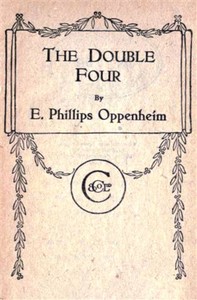
The Double Four
Language: en4,647 downloads on Project Gutenberg
Subjects
In: Crime, Thrillers and Mystery·Novels·British Literature
Public-domain ebook sourced from Project Gutenberg #28091.
Public-domain ebook
Language: en4,647 downloads on Project Gutenberg
Subjects
In: Crime, Thrillers and Mystery·Novels·British Literature
Public-domain ebook sourced from Project Gutenberg #28091.
The Double Four is a secret‑society thriller that begins with Peter Ruff, a country gentleman who has spent four tranquil years tending his Somerset farm, being jolted back into a world of intrigue by a cryptic invitation from a mysterious “Madame.” The opening scene contrasts the idyllic croquet lawn, tennis court, and blooming orchards with the relentless echo of a past life of power and crime, setting up a tension between domestic peace and the pull of a hidden organization. As Ruff wrestles with the summons, his wife Violet dismisses it as harmless, while the letters he receives grow increasingly urgent, eventually drawing him from the English countryside to a dying aristocrat’s bedside in Paris and then into the shadowy council of the Double Four itself.
Written in the polished, descriptive prose of early twentieth‑century British adventure fiction, the novel combines leisurely pastoral detail with a steadily rising sense of menace. Its narrator’s voice is formal yet intimate, reflecting the era’s fascination with secret orders and the moral dilemmas of retired heroes. Readers who enjoy methodical, atmospheric mysteries, particularly those featuring gentlemanly protagonists, clandestine societies, and a gradual escalation from personal conflict to geopolitical scheming, will find The Double Four a compelling, period‑appropriate journey.
The opening · free to read
Peter Ruff clenched his fists as he read the words once more. It was a message from a world every memory of which had been deliberately crushed--a world, indeed, in which he had seemed no longer to hold any place. He was Peter Ruff, Esquire, of Aynesford Manor, in the County of Somerset. It could not be for him, this strange summons.
The rustle of a woman's soft draperies broke in upon his reverie. He turned round with his usual morning greeting upon his lips. She was, without doubt, a most beautiful woman: petite, and well moulded, with the glow of health in her eyes and on her cheeks. She came smiling to him--a dream of muslin and pink ribbons.
"Another forage bill, my dear Peter?" she demanded, passing her arm through his. "Put it away and admire my new morning gown. It came straight from Paris, and you will have to pay a great deal of money for it."
He pulled himself together--he had no secrets from his wife.
"Listen," he said, and read aloud:
"_Rue de St. Quintaine, Paris._
"DEAR MR. RUFF,--_It is a long time since we had the pleasure of a visit from you. It is the desire of Madame that you should join our circle here on Thursday evening next, at ten o'clock._--SOGRANGE."
Violet was a little perplexed. She failed, somehow, to recognise the sinister note underlying those few sentences.
"It sounds friendly enough," she remarked. "You are not obliged to go, of course."
Peter Ruff smiled grimly.
"Yes, it sounds all right," he admitted.
"They won't expect you to take any notice of it, surely?" she continued. "When you bought this place, Peter, you gave them definitely to understand that you had retired into private life, that all these things were finished with you."
"There are some things," Peter Ruff said slowly, "which are never finished."
"But you resigned," she reminded him. "I remember your letter distinctly."
"From the Double Four," he answered, "no resignation is recognised save death. I did what I could, and they accepted my explanations gracefully and without comment. Now that the time has come, however, when they need, or think they need, my help, you see they do not hesitate to claim it."
"You will not go, Peter? You will not think of going?" she begged.
He twisted the letter between his fingers and sat down to his breakfast.
"No," he said, "I shall not go."
That morning Peter Ruff spent upon his farm, looking over his stock, examining some new machinery, and talking crops with his bailiff. In the afternoon he played his customary round of golf. It was the sort of day which, as a rule, he found completely satisfactory, yet, somehow or other, a certain sense of weariness crept in upon him towards its close. The agricultural details in which he was accustomed to take so much interest had fallen a little flat. He even found himself wondering, after one of his best drives, whether it was well for the mind of a man to be so utterly engrossed by the flight of that small white ball towards its destination. More than once lately, despite his half-angry rejection of them, certain memories, half-wistful, half-tantalising, from the world of which he now saw so little, had forced their way in upon his attention. This morning the lines of that brief note seemed to stand out before him all the time with a curious vividness. In a way he played the hypocrite to himself. He professed to have found that summons disturbing and unwelcome, yet his thoughts were continually occupied with it. He knew well that what would follow was inevitable, but he made no sign.
Two days later he received another letter. This time it was couched in different terms. On a square card, at the top of which was stamped a small coronet, he read as follows:
"_Madame de Maupassim at home, Saturday evening, May 2nd, at ten o'clock._"
In small letters at the bottom left-hand corner were added the words:
"_To meet friends._"
Peter Ruff put the card upon the fire and went out for a morning's rabbit shooting with his keeper. When he returned, luncheon was ready, but Violet was absent. He rang the bell.
"Where is your mistress, Jane?" he asked the parlourmaid.
The girl had no idea. Mrs. Ruff had left for the village several hours ago. Since then she had not been seen.
Peter Ruff ate his luncheon alone and understood. The afternoon wore on, and at night he travelled up to London. He knew better than to waste time by purposeless inquiries. Instead he took the nine o'clock train the next morning to Paris.
It was a chamber of death into which he was ushered--dismal, yet, of its sort, unique, marvellous. The room itself might have been the sleeping apartment of an Empress--lofty, with white panelled walls adorned simply with gilded lines; with high windows, closely curtained now so that neither sound nor the light of day might penetrate into the room. In the middle of the apartment, upon a canopy bedstead which had once adorned a king's palace, lay Madame de Maupassim. Her face was already touched with the finger of death, yet her eyes were undimmed and her lips unquivering. Her hands, covered with rings, lay out before her upon the lace coverlid. Supported by many pillows, she was issuing her last instructions with the cold precision of the man of affairs who makes the necessary arrangements for a few days' absence from his business.
Peter Ruff, who had not even been allowed sufficient time to change his travelling clothes, was brought without hesitation to her bedside. She looked at him in silence for a moment with a cold glitter in her eyes.
"You are four days late, Monsieur Peter Ruff," she remarked. "Why did you not obey your first summons?"
"Madame," he answered, "I thought that there must be a misunderstanding. Four years ago I gave notice to the council that I had married and retired into private life. A country farmer is of no further use to the world."
The woman's thin lip curled.
"From death and the Double Four," she said, "there is no resignation which counts. You are as much our creature to-day as I am the creature of the disease which is carrying me across the threshold of death."
Peter Ruff remained silent. The woman's words seemed full of dread significance. Besides, how was it possible to contradict the dying?
"It is upon the unwilling of the world," she continued, speaking slowly, yet with extraordinary distinctness, "that its greatest honours are often conferred. The name of my successor has been balloted for secretly. It is you, Peter Ruff, who have been chosen."
This time he was silent, because he was literally bereft of words. This woman was dying, and fancying strange things! He looked from one to the other of the stern, pale faces of those who were gathered around her bedside. Seven of them there were--the same seven. At that moment their eyes were all focused upon him. Peter Ruff shrank back.
"Madame," he murmured, "this cannot be."
Her lips twitched as though she would have smiled.
"What we have decided," she said, "we have decided. Nothing can alter that--not even the will of Mr. Peter Ruff."
"I have been out of the world for four years," Peter Ruff protested. "I have no longer ambitions, no longer any desire----"
The book keeps going
Reading is free forever. Sign up and watch scenes appear while you read.



Scenes Storieta drew for other classics.
New illustrated classics
Once or twice a month: the latest books to get full character casts, scene art, and free comic editions. No account needed.