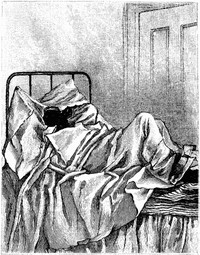
A DUET.
BY MARGARET EYTINGE.
Sunshine on the meadow, Sunshine on the sea; Green buds on the rose-bush, Blossoms on the tree. Two wee children singing In a rapt delight-- One as fair as morning, One as dark as night. Hymn-book held between them With the greatest care, Though they can not read a word That is printed there.
"Jesus, Saviour, meek and mild, Friend of ev'ry little child, Once a child Thyself, we pray Thou wilt guard us day by day; For such helpless things are we, We can only sing to Thee!"
Standing in the doorway, Arnak smiles to hear Bird-like voices blending Sweet and loud and clear. "'Pears to me de angels Mus' be lis'nin' too-- Lis'nin' an' a-lookin' From de hebbens blue; Lookin' an' a-smilin' At de pretty sight; An' in dar eyes--bress de Lord!-- Bofe dem chillun's white."
EASTER FLOWERS.
BY F. E. FRYATT.
"Come, Nell, and you too, Harry. I have planned a delightful trip for you, and we must be off bright and early."
"Where--where, Miss Eleanor?" cried both children together.
"To the large greenhouses just beyond the city line. You remember the minister said on Sunday, 'Let every person bring flowers, if but a single lily or a rose, to make God's house beautiful on Easter-day'? There are millions of flowers in blossom now at the greenhouses, and I wish you to see them, and learn how the florists make them bloom out of season."
"I hope you will tell us something about it," said Harry, as we rattled swiftly over the rails in the steam-dummy; "that is, when we get out of this noisy old trap."
In a few minutes we alighted at the city line, and Harry, taking my arm, declared himself ready for more "flower talk."
"Suppose," said I, "that a florist wishes to have several thousand plants in bloom for Easter, does he allow them plenty of water and sunshine, and opportunity to bloom several months in advance of the day? No; he stows them all away to rest, or sleep, as he calls it, for weeks and weeks, in cool, dry, shady places, some on shelves, some in sand, and some in pots 'in cool houses.'
"After a time the bulbs are taken out of the sand, and placed in earth, and with the other plants are allowed to enjoy a little warmth and sunshine.
"The rose-bushes are pruned, bound, and tied in trim forms, and placed in rows, and though destitute of foliage, look so healthy and neat one can not but admire them. In a week or two, as if by magic, thousands of buds are swelling and bursting into leaf on every stem.
"Five weeks ago I visited the greenhouses we are now going to, and as I stood in the Easter 'roseries,' I thought it must be quite delightful to be a young rose in training for Easter, the sunshine was so warm and golden, the air so soft and dewy sweet. Every bush showed signs of coming buds--very, very tiny, but they were there. The bulb houses were stocked with rows and rows of cherry-red pots filled with rich brown mould; in some the point of a tulip or hyacinth leaf peered up green and bright, in others there were already brave crowns of strong leaves.
"'Ah,' thought I, 'these will surely please the florist's eye;' but I assure you they had a very different effect, for he looked at them with a frown that said, plainer than words, 'My brave young folks, wouldn't you like to blossom before Easter, and spoil my fine show for me? Indeed you shall not.' He thought that, of course; for the next minute he cried out, 'John, take these forward bulbs and put them back in the "cold house."'"
"What a pity!" murmured Nell.
"Not at all," replied I, "for soon they would have had spikes of fine blossoms; then Madam Hyacinth and Mr. Tulip might bid farewell to all thought of going to church on Easter-day, for long before that time their gay clothes would be faded and spoiled."
"What is the 'cold house'?" inquired Harry.
"A greenhouse where the mercury stands below 50 deg. Jonquils, tulips, hyacinths and lilies, and most other Easter plants, need warmer air than that to grow rapidly in. The 'cold houses' are not neglected, for they have a certain amount of moisture and sunshine allowed them too, or the plants would die.
"As the happy day draws nearer and nearer, great activity reigns in the greenhouses: batches of plants are seen going back to the 'warm houses,' and such a showering, sponging, snipping and training, and general petting going on, that if plants had any brains, they would go mad with it all. But as they are not troubled with brains, they enjoy the warm sunshine, and the gentle vapors that rise steaming from the earth, and just set themselves to blossoming and looking as lovely as they can."
"So it takes earth, sunshine, wind, and water to raise flowers?" said Harry.
"Yes, and labor and knowledge."
Here the flower lecture ended, for we were at the greenhouse gates. In another moment a door was opened, and we were ushered into a world of beauty.
"How lovely!" cried Nell, looking down the green aisles of the "azalea house."
"They look like swarms of great white butterflies among the dark leaves," remarked Harry.
"Or giant snow-flakes ready to melt or blow away," suggested Nell.
"If you call those white azaleas so handsome, I wonder what you will say to these!" exclaimed the florist, opening wide the door of a "lily house."
"Come here, children," cried I. "Was there ever a more heavenly sight than these hosts of lilies holding up their white chalices to the flooding sunshine?"
"Or anything more delicious?" murmured Nell, bending lovingly over a group of Ascension lilies.
Further on there were ranks and ranks of tall callas, stately as sceptred queens, starry narcissus, white as snow, and jasmine bouvardias, with ivory tube-like blossoms in fragrant clusters.
Something "new, and strange, and sweet" greeted us at every step. Here it was a Deutzia, with starry cup-like blossoms; there a Spiraea, with spikes of milk-white plumes; here sprays of creamy Lantanas, and yonder clusters of tasselled Ageratum.
"Don't go yet," pleaded Nell and Harry, as I turned to leave.
"You'll admire the 'rosery' more than this," said the gardener, opening another door, and standing aside.
A marvellous fragrance saluted us as we looked down the long ranks of tall nyphetos shrubs laden with hundreds of silken buds and opening blossoms, in every shade from lemon to purest white.
How dainty!--how exquisite! Here and there a full-blown rose showed its closely folded centre, and long slender petals so delicately hung that a breath might scatter them.
Along the walls were trained vine-like Marshal Neils, with great golden buds and blossoms, while below rows of Safranos lifted fragrant cups rivalling in tint the bloom of an apricot's cheek.
In a second "rosery" we were fairly smothered in sweets. Scores of pale pink Hermanos, blushing Bon Silenes, and Plantiers--living balls of snow--and white Lamarques mingled their spicy breaths in one soft cloud of incense. Pink and white, ruby, buff, and golden, they hung and nodded on every stem, till, like Aladdin in the magician's garden, we knew not which way to turn.
As for the "carnation houses," they made us think of spice islands floating on seas of green; the "pansy houses" were beds of gold and amethyst; the "violet houses" and "smilax greeneries," perfect visions of spring.